![MaritimeJournal[Seawork]](https://www.maritimejournal.com/wp-content/uploads/2026/09/MaritimeJournalSeawork.svg)


Actipass locks on – with no contact
A very, very new access system has been designed which can automatically ‘hang’ within 15cm of an access platform “like a bee in front of a flower” explained Jean-Pierre Moreau of French deck equipment specialist ACEBI.
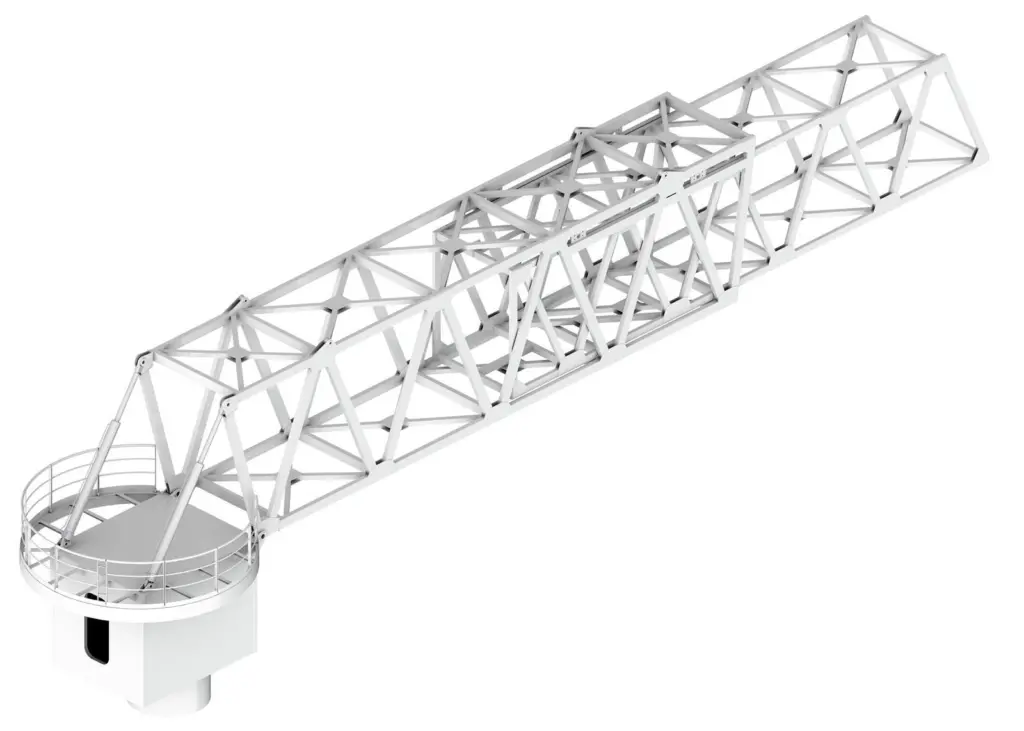
There are two versions of the Actipass; the larger, hydraulically engineered model works with a support vessel’s dynamic positioning. Once the boat is holding station in place near the platform, the Actipass uses camera technology and new generation, 3-D lidar systems to ‘lock on’ to a target position on the platform – usefully, this target is simply defined by the operator as it comes alongside.
The Actipass then uses its active compensation system to maintain the position of the end of the passerelle within 15cm of that target without actually making contact with the platform. This stops any impact damaging either tower or gangway, but more importantly it mitigates against the kind of physical shock that can create danger for those in transit.
Another element that helps the Actipass to get ahead is the predictive software: this pre-loads the hydraulics to ensure rapid reaction time.
Interestingly, the Actipass was developed by incorporating technology from unmanned vehicle research by the Embedded Electronic Systems Research Institute (IRSEEM) in Rouen: in the automotive sphere they are specialists in ‘fault tolerant predictive control’, all of which adds to the safety for personnel.
The hydraulically controlled extending passerelle has a maximum extension of 21 metres and a maximum payload of 300kg. It can be operated in significant wave heights up to 2.5 metres with swell durations of 7 to 9 seconds, a yaw rotation of +/- 3.3m, roll rotation +/- 1.5m, and pitch rotation +/- 2.6m. The maximum pivoting range is +/-20 degrees.
In the event of a problem on the vessel the passerelle is retracted automatically, with red lights warning the operator – importantly this happens with any personnel being safely transported back along with the access gangway, Mr Moreau assured MJ.
A lighter version of the system is to be made available for crew boats. Using carbon fibre in place of steel and aluminium to reduce weight and folding under the deck when not deployed to save space, this version uses entirely electrical controls to enable the more rapid reaction time required by the movement of a smaller vessel. True, Mr Moreau admitted it won’t have quite the same operational window as its bigger relative, but it will be a useful addition to high end crew transfer craft.
Watch this space.
By Stevie Knight
Related Articles
 ACCESSORIES & EQUIPMENT
 OTHER NEWS
 ACCESSORIES & EQUIPMENT