![MaritimeJournal[Seawork]](https://www.maritimejournal.com/wp-content/uploads/2026/09/MaritimeJournalSeawork.svg)






Deeper water, longer reach and easier operation
Capable, with a 15 tonne capacity and rated to 4,050m, Seaonics’ A-frame has a trick up its sleeve – a knuckle joint about three-fifths of the way up.
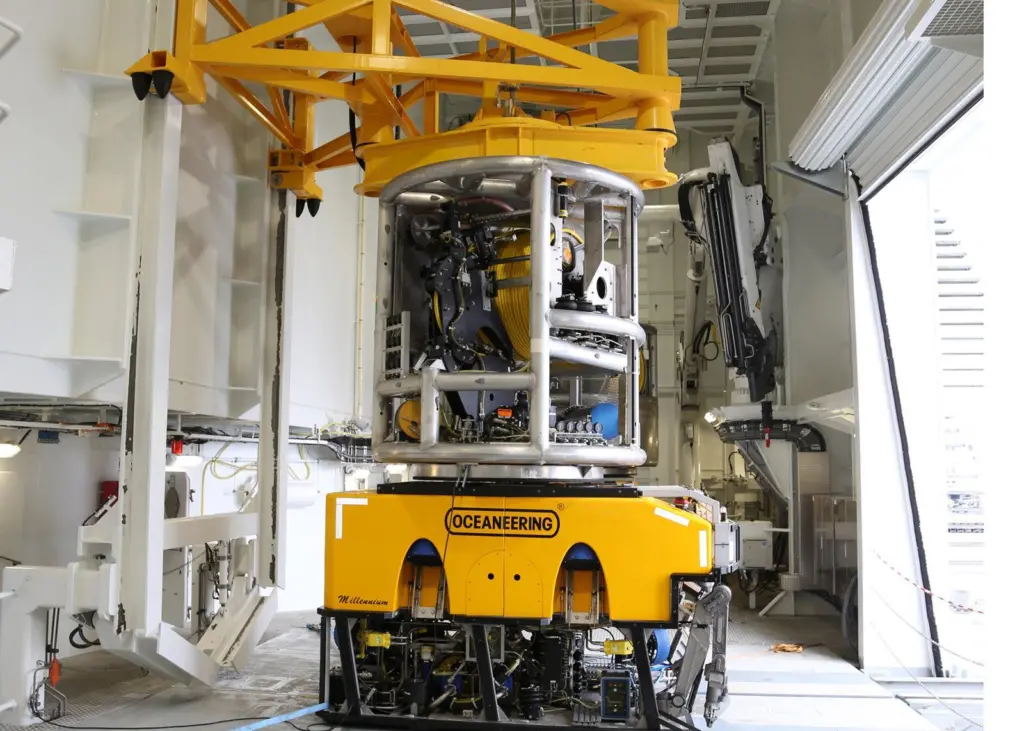
Jesper Skjong of Seaonics explained; “Like fingers, you can bend it to get into tight spaces or extend it for reach.” In fact given this the A-frame can reach out to around 7m there’s much less fear that the pendulum effect will end up with contact between ROV and hull, allowing for over the side launches in much in higher seas.
Inside the hangar it also means that the frame can be straightened up to its full 5.5m height to make space for other equipment as necessary, but it also means that, since the knuckle can drop its top section downward, inspection or repair of the Tether Management System (TMS) can take place from the hangar floor without needing a technician to take on a three metre climb to get at it – a safety concern when out at sea.
This kind of set-up, first introduced onboard Solstad Offshore’s Normand Reach, is finding a home on both new Farstad Shipping’s subsea construction vessels, Far Sleipner and Far Sentinel presently under build by Vard in Norway, due to be delivered in the third quarter of this year.
Both vessels are also going a bit further and making use of the hangar skidding system, the company’s deck cranes (with a capacity of 3 tonnes at 15m extension for moving cargo around) and 5.6m by 4.00m ROV deployment moonpool – which has a splash zone relatively unaffected by weather and waves. This has a similar specification to the A-frame – again a 4,050m depth rating, 15 tonne load, but with a cursor and rail guide unit integrated into the side of the moonpool.
Last but not least, there are Seaonics’ hangar doors: these are sectioned into five areas which give the crew a lot of scope for shutting the different segments in order to keep the worst of the weather out while the ROV is deployed.
These hangar doors are pretty robust and a bit more expensive than the aluminium roll shutter versions which can, said Mr Skjong, at least “create a huge amount of noise and at worst get damaged in harsh conditions”. He is adamant about their value to operations, and while aware of the cost shaving element that’s hitting the headlines as a growing factor for newbuilds, he added: “It’s just not worth the possibility of wrecking both a vessel’s up-time and its reputation for a relatively small investment.”
By Stevie Knight

Related Articles
 ACCESSORIES & EQUIPMENT
 OTHER NEWS
 ACCESSORIES & EQUIPMENT