![MaritimeJournal[Seawork]](https://www.maritimejournal.com/wp-content/uploads/2026/09/MaritimeJournalSeawork.svg)


Italian SAR training
The Italian Air Force Search and Rescue team has been expanding its skills and knowledge during a visit to a UK subsea trials and training facility The Underwater Centre, which claims it is fast developing a reputation for supporting international rescue teams with its range of bespoke packages.
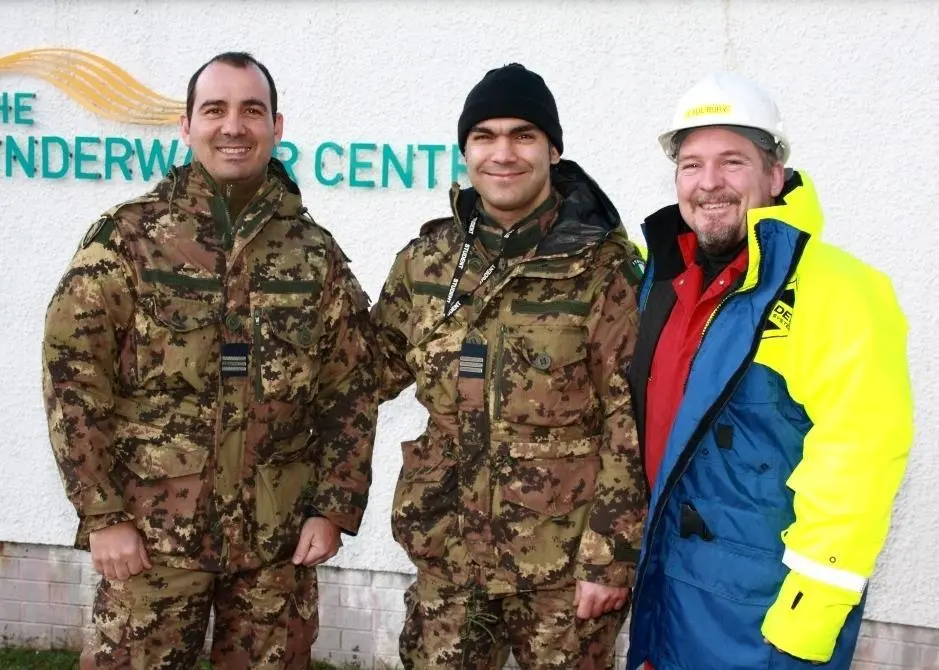
Beniamino Panduccio, David Padula, and Massimiliano Lai – members of the Sardinian-based Italian Air Force Search and Rescue team – spent three days at the Centre in Fort William, Scotland, undergoing advanced, intensive and challenging ROV operations training, during which they worked primarily with the Centre’s Saab Seaeye Falcon observation class ROV.
The Underwater Centre’s history in the energy and military industries means that it is seeing an increasing level of cross-over into other sectors, such as that of search and rescue. While providing comprehensive, industry-approved courses, the Centre also offers bespoke training with the aim of ensuring companies and their employees achieve their exact aims.
Just last year, a group of 10 members of the Finnish coastguard completed advanced diver training at the Centre, allowing them to dive offshore using their newly-acquired multi-purpose DPV (dynamic positioning vessel). A number of their colleagues are due to attend similar training at the Centre later on this year.
Meanwhile, the UK’s first Sub-Surface Search and Recovery Unit – Norfolk Fire and Rescue Service – which was set up as a dedicated flood disaster response unit, also trains regularly at The Underwater Centre.
During their stay, the Italian team also learned about mapping, measuring and navigation using sonar in preparation for operating in difficult conditions including zero light and visibility, as well as practicing search and recovery.
The candidates spent the first day flying the ROV from the pier with the A-Frame LARS and cage allowing them to get used to the operation and work regime for the observation class system. They also flew the SAAB Seaeye Falcon in Loch Linnhe, the tidal seawater loch on which the Centre is located, from the Centre’s dive vessel, Loch Sunart, from which they spent time diving to the seabed, some 150ft below in pitch-black conditions.
A challenging simulated rescue was undertaken on the loch using the ROV hook, a specialist piece of equipment designed to assist ROV operators, latching and un-latching equipment safely for deployment and recovery. A dummy cargo was lowered to the seabed using the hook allowing the team to practice hooking and un-hooking the weight to simulate a recovery.
Massimiliano Lai, of the Sardinian team, said: “We have learned a lot in a short time, in particular from our instructor Paul, and we are very satisfied with the level of care and safety that out team was shown.”
By Jake Frith
Related Articles
 ACCESSORIES & EQUIPMENT
 OTHER NEWS
 ACCESSORIES & EQUIPMENT