![MaritimeJournal[Seawork]](https://www.maritimejournal.com/wp-content/uploads/2026/09/MaritimeJournalSeawork.svg)


MLiner renewables solution
Founded in 2011 by former engineers from the STX shipyard in St-Nazaire, GEPS Techno is a French start-up company that is focussing on renewable energy projects.
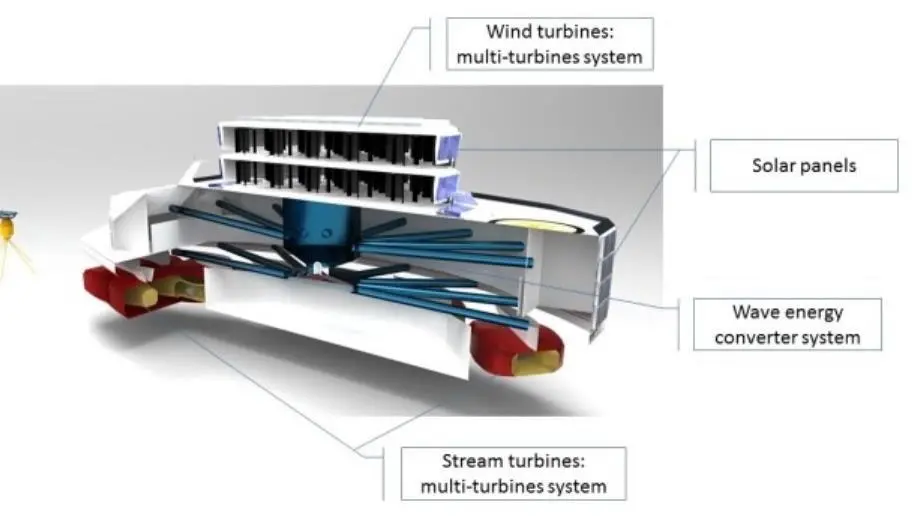
For over 3 years the company has been developing the MLiner project which is claimed to be the first renewable energy concept that can generate energy from four renewable sources. The aim of the MLiner is to create a renewable energy generator that can generate electricity consistently irrespective of the prevailing wind and sea conditions.
The MLiner can produce electrical power from waves and swell, solar power, wind, and from currents or tides. By offering this combination it is hoped that the MLiner can be a sole source of energy for remote locations such as islands without the need for back-up powered generators. Storage battery systems on board can help to maintain supplies during calm periods at night. Whilst the overall concept has still to be proven in practical application the four power generating systems are all proven in practical applications. Solar panels are a well proven technology as are current generators. Wind turbines are generally of the propeller type but on the MLiner, vertical axis turbines are proposed. Power from wave movements on the MLiner are based on the Octopusea and GSire systems developed by Geps Techno.
The proposed Octopusea wave generating system is internal to the floating structure based on a closed-circuit operating system. It uses the liquid flow from one compartment in the hull to another which generates a kinetic energy in the central structure. A turbine located within this central structure captures this kinetic energy and transform it into electricity. The system was originally developed as a means of stabilising ship rolling motions and further developed as a means of providing power for buoys. In the GSire system the electrical energy recovered for the rolling motions is translated into propulsion power to reduce fuel consumption.
The current generators are installed into shaped tunnels that are built into the catamaran hull of the supporting pontoon and are of the conventional multi-bladed type. The vertical axis wind turbines are large diameter units incorporating a series of internal turbines that are mounted above the main superstructure and were chosen in preference to propeller type turbines in order to maintain stability and reduce the overall height. Finally the whole of the outside of the superstructure in covered in solar panels.
The first demonstration of a prototype 6 metre MLiner is scheduled for sea trials this year. This is claimed to generate sufficient power to meet the requirements of an island of 1000 inhabitants. A second demonstrator which will be 20 metres long is at the planning stage which when connected to a shore network could provide the same power as 10 offshore wind turbines. It is claimed that the whole concept is scalable in size so much larger versions are possible. Full size versions based on 100 metre long hulls are costed at between €150 and €200 million.
By Dag Pike
Related Articles
 OFFSHORE RENEWABLES
 OFFSHORE RENEWABLES
 ENVIRONMENT