![MaritimeJournal[Seawork]](https://www.maritimejournal.com/wp-content/uploads/2026/09/MaritimeJournalSeawork.svg)




The long view from Blyth
“Typically, we try to keep our operations as diverse as possible. It helps ride the changes,” explained Alan Todd, Blyth’s port director.
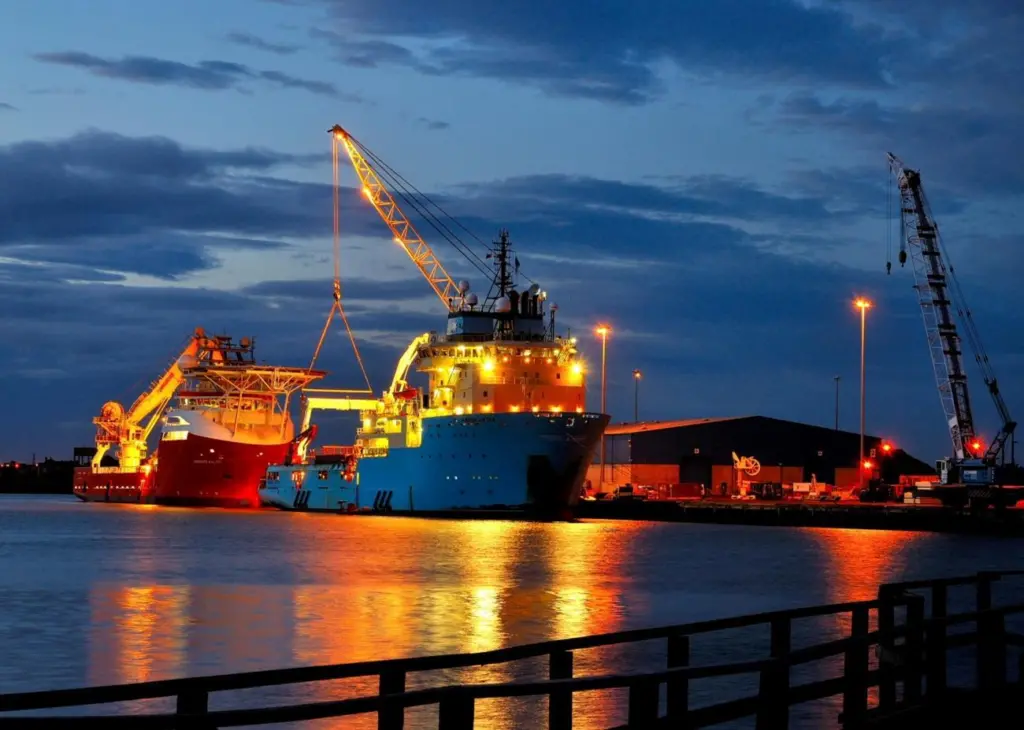
So the port keeps its eyes open for opportunities and while some will take a hit (take Reef Subsea, a recent signing that disappeared suddenly), yet others have potential to grow. For example, the marine gas oil bunkering facility which opened earlier this year was a 50-50 joint venture between the port and Geos Group. As Mr Todd’s colleague Mark Thompson pointed out the low sulphur fuel will be of interest to a range of offshore craft, not just the beleaguered oil and gas vessels but renewables support, all of which are under pressure to run on cleaner fuel: “They will need crew changes, repairs, and the more our customers do business, the more we do business.”
It helps the port has space: the gas oil facility is situated on the sheltered Bates Terminal with a 7m depth to the fairway and 8m alongside: “There’s enough room for tankers, like Shannon Fisher, to fill us up,” added Mr Todd.
The three big gas oil tanks came in at a price of around £1m apiece: these are capable of holding 50 million litres between them. The other half of this £6 million project, (designed and built by local contractors Fairhurst and Hall Construction) was focused on the supporting infrastructure, including the long run of piping necessary to link the tanks and bunkering points – plus a truly huge amount of concrete.
More in fact than meets the eye. “Below the surface these foundations are piled into the bedrock to a depth 10m,” said Mr Todd. Then on top of that the three tanks sit in what appears to be a wide concrete basin – which is in essence a big drip tray to contain the fuel in case of a spill, he explained. “If you add it all together, we have laid down almost a square hectare of concrete.”
The port also has been developing relationships with other offshore projects and Mark Thompson is pragmatic about the ups and downs of the oil price, preferring to keep his eye on future potential: “We are a trust port, although we still have to turn a profit, we don’t have shareholders to satisfy,” he explained. “We are not it in for a fast buck… and money spent one year shows up on the quay the next.”
The port’s ability to take the long view can help others ride the storm too; for example Blyth is providing new facilities for IHC Engineering Business (IHC EB) which first came into the port to design and build a big, 2,500 tonne J-lay tower. However, faced with uncertainty surrounding future offshore projects IHC EB decided to consolidate its UK manufacturing base, and Blyth became the obvious choice.
By Stevie Knight

Related Articles
 OTHER NEWS
 OTHER NEWS
 FEATURES & VIDEOS