![MaritimeJournal[Seawork]](https://www.maritimejournal.com/wp-content/uploads/2026/09/MaritimeJournalSeawork.svg)



Port Radar for a safer maritime domain
Lystrup, Denmark-based Terma is providing three high-resolution Scanter 5102 radars to be deployed in and around the remote Port of Prince Rupert, on Canada’s rugged British Columbia coast.
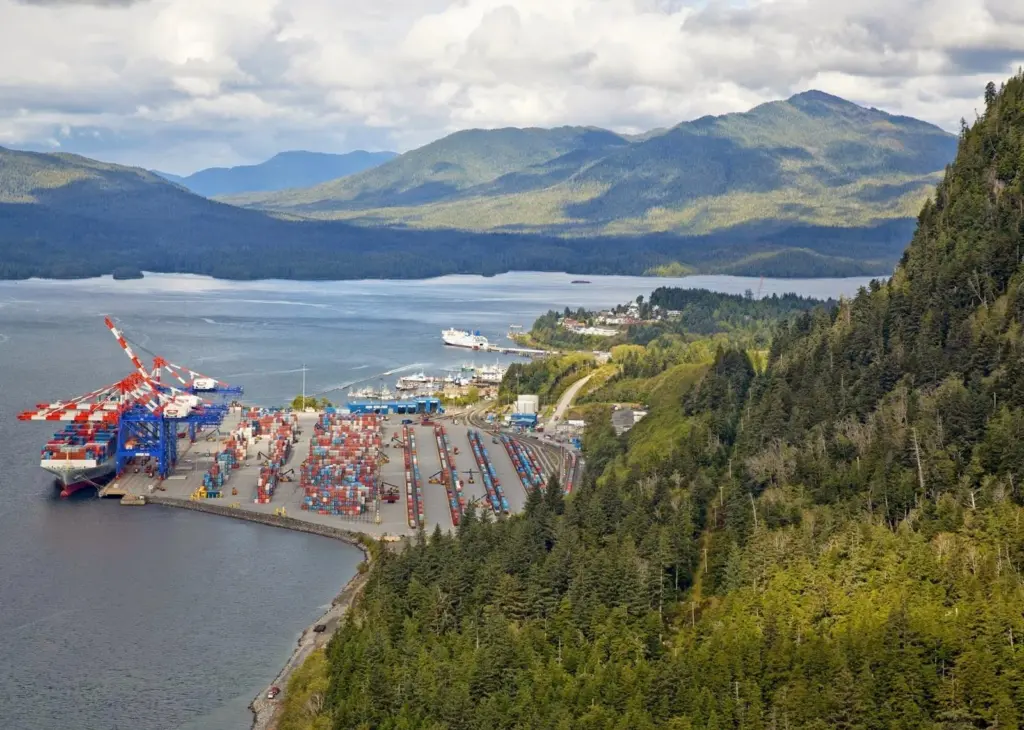
Prince Rupert has a legacy of fish and forest product exports, and today is home for major grain, coal, cruise ship and container terminals. The protected deep-water port represents the shortest marine route from Asia, as well as a direct rail link to and mid-America. A major investment in liquefied natural gas (LNG) pipelines and terminals will bring an increase in shipping to the port.
The Prince Rupert Port Authority (PRPA) expects more and bigger ships, and potentially sensitive cargos—so protecting the safety and security of the ships, crews, cargoes and the environment becomes even more important. In recent years PRPA has proactively introduced a suite a safety initiatives, including new anchorage positions and tide and current monitoring stations, as well as a shore-based radar system to cover the waters of the North Coast.
Three high-resolution Terma Scanter 5102 radar towers will provide radar coverage 50 nautical miles west to the northern tip of the Haida Gwaii archipelago and beyond the Alaska border, augmenting the automated information system (AIS) transponders already in place.
Funding for the CAN$5m project is being shared by a consortium of stakeholders, which includes a $2 million investment from Western Economic Diversification Canada. The radar network will be operated by the Canadian Coast Guard.
As aids to navigation (ATON) are upgraded, Laura Yerex officer in charge of marine communications and traffic services for the Canadian Coast Guard at Prince Rupert said the port and surrounding waters have become the standard for ATON. “This represents the new national level of service.”
“With our local partners, we’re making the port safer and more secure, allowing us to develop the port in a responsible and sustainable way,” said Don Krusel, president and CEO of the Prince Rupert Port Authority (PRPA). “We’re improving our radar and navigational aids, so we can have world-class, leading-edge approaches and procedures for the safety, security and efficiency of the port.”
Sonia Lowe, a spokesperson for the BC Ministry of Transportation and Infrastructure, said the province is in support of projects that will ensure the Port of Prince Rupert has the infrastructure it needs to operate successfully in a trade-driven global economy.
“This investment is an acknowledgment by our federal partners of the Port of Prince Rupert’s expanding role as a major marine gateway in British Columbia. It recognises the potential of future LNG traffic in the region and the need to accommodate growing international trade traffic,” Lowe said.
There are Terma radars all over the world, on ships, along the coast, and at airports, where they are commonly used for ground movement tracking.
The solid-state Scanter 5000-series of radars are used for maritime applications such as vessel traffic services (VTS) and coastal surveillance, and have the ability to detect and track very small targets in heavy seas and bad weather. Because they have such a low power output they don’t pose the environmental or safety concerns sometimes associated with analog radars with much high radiated power output.
The radars also contribute to maritime security because they can track small boats that do not have the AIS transponders that larger ships are required to have.
“This tool will help us gather and analyse intelligence at the port and from the surrounding maritime environment in support of our law enforcement initiatives,” said Chief Superintendent Sean Bourrie of the Royal Canadian Mounted Police.
The Scanter 5000 series are fully coherent, frequency and time diversity, solid state radars with software defined functionality for professional applications such as VTS, coastal surveillance and airport surface movement radars (SMR). The X-band, 2D, pulse compression radar uses a 6.4 meter high-gain slotted waveguide circularly polarized antenna ensure excellent weather penetration and high resolution. Similar technology is employed in the Scanter 6000 series of radars for shipborne applications.
Terma has delivered 5000-series radars to meet a variety of requirements, such as harbor and waterway surveillance in Hamburg, Germany; protection of inland waterways in the Netherlands; maritime border protection in Estonia; or vessel tracking services in Norway (which has 32 Terma radars), just to name a few examples.
HIGH RESOLUTION, LOW POWER
Radars have traditionally been associated with kilowatts or even megawatts of transmitted peak power, said Jens Christian Pedersen, director of product portfolio and innovation for radar systems at Terma A/S. “We can obtain very high quality radar images with very low power levels. The fine resolution is gives the operator very good discrimination between targets and furthermore improves the results from the utilisation of both frequency and time diversity.”
Algorithms have been developed to use high resolution X-and radar to detect and monitor oil spills, because oil-covered water dampens the capillary waves that cause backscatter.
Another new application involves offshore windfarms. The Riffgat offshore array in the North Sea has 30 turbines. Two Terma Scanter 5000-series radars have been integrated with AIS information to conduct surveillance around the wind turbines to prevent collisions and collateral damage.
The Port of London Authority (PLA) is also upgrading its radars onthe Thames from the North Sea and the Dover Strait approaches to Greenwich for co-ordination, control and safety of shipping and other river traffic.
PLA is a longstanding Terma customer and was the first to field the new solid state models. The installation of the Terma Scanter 5000-series radar at Beckton, East London, is part of PLA’s 18-strong radar network that covers the eastern part of the Thames Barrier Control Zone and its approaches, feeding data directly to the PLA’s Thames Barrier Navigation Centre at Woolwich.
By Edward Lundquist
Related Articles
 OTHER NEWS
 OTHER NEWS
 FEATURES & VIDEOS