![MaritimeJournal[Seawork]](https://www.maritimejournal.com/wp-content/uploads/2026/09/MaritimeJournalSeawork.svg)






Hamburg completes lock rebuild
The Rugenberger Schleuse, an important central access lock in the Port of Hamburg, is being re-opened to traffic this autumn after being rebuilt as part of a giant port infrastructure development programme lasting until about 2019 and costing about €110 million.
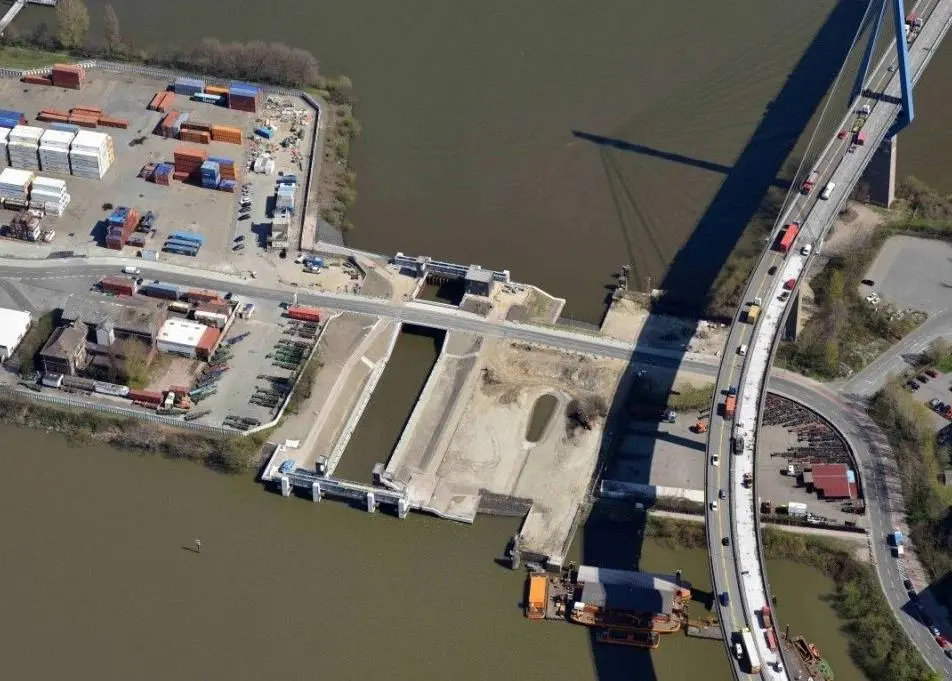
The lock rebuilding is just one of a number of port civil engineering projects designed to improve accessibility and links to central handling facilities in the port, like the neighbouring Waltershof Harbour. Facilities there include Hamburg’s biggest container terminal Burchardkai, now earmarked for expansion.
Hamburg, which turned over 145.7 million tons of cargo in 2014 is now Europe’s second biggest seaport after Rotterdam and is pushing infrastructure development to meet anticipated further growth. It says it wants to pass the 10 million container TEU mark this year. Economics Senator Frank Horch has said Rugenberger Lock is an important part of a long-term programme to improve road and rail traffic flows and prepare. “Significant container growth is predicted for the port in the coming years”, he says.
Ramming work on the rebuilding of the Rugenberger Lock and on a new road bridge over it began in December 2012 for the Hamburg Port Authority (HPA). The road bridge – the Rugenberger Damm – cost some €3.5 million alone and was completed and opened to traffic earlier this year.
HPA described the road work as the first very important part of the overall expansion project. Elsewhere the construction of new bridges in the Waltershof Harbour area also began this year and an additional single track port raiIway bridge was also being built for completion expected in 2016.
The new Rugenberger Schleuse -18m wide, with a total length of 127m and a usable length of 110m – was being re-opened at the end of November. Apart from having to cope with the passage of around 22,000 vessels each year the facility is described as necessary for nautical and other traffic movement. That’s because it is a purely tidal lock designed to prevent unfavourable tidal influences. Without it, sediment build-up would affect ship movement and regular and expensive dredging maintenance would be needed.
The new lock replaces an original two-chamber facility completed about 100 years ago. Officials said that it was no longer safe and renovation would have been uneconomical. Instead the South Lock and its gates were rebuilt with the new road bridge over it, while the old North Lock was taken out of service, partially broken up and filled in.
The newbuilding was carried out by a consortium grouping construction engineering concerns August Prien and Bilfinger Construction with the steel construction and engineering company Heinrich Rönner. ISA Technology handled the electronics and Willy Meyer the road construction. Overseeing the operation were construction engineers Grassl.
By Tom Todd

Related Articles
 OTHER NEWS
 OTHER NEWS
 FEATURES & VIDEOS