![MaritimeJournal[Seawork]](https://www.maritimejournal.com/wp-content/uploads/2026/09/MaritimeJournalSeawork.svg)



Sonardyne positioning for MBARI expedition
ROV tracking technology supplied by Sonardyne Inc. in Houston, USA to the Monterey Bay Aquarium Research Institute (MBARI) has been successfully used during an expedition to study recently discovered deep sea hydrothermal vents in the Gulf of California.
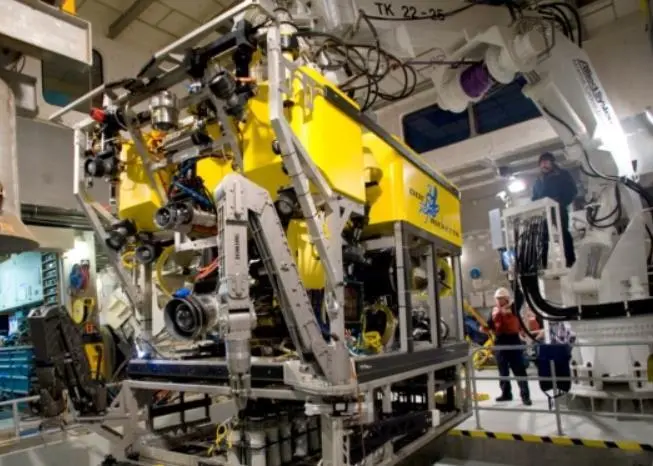
Installed on MBARI’s Western Flyer research vessel, the Ranger 2 USBL system was used to track the position of the ROV Doc Ricketts as it dived down 12,500 feet (3,800 metres) to the seafloor and flew around the Pescadero Basin vent field, collecting video and samples for analysis. Despite the challenging conditions created by the vents spewing out super-heated seawater and suspended solids, Sonardyne reports that the Ranger 2 provided three-metre accuracy at that depth and stability of positioning.
Located in Moss Landing, California, MBARI is recognised as a world centre for advanced research and education in ocean science and technology. To support its work, it has at its disposal a wide range of marine technology and assets including; research vessels, deep rated ROVs, several AUVs and a large inventory of scientific instruments.
MBARI has been a user of Sonardyne’s original Ranger 1 USBL technology since 2000, when a system was first fitted to the Western Flyer. During that time, it has supported a wide range of expeditions off the California coast where water depths rapidly reach beyond 13,000 feet. However, it was noted that on occasions, multi-path signals reflecting off the vessel’s twin hulls and noise from ROV thrusters, could interfere with transponder signals coming from great depths.
“Challenging conditions like these are exactly why we developed 6G – our sixth generation acoustic positioning platform,” said Kim Swords, Senior Applications Engineer with Sonardyne. “6G systems like Ranger 2 use Wideband 2 digital signal architecture to provide robust navigation, greater precision and fast position updates in all scenarios, deep or shallow and on all types of vessel. We were confident that by upgrading the Western Flyer to the latest 6G standard, MBARI’s deep water vehicle operations would be faster, more accurate and more efficient.”
As part of the upgrade, the Western Flyer was fitted with Sonardyne’s deep water optimised HPT 7000 USBL transceiver. Co-located with it on the vessel’s deployment pole was Lodestar, Sonardyne’s premium grade motion sensor – a configuration referred to as Optimised USBL. This integration achieves a tightly compensated solution and allows the positioning accuracy obtainable from Ranger 2 to be maximised.
The MBARI research project to investigate the Pescadero Basin vent field included repeated dives in April 2015 by the ROV Doc Ricketts to accurately map the site and gather samples which have subsequently been shown to contain both carbonate minerals and hydrocarbons. During the missions, the positioning repeatability of the Ranger 2 was shown to be just a few metres, performance that enabled MBARI’s ROV pilots to save time by flying directly to points of interest.
By Jake Frith
Related Articles
 OFFSHORE RENEWABLES
 OTHER NEWS
 OTHER NEWS