![MaritimeJournal[Seawork]](https://www.maritimejournal.com/wp-content/uploads/2026/09/MaritimeJournalSeawork.svg)



Simrad plots route to conservation
A complete bridge system overhaul using technology from global marine electronics brand Simrad has enhanced the ground-breaking conservation work done by the Auckland Whale & Dolphin Safari in New Zealand.
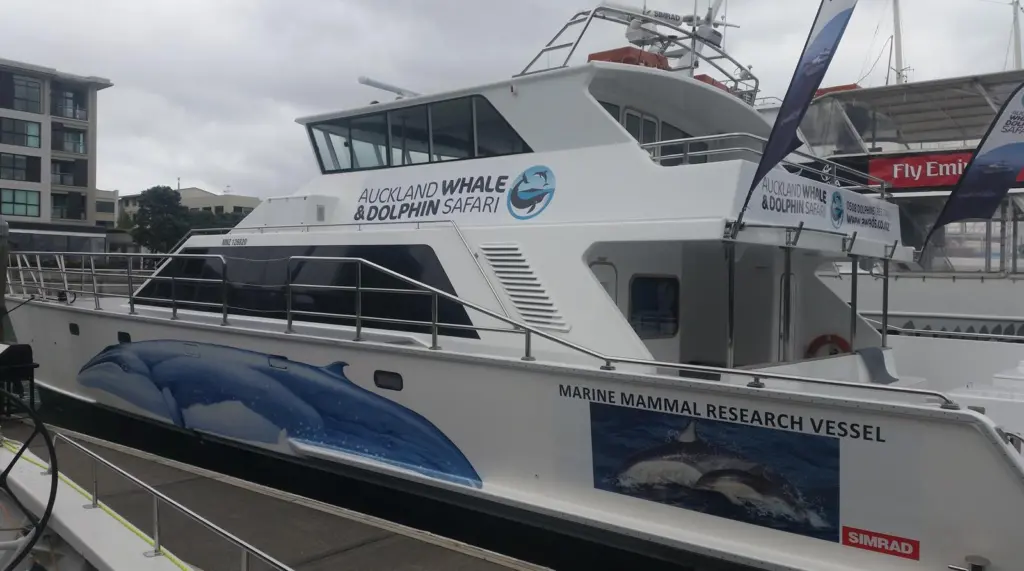
The 4.5 hour ‘Safari’ is both pleasure trip and conservation voyage, departing on average 250 days a year from Viaduct Harbour in down-town Auckland city. AWADS works with New Zealand’s Department of Conservation and several universities to combine up-close viewing of whales, dolphins and sea birds with marine-biology research.
AWAD’s catamaran Dolphin Explorer has undergone a complete bridge refit, including major instrumentation and systems upgrades. The most visible changes come in the shape of a new VHF antenna and three new widescreen, multi-touch, high definition Simrad monitors. However, Dolphin Explorer’s skipper Andy Light said even the smallest technical change can bring benefits. A new Simrad RS90 VHF unit with built-in thirty second record and replay as making a “major impact to my day, because I can play back any messages that I’ve missed if I’m talking to passengers”.
Even so, Light singled out Simrad’s latest NSO evo2 Multi-function Echosounder with built-in CHIRP and the completely new Simrad Halo Radar as the features yielding a “major step up” in conservation efforts.
“The echosounder technology is helping us to create an improved sonar log and therefore to get a better understanding of the seafloor,” said Light. “The detail is good enough for the echosounder to act as a hydrographic instrument, giving us a deeper insight of reasons behind the movement of animals.”
Greater accuracy is also having an impact day-to-day, he explained. Towards evening, a scattering layer of the zoo plankton on which whales feed rises in the water to graze on the phytoplankton that has been photosynthesising at the surface during the day. CHIRP, the sweep signal technology used by the NSO evo2, can identify the contours associated with such events. Light said the new transducers onboard Dolphin Explorer are delivering “brilliant” pictures that make the predictive process “far easier now”.
However, he saved his most extensive comments for Simrad Halo – the solid state pulse compression radar solution that supplier Simrad believes will revolutionise light commercial marine and workboat operations. In fact, Dolphin Explorer has acted as the beta tester for Simrad Halo, which has been developed to combine the best characteristics of traditional pulse and Broadband 4G Radar systems.
The unit uses pulse compression technology to deliver an unprecedented mix of close and long-range detection, precise target definition, and low clutter. Solid-state technology means minimal warm-up time and maximum ocean-going reliability, while compliance with upcoming Low Emission standards makes Halo Radar safe to run in anchorages and marinas.
“At close range, the performance of broadband is just amazing,” he said. “When it comes to using the pulse capability at distance, rather than looking for white birds on a white background, we’re able to identify bird patterns 6-8 miles away, so that I know where to put my binoculars.”
Even when used in a four array configuration, as was the case during commissioning, the Simrad Halo made a significant impact, Light said. Now that the unit is operating in 6-array, “the performance is even better”.
“We track the mammals and their migration routes. Marine mammals are the first to leave if pollution occurs and so they are critical ‘eco-indicators’. The data that we gather also provides evidence of the real impact that increasing ship traffic has on the marine environment. We know, for example, that we are losing two whales every year as a result of container ship strike.”
Light confides that initial contact on developments at Simrad came after a holidaying technician from the supplier’s Florida office took in the AWADS ‘safari’, and the two struck up a rapport. Although the skipper started his career as a fisherman, he also has extensive experience ashore in the IT sector, both in software development and network installation, and has even rewritten the technical manuals for Dolphin Explorer. The rapport with Simrad evolved into an opportunity to put newly developing technology through its paces in tough conditions, working with an IT-savvy skipper able to generate invaluable feedback.
By Jake Frith
Related Articles
 ACCESSORIES & EQUIPMENT
 OTHER NEWS
 ACCESSORIES & EQUIPMENT