![MaritimeJournal[Seawork]](https://www.maritimejournal.com/wp-content/uploads/2026/09/MaritimeJournalSeawork.svg)




A year under ice
A robot that can remain under the ice for a year in order to measure the Arctic seabed’s varying oxygen profiles has been tested out below 4km of water.
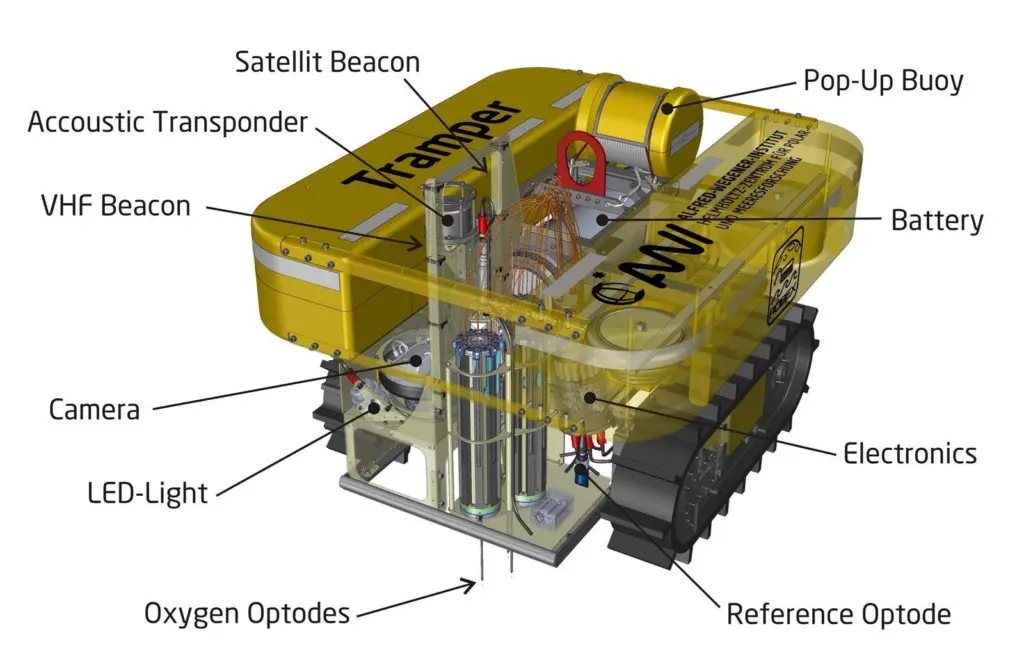
The 1.5m robot, called Tramper, was put through its paces to ready it for work this summer: being deployed by the RV Sonne around 850km off the coast of Peru where the seabed is 4,146m below the surface.
Certainly the Alfred Wegener Institute (AWI) and Robex Alliance partnership has had to overcome a number of challenges, both on the payload and vehicle itself. The testing kit consists of a camera to document the site and a number of ‘optodes’ – fiberoptic cables with a fleck of fluorescent paint at the tip that changes the light let through the cable in response to oxygen levels. Of course the ends stand to get worn, so the team designed a revolving carousel system that would exchange the sensors during the year-long deployment.
But another aspect that directly influenced vehicle design is that the probes are pushed into the seabed in 1/10mm stages, resulting in a lengthy, two hour process: therefore Tramper is a crawler with mini-excavator caterpillar tracks that will give the kit a stable base.
At the same time Tramper can’t afford to disturb the soft sea floor it’s trying to measure, so while on deck it has a mass of 653kg it weighs just 19kg in sea water with 35PSU salinity due to the large amount of buoyancy foam packed inside it – in fact a ballast weight adds a necessary amount to keep it on the seabed. This recent set of tests in the Pacific likewise reassured the team that the vehicle would be able to move without getting bogged down.
And of course a year without coming up means the crawler has power issues; further in 1.75°C waters as much as one third of the battery capacity is lost to self-discharge: therefore it’s designed to fall into a week-long sleep between testing rounds in order to conserve its energy.
The crawler is deposited on the seabed using a newly developed launcher system with a special quick release underneath; this lowering frame is also necessary in order to help the almost-buoyant Tramper sink down to the sea floor which could be 6,000m below.
At the end of its mission – when clear of ice – the ballast weight is released, triggered by an acoustic signal from the surface vessel allowing Tramper to ascend. In bad visibility, the system can be tracked by means of a satellite beacon and, in closer vicinity, by a VHF direction finder.
Its next outing will be on the RV Polarstern during its visit to the AWI Hausgarten site in the Fram Strait this June: Tramper will stay there taking measurements until it’s retrieved in the summer of 2017.
By Stevie Knight

Related Articles
 OFFSHORE RENEWABLES
 OTHER NEWS
 OTHER NEWS