![MaritimeJournal[Seawork]](https://www.maritimejournal.com/wp-content/uploads/2026/09/MaritimeJournalSeawork.svg)




GKinetic Energy launches novel tidal energy device
Late last year, Irish company GKinetic Energy deployed its innovative OC1 tidal energy device in Limerick Docks. So how exactly does the new technology work? What challenges do the project team face in deploying the device? And what are the prospects for its future roll out and commercialisation?
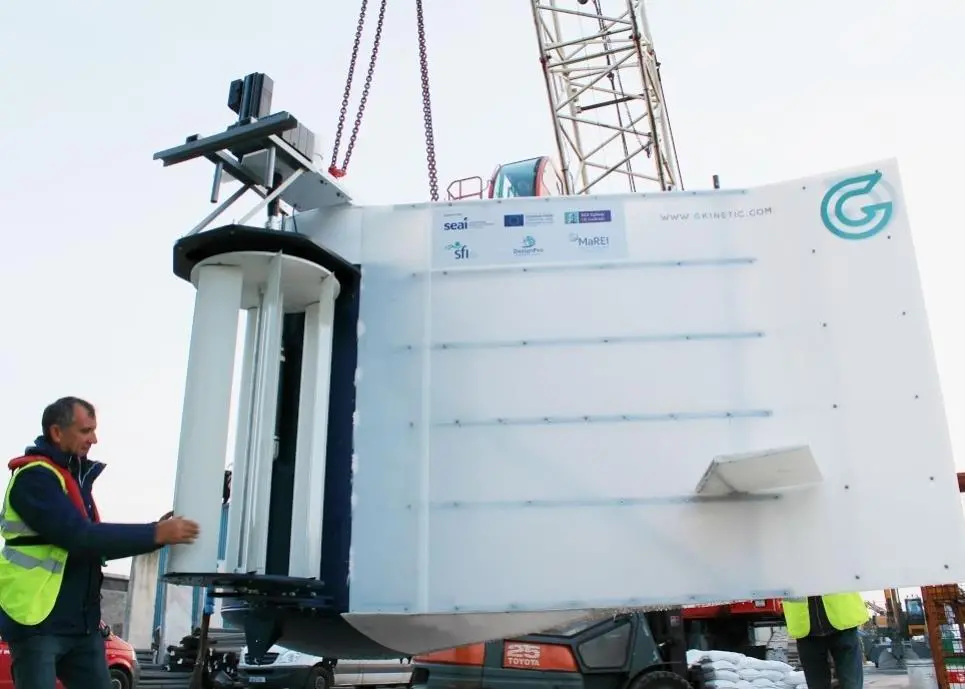
GKinetic’s tidal energy technology is based on a hydrokinetic turbine designed to be deployed in a variety of maritime environments, as well as in rivers and canals. The OC1 unit is the first operational river device, and was deployed in Limerick Docks on 16th October 2015. The design features two vertical axis water turbines (VAWTs), which are placed on either side of a patented flow-accelerating body, known as a ‘bluff body’ or ‘flume.’ The device also features what the company describes as a ‘dual cam blade pitch control system’ – employed to control the pitch of the turbine blades. As Vincent McCormack, Managing Director of GKinetic Energy, explains, this combination of accelerated water, alongside blade pitch control, results in ‘very high power outputs.’
“The GKinetic device is the first to exploit the natural phenomena that occurs when fluid accelerates around and outside an obstacle. Research shows that the power available in this accelerated region is eight times that of the ambient flow. [Another] novel feature of the OC1 is that, unlike many other tidal devices, it can be lifted in and out of the water extremely easily. We lift it out most weekends to perform fixes and checks,” he says.
Testing of the device will continue until the end of February and final performance results will not be known until all the data has been collected. However, McCormack reveals that readings taken so far are ‘very good’ and the team are very happy with the deployment and retrieval process. The device has also proven itself to be ‘incredibly stable and robust’ during tow-tests.
Partnership Approach
The idea for the technology first occurred to McCormack after years of research into tidal energy potential and extraction methods ‘grew organically from a hobby to a fulltime dedication.’ It was this growing interest that led him to establish GKinetic Energy in 2013 to pursue his vision for the development of hydrokinetic energy generation.
Since then, McCormack says a critical part of the company’s success is the ‘excellent collaboration and support’ it has received from SEAI (the Sustainable Energy Authority of Ireland), NUIG (the National University of Ireland, Galway), MaREI (Marine Renewable Energy Ireland) and SFPC (Shannon Foynes Port Company). The company has also worked closely with Limerick-based precision automation company DesignPro on the development and construction of its turbines – a partnership that began when DesignPro was contracted to build the first physical operating device, which was tested in the IFREMAR testing centre in France in November 2014.
“The results of the tests were incredibly positive and we then went on to build the first full scale river device, which later went on to be named the OC1,” says Paul Collins, Managing Director of DesignPro Ltd.
“The collaboration between DesignPro and GKinetic was key to getting the device into the water, the real test of all the hard work,” he adds.
Market Opportunities
McCormack points out that one of the key advantages of the OC1 is the fact that no height differential, or ‘head’ of water is needed to generate adequate power from the ambient flow, meaning that there is no need for ‘expensive and disruptive’ civil works. He is also confident that the device’s small size and ease of deployment and maintenance opens up ‘huge new market opportunities in terms of river and ocean kinetic energy generation.’ As well as lower deployment costs, McCormack highlights the fact that operations and maintenance is also ‘much easier’ because the device is ‘so accessible and simple to retrieve if necessary.’
“The device does not need to be permanently fixed in order to generate power and can be easily moved if a more suitable site becomes available. It offers a potential Levelised Cost of Energy of €0.08 making it a sound investment for end users and highly competitive on the energy device market. The compact design and size of the GKinetic device means that it can operate in depths as little as two metres – and a width of three metres,” he says.
Amongst other things, McCormack claims that this versatility means that a ‘huge number’ of sites that were previously unfeasible for a turbine now have an option for HydroKinetic Energy generation available to them.
Looking ahead, his ‘ultimate vision’ is to build and deploy devices worldwide – and he says that the OC1 device will be returning to DesignPro later in February for further improvements and optimisation based on data collected from the ongoing tow-tests.
“From this we will be building our first production model and a number of pilot devices will be deployed in centres of excellence around the world. These deployments will allow us to test the durability, reliability and long-term operational performance of the device,” he says.
“Our device is particularly suitable for those located in remote locations who do not have access to a stable energy supply, but it has numerous very feasible market applications,”
DesignPro is also heavily involved in the future development of the device and is heading up a spin-out project to take a ‘utility river device’ to market. According to Collins, this project has recently received funding and is ‘well underway.’
“The various stages in this project will allow us to further the development and commercialisation of the GKinetic river device. We look forward to the next stage of this success as a growing company in this market but also to see the large scale device that GKinetic will further develop,” he says.
By Andrew Williams

Related Articles
 OFFSHORE RENEWABLES
 OFFSHORE RENEWABLES
 ENVIRONMENT