![MaritimeJournal[Seawork]](https://www.maritimejournal.com/wp-content/uploads/2026/09/MaritimeJournalSeawork.svg)




Canal outlook positive despite setbacks
A positive future is being predicted for Germany’s Kiel Canal – the world’s busiest man-made waterway – despite a dramatic decline in ships and cargo in a year scarred by accidents and lock breakdowns.
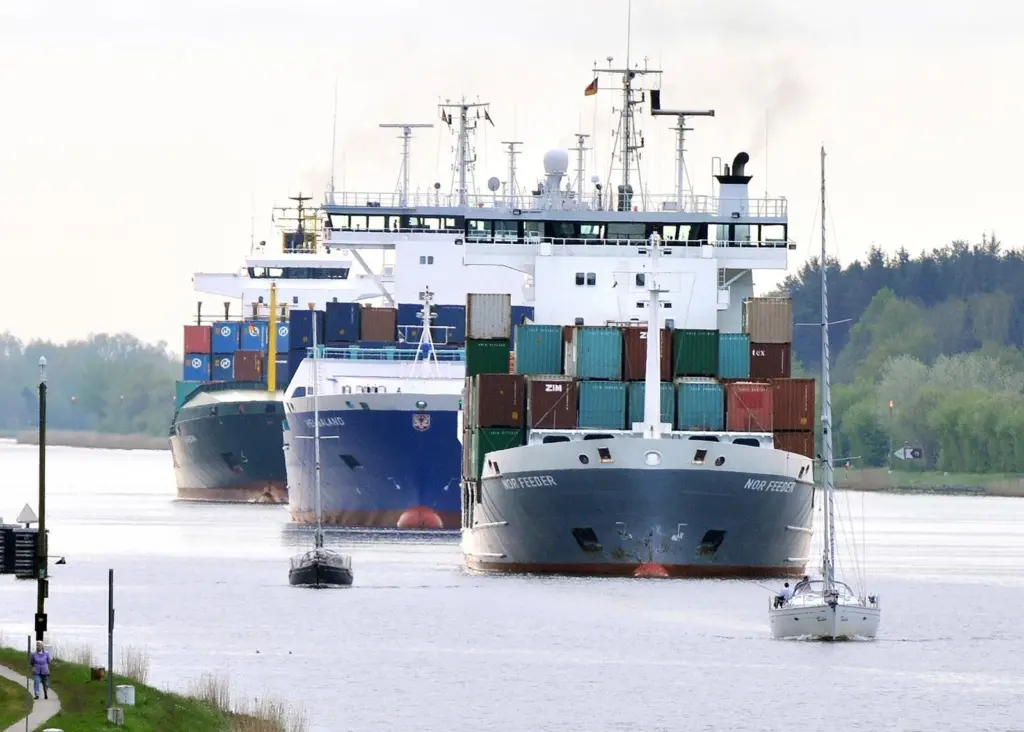
The Wasser und Schiffahrtsverwaltung (WSV) which operates the 100 kms long canal, reported that both shipping and cargo had declined in 2015.
It said 32,091 ships used the waterway, which links the North Sea and the Baltic in northern Germany. That’s some 500 fewer ships than in 2014 while cargo decline last year had been even more dramatic, falling about 10% to 90.6 million tons compared to 99.1 million in 2014.
German sanctions on Russia also played a part as shipping to and from Russian ports via the canal dropped by nearly 20% with only 2,829 ships reported in 2015 against 3,524 in 2014.
In the record years 2008 and 2012 well over 100 million tons were carried along the Kiel Canal. But experts have for years warned of ageing lock structures and the need for wide-ranging renovations on the more than 100 year old waterway.
A string of ship accidents and lock problems have disrupted operations and sometimes closed the canal completely to shipping in recent years and that susceptibility has not diminished this year.
In January an inland ship ran into a suspension ferry near Rendsburg causing rail bridge damage which could take years to repair and a container feeder ship ran into a canal bank after engine failure. In February another feeder ran into a bank near Kiel closing the canal for hours while a cargo ship halted traffic after an engine breakdown.
The Nautical Association in Brunsbüttel ,where a new fifth lock is being built, said that much remains to be done on the canal and spoke of the “apparent neglect” of maintenance and of continuing “operational problems”.
However, commenting on the latest traffic downturns and the situation in general, Hans-Heinrich Witte, head of the WSV’s Wasserstrassen und Schiffahrt division, noted that repairs have now been carried out on all four of the waterway’s big locks – two at Brunsbüttel at the Elbe end and two in Kiel Holtenau at the Baltic end of the canal. He said shipping had risen immediately after these completions in December. “We have created more efficient capacity for ships that are getting bigger all the time”, he declared. Work on planning the expansion of the northeastern section of the Canal is meanwhile also underway.
Despite the depressed handling figures, 2015 had also been a positive year, Witte said. “Cargo volumes show that the Kiel Canal is indispensible as an important transit route for international shipping. Nothing stands in the way of 2016 being a strong year”, he said.
By Tom Todd