![MaritimeJournal[Seawork]](https://www.maritimejournal.com/wp-content/uploads/2026/09/MaritimeJournalSeawork.svg)


Alternative to floating wind turbines?
Current technology tends to limit offshore wind farms to water depths of less than 50 metres but now technology has been developed that can extend this to depths of up to 200 metres, providing a challenge to the use of expensive floating wind turbines.
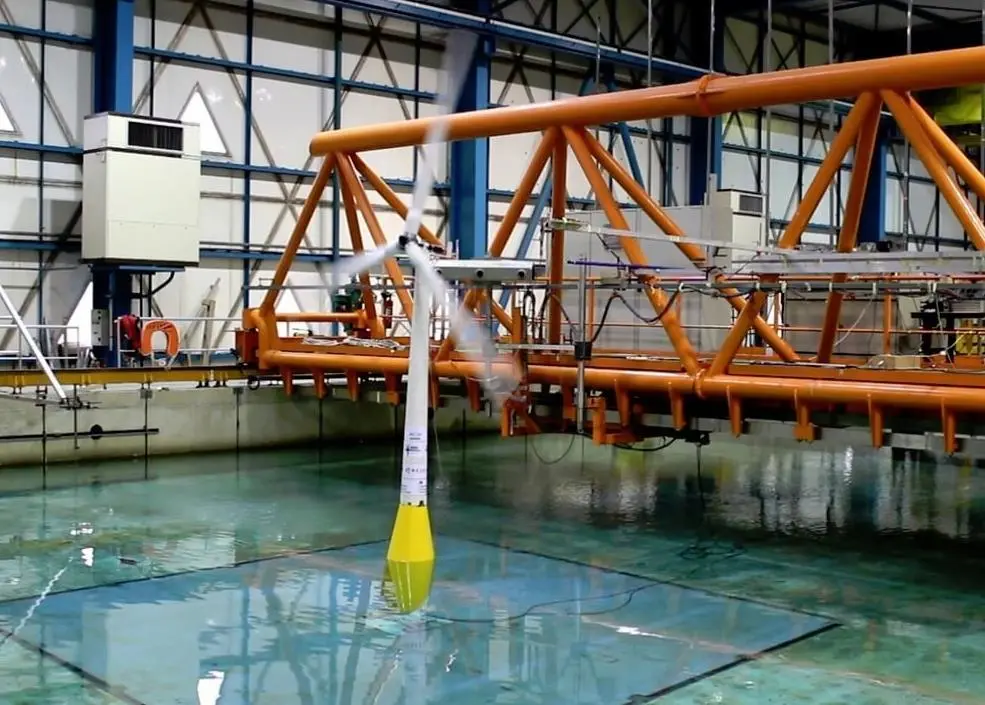
The technology has been developed by Marine Engineering Energy Solutions (MEES) who are supported by the DORIS Group and its international engineering and operations support services subsidiary ODE.
The articulated wind column (AWC) has been developed from technology already deployed in the offshore oil and gas industry. MEES and ODE claim that AWC offshore wind foundation system that will unlock vast areas of deep water around the world for economically viable offshore wind production. The foundation system has been designed to provide structural support for turbines in offshore waters ranging from 45m to 200m and is suitable for the largest wind turbines currently available.
The AWC structure consists of a compliant concrete vertical column and the concrete base, which is located on the seabed. The two main parts are connected by an articulated joint, which allows rotation about both horizontal axes. The AWC uses the buoyancy in the deeper water to maintain the support structure near vertical, resisting the forces from wind, current and waves. It can be located where the power is needed, closer to shore significantly reducing installation and operation costs.
By using an AWC structure, the complete unit can be constructed onshore in a dry dock using corrosion proof and cheap concrete. Once floated out the AWC is towed to the installation site horizontally and then ballasted into the vertical mode and located on the sea bed. At that point rock ballast is sent down by a specialised ship to fill the base and the unit is installed apart from the electrical connection to the shore. The turbine and its blades can then be installed by conventional means.
The design enables the structures to be produced in high volumes and at lower cost. It also allows for installation on an uneven seabed without the need for seabed preparation, delivering the potential for a lower cost of energy when compared to conventional offshore wind solutions. The design also allows for easy removal at the end of its life.
“The AWC is based on a proven, robust technical solution suitable for the harshest environmental conditions. It has a simple installation and removal process, based on a design successfully used by the oil and gas sector in the North Sea for many years,” said ODE managing director Peter Godfrey.
The origins of the AWC’s design lay in the concrete articulated column developed by the DORIS Group for the Maureen oil platform in the North Sea in the 1980s and a further 12 articulated loading columns have been installed, some of which are still in operation.
By Dag Pike
Related Articles
 OFFSHORE RENEWABLES
 OFFSHORE RENEWABLES
 ENVIRONMENT