![MaritimeJournal[Seawork]](https://www.maritimejournal.com/wp-content/uploads/2026/09/MaritimeJournalSeawork.svg)




Dutch tidal development centre
With the offshore wind market entering maturity the focus for renewables is turning further towards tidal and wave energy with tidal energy attracting a lot of attention.
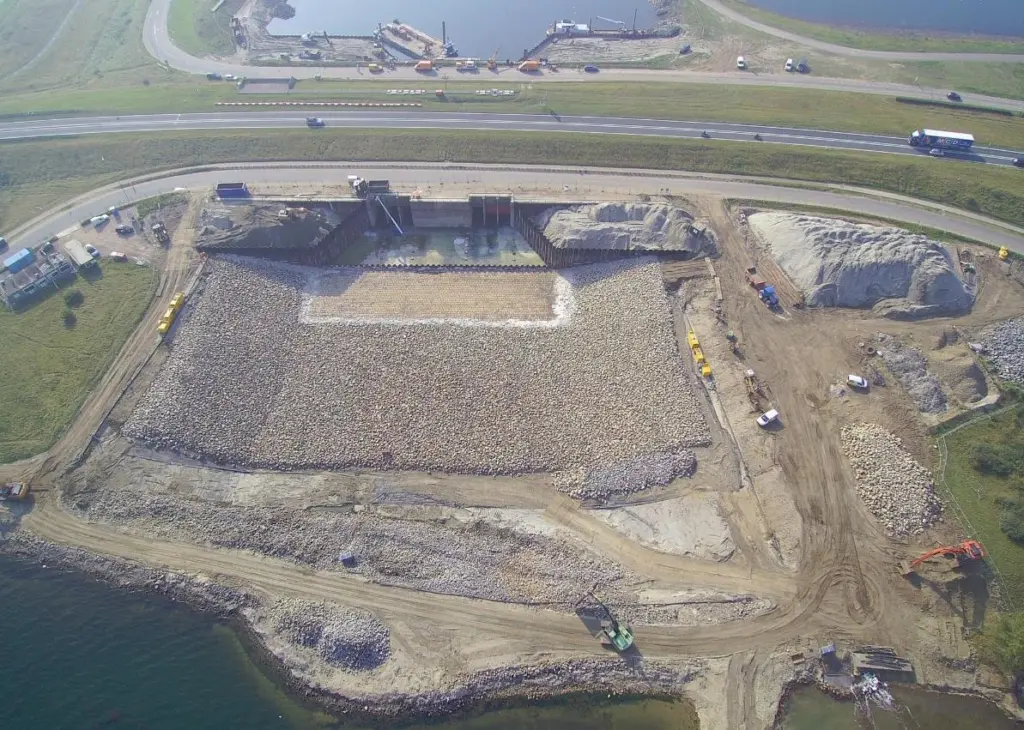
However the challenge has been to test tidal equipment in a controlled environment where it can be fully evaluated rather than in the turbulent waters where it is likely to be finally installed and where testing can be both costly and weather dependent. Now Dutch company BT Projects has come up with a solution.
The demand for testing facilities for projects being developed has prompted this development. The project will provide facilities where suppliers may test, certify and showcase their innovative systems in a live tidal maritime environment. The Grevelingendam in southern Holland is part of the mighty Delta Works that were constructed to reduce the risk of flooding from tidal surges and it is the tidal sluice at Flakkeese Spuisluis that is being used for the tidal testing centre.
BT Projects claims that this is an ideal location for a test and demonstration facility in tidal energy. It is planned to have the Tidal Technology Centre at Grevelingendam in operation in late 2017 or early 2018 and to create it by providing a platform for the controlled development of the tidal energy industry.
When completed the Tidal Technology Centre (TTC-GD) will provide developers of new technologies in tidal energy with the means to both test and to demonstrate their products in fully operational tidal context. It will also provide a demonstration setup of 4 turbines capable of producing 1.0 MW of energy.
The test centre will be built into the structure of the dam and it will be developed using existing sluices that are part of the structure. There will be three test channels that will range in size from 3 metres up to 10.5 metres wide and they will have a depth of 5.75 metres, allowing for large scale testing of tidal generators. The tidal range in the area is around 2 metres but because the Grevelingendam is isolated from the main tides in the North Sea by the outer dams, the tidal flow through the sluices can be controlled to a large degree.
Compared with installing turbines in tidal channels in the open sea the ability to monitor and record the data from the turbines in the test channels will give a much better record of performance. This recoding will be on a continuous basis and will not require the turbine to be recovered for the information to be available. BT Projects also claims that not only can the turbines be tested and certified in this new facility but the power they generate can be easily transmitted into the grid to supply homes and business nearby.
With the four demonstration turbines in operation, each of between 0.5 and 1 mW capacity, the output will be around 2.5 mW, which is claimed to be adequate for 2000 households. TTC-GD will purchase and operate the four demonstration turbines. These turbines will also be available to research institutes and universities for independent research. Installed in the three test channels into which the turbines, mills and their components may be tested, certified and demonstrated the set-up is also claimed to be ideal for monitoring the impact of tidal energy facilities on morphology, on tidal flow patterns, environmental impact and a host of other variables.
The four turbines that will initially be installed for the purpose of demonstrating these technologies and generate electricity for the people in the region can be replaced by turbines from clients who want to use the facilities to both test and to demonstrate their products.
One of the big bonuses of this new test facility is the easy access to the test site from land allowing the turbines to be installed using conventional handling equipment. This avoids the need for high cost offshore installation and costs of hiring vessels that are suitable for the installation work which can be subject to weather and operational delays. BT Projects claims that this make the new site the perfect low-cost test and demonstration facility, positioned between small-scale tank tests and large-scale offshore demonstrations. Customers will be able to showcase, test and certify their new technologies at TTC-GD and it will also make it an ideal location to welcome visitors and potential clients.
TTC-GD is intended to feature ample facilities for research, monitoring and data logging and the company is working with various certification and standardisation institutions to become a fully equipped centre for certification. By making use of the existing facilities in the Flakkeese Spuisluis it has allowed the new test site to be developed within a short timeframe. The tidal sluice that previously existed is now being completely renovated by the Dutch water authority board, the Rijkswaterstaat, after which completion of the TTC-GD is anticipated towards the end of this year or early next year.
In a second phase of the development, TTC-GD is claimed to be the perfect place to demonstrate the potential of power storage systems that can help to smooth out power production and allow it to better meet demand. It will be possible for systems such as water-buffering, flywheel technologies and battery storage to be taken into consideration, as well as co-operation with Power-to-Gas systems that are realised in the area.
With the development of this new facility for testing tidal power systems, BT Projects is claiming that they will provide a test facility that should not only help to reduce the costs of testing new tidal generating systems but also to ensure that when tidal generators are installed in offshore locations for final testing there is a much reduced chance of failure in these offshore locations.
By Dag Pike

Related Articles
 OFFSHORE RENEWABLES
 OFFSHORE RENEWABLES
 ENVIRONMENT