![MaritimeJournal[Seawork]](https://www.maritimejournal.com/wp-content/uploads/2026/09/MaritimeJournalSeawork.svg)






Commercial vessel versatility is egg-shaped according to Jet Capsule
An Italian company has developed an intriguing concept designed to meet a number of commercial vessel requirements. Shaped rather like an egg with a pointed end the Jet Capsule is based on a conventional deep vee hull to allow good sea-going performance and its main innovation lies in its superstructure that can be adapted for many requirements
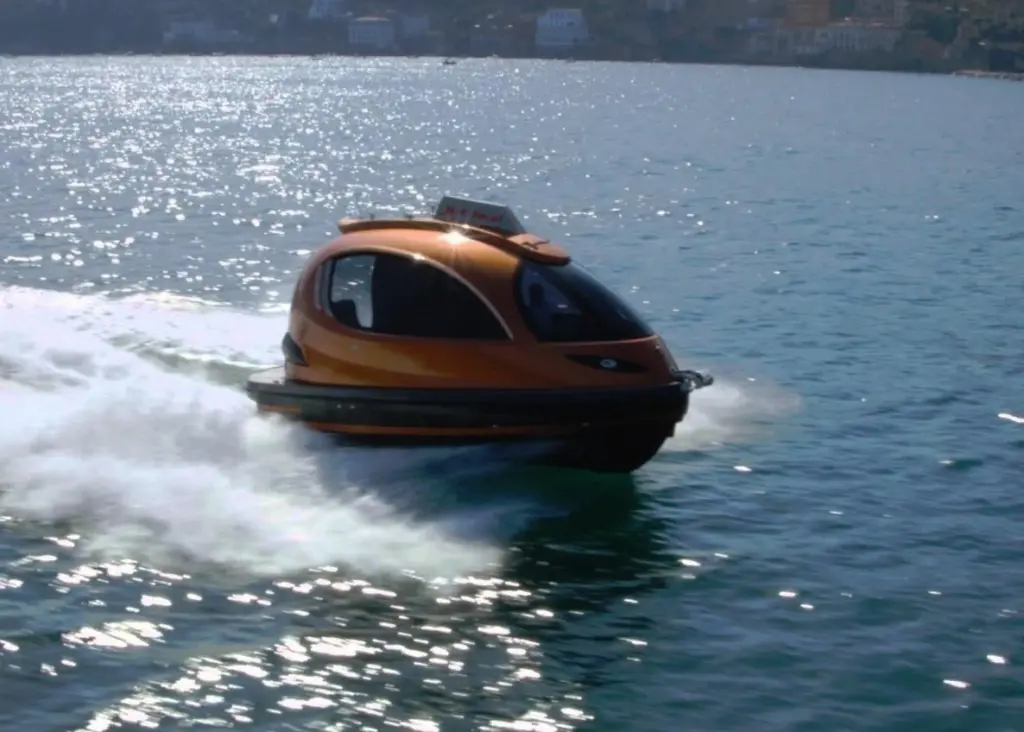
The Jet Capsule comes in two sizes, one 7.35 metres long and its smaller sister the Super Jet which is 6.20 metres long. On both of these models the superstructure covers virtually the whole of the hull in a smooth enclosure and this is high enough to allow full standing headroom inside. Access to the interior is via a hinged door let into the windscreen or by means of a rear hinged door. This creates a considerable internal space which can be adapted to a variety of purposes.
Control is from a cantilevered helm pod in the bow which is fitted with an extended dashboard that can be equipped with instrumentation to match the role of the craft. Behind this the space can be adapted for the role with one of the primary roles envisaged being that of a water taxi with 12 seats for passengers. In this version the superstructure can look car-like with headlamps in the bow and large side windows. Construction is in composites with polycarbonate windows.
An emergency version can be equipped as a rescue boat with space for two stretchers inside and a stern platform to facilitate rescue work or an extending telescopic ramp to assist in casualty handling. A police/patrol version is proposed with twin engines to enable the boat to operate at high speeds.
The standard engine on the 7.35 Jet Capsule is a 370hp Yanmar diesel and this is coupled to a Hamilton water jet to give speeds up to 32 knots. The fuel tank capacity allows a range of 130 miles at the 25 knot cruising speed. For higher speeds a twin engine installation delivering 700hp can be specified that allows speeds up to 50 knots.
The Jet Capsule is a novel approach to commercial vessel design and whilst it has a somewhat unconventional appearance, it offers a compact and practical approach to many requirements.
By Dag Pike