
First full-scale CCS subsea store in Europe opens
After years of developing the technology and infrastructure needed to capture carbon dioxide from industrial processes and store it permanently underground, the European Union has its first full-scale CCS project in operation.
On 18 September, King Frederik X of Denmark officially opened the Greensand CO₂ storage facility at the Port of Esbjerg, marking the project’s move from demonstration to commercial operation.
Led by INEOS Energy alongside Harbour Energy and Denmark’s North Sea Fund, the opening marks the completion of a chain that stretches from CO₂ capture on land to a depleted oil field beneath the North Sea.
Greensand’s first commercial phase is designed to store up to 400,000 tonnes of CO₂ a year. The infrastructure has been designed so that capacity can eventually increase to between 4 million and 8 million tonnes a year as more captured CO₂ becomes available.
“This is not a pilot project, a concept or a political ambition. It is a fully operational carbon storage business,” Jim Ratcliffe, INEOS founder and chairman, said at the opening. “The technology works. The storage is ready. The challenge now is creating the enabling conditions for carbon capture to grow quickly at scale across Europe.”
From Danish biomethane to the North Sea
The first CO₂ entering the commercial Greensand system will come primarily from Danish biomethane plants.
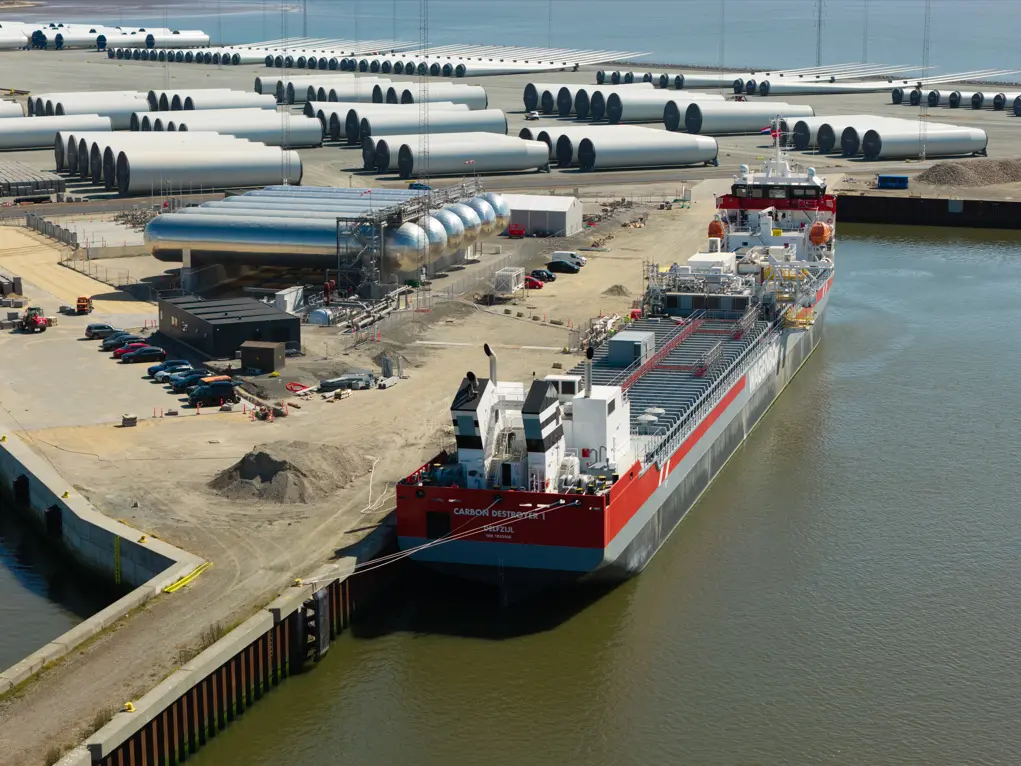
Once captured, the CO₂ is liquefied and transported by road to a dedicated terminal at Port Esbjerg. There, six storage tanks provide temporary capacity of about 6,000 tonnes before the CO₂ is transferred to a ship for the offshore journey. Greensand says the terminal is designed to handle between 60 and 72 trucks a day.
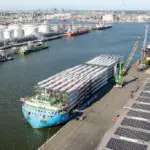
The ship waiting to take that cargo is Carbon Destroyer 1, a purpose-built CO₂ carrier with capacity for approximately 5,300 tonnes.
The vessel has eight CO₂ storage tanks, manufactured by Geldof (Engicon) in Belgium and installed at Royal Niestern Sander’s shipyard in the Netherlands. Two specially designed suction tanks supplied by Danish company Dana-Tank were also installed in the cargo hold.
Carbon Destroyer 1 arrived in Esbjerg in March 2026, completing the link between the new terminal and the offshore storage site. Greensand describes it as the EU’s first purpose-built CO₂ carrier.
It will transport the gas to Nini West, a depleted oil field that previously formed part of Denmark’s North Sea oil and gas production.
The Danish Energy Agency granted Greensand a permit in December 2025 allowing up to 2.4 million tonnes of CO₂ to be stored there over 30 years, the first full-scale CO₂ storage permit issued in Denmark.
The CO₂ will be injected into a sandstone reservoir approximately 1,700–1,800 metres beneath the seabed and it will be kept in place by sealing rock formations above the reservoir.
It means part of the infrastructure developed for oil and gas production is being reused rather than building an entirely new offshore field.
The concept was tested first at pilot scale. In March 2023, Greensand injected CO₂ into the Nini West reservoir, demonstrating what it described as the first complete cross-border offshore CO₂ storage value chain. The pilot established that CO₂ could be captured, transported across national borders and injected offshore into the reservoir.
Engineering between ship and well
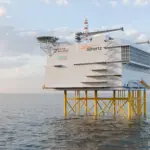
The most substantial new engineering offshore is the system that connects Carbon Destroyer 1 to Nini A.
The Danish Energy Agency approved a new CO₂ offloading system comprising fixed and flexible pipework, a dynamic riser and a pipeline-end manifold, or PLEM.
The subsea installation includes sections of static pipeline approximately 300 metres, 180 metres and 120 metres long. Concrete mattresses are used to protect and secure sections of pipe on the seabed.
The system also includes a dynamic riser equipped with buoyancy elements and a rigid bridle, together with pickup lines. Before operation, the installed pipework is subjected to leak testing. The offshore system also incorporates CO₂ leak monitoring.
The arrangement is designed to transfer CO₂ from the moving ship into the fixed offshore infrastructure and ultimately towards the injection facilities on Nini A.
Once the CO₂ reaches the platform, it is sent down the injection well and into the sandstone reservoir.
The storage formation itself provides the long-term geological containment. The Danish Energy Agency says the reservoir lies beneath sealing rock formations, while the Greensand storage system uses the existing offshore infrastructure and wells as part of the engineered system.
From pilot to full-scale operation
CCS projects have previously demonstrated individual parts of the CCS process: capturing CO₂, transporting it, injecting it underground or storing it in geological formations.
Greensand’s claim is that the pieces can now operate together as a commercial system: the gas is captured at a plant; liquefied and taken by road to Esbjerg; stored temporarily in the new terminal; Carbon Destroyer 1 takes it offshore and transfers it into the subsea well.

The CO₂ travels through the Nini A facilities and down an injection well, ending up in the depleted Nini West reservoir, approximately 1.8 kilometres below the seabed.
The Danish Energy Agency has described the storage element as a critical part of the wider CCS chain, but it’s actually just one step ahead of a number of other projects in Europe.
Leading the rest is Northern Lights in Norway, which transports captured CO₂ by ship to the Aurora storage facility beneath the Norwegian North Sea. Its first phase is designed to handle up to 1.5 million tonnes a year, with expansion planned to 5 million tonnes.
In the Netherlands, Porthos is developing a network to move CO₂ from Rotterdam, Antwerp and Ghent to depleted North Sea gas fields, while Aramis plans a 200km offshore trunkline from Rotterdam to multiple Dutch storage sites. Other projects include Denmark’s Bifrost, Greece’s Prinos and Norway’s Atlas, reflecting a rapidly developing North Sea and Mediterranean CCS network.
In the UK, HyNet is being developed by Liverpool Bay CCS Ltd, part of Eni, and is the CCS backbone of the wider HyNet cluster covering north-west England and north Wales. It will transport the gas through a new and repurposed pipeline network to depleted gas fields beneath Liverpool Bay, where it will be injected through repurposed offshore infrastructure.