![MaritimeJournal[Seawork]](https://www.maritimejournal.com/wp-content/uploads/2026/09/MaritimeJournalSeawork.svg)

Cruise ship lift death raises warning for larger work vessels
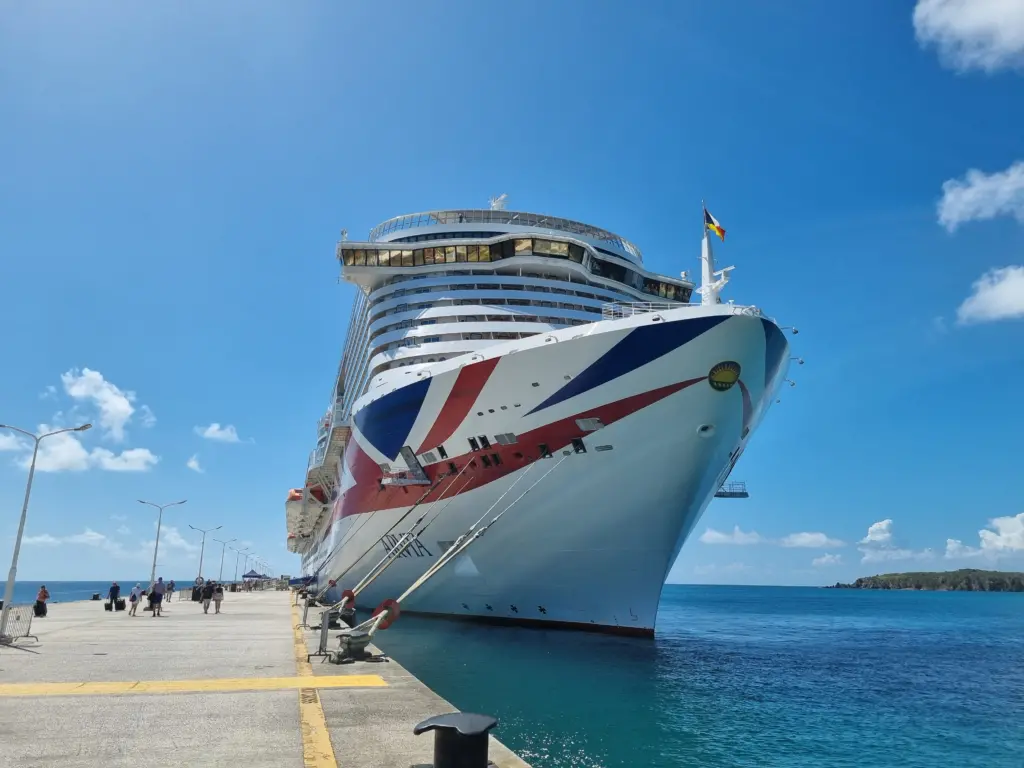
A fatal accident on board the cruise ship Arvia has sounded a warning for commercial marine operators as lifts become increasingly common aboard larger offshore and research vessels.
An electrician was killed while inspecting a passenger lift following overnight repairs aboard the vessel Arvia in October 2025. The 344.5m-long vessel, which was carrying 5,299 passengers and 1,681 crew, was on passage from Southampton to Santa Cruz de Tenerife.
The technician was inside the lift shaft when the lift moved and crushed him between the lift car and the side of the shaft.
The Marine Accident Investigation Branch (MAIB) found that the inspection was not supported by a clearly communicated and mutually understood plan; positive control of the lift had not been established before the electrician entered the shaft; and the system of work relied on self-resetting door interlocks that did not provide an effective barrier against lift movement.
As commercial vessels become larger and more complex, lifts are increasingly being fitted to crew transfer vessels (CTVs), service operation vessels (SOVs), construction service operation vessels (CSOVs) and research vessels.
These lifts can provide essential access between accommodation, machinery and working areas, but they also introduce a specialist maintenance hazard that needs to be considered in vessel safety management, maintenance planning and crew training.
Planning and communication
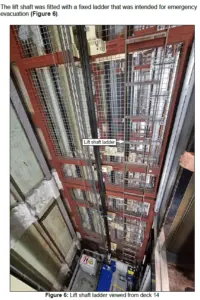 The Arvia accident developed from troubleshooting and repairs to a passenger lift. An inspection of a travelling cable bracket was subsequently required, but this was not part of the original maintenance plan.
The supervising officer and electrician did not revise the permit to work, conduct a job safety review or stop to agree how the additional work would be carried out.
“Communication between the SETO (senior electrical technical officer) and ET (electrical technician) was ineffective,” says the MAIB report. “This resulted in a lack of shared understanding of the task and actions that allowed the lift to return to a state that exposed the ET to the risk of unintended lift movement.”
The situation changed when the technician could not gain normal access through a deck 12 landing door and went to deck 14, where he used an alternative route into the lift shaft.
The report found that this significant change in the work should have prompted the crew to pause, re-establish communication and confirm a safe method of working.
Positive control
Control of lift movement was central to the accident. Manufacturer procedures, the permit-to-work system and Carnival UK’s safety instructions required the lift to be placed under control, with the emergency stop and inspection mode used before anyone entered the shaft.
Instead, the work relied on the landing-door interlocks, which interrupted the lift’s safety circuit while the doors were open, but automatically reset when the doors closed.
That meant that closing the doors restored the safety circuit and allowed the lift to respond to an outstanding call.
“The system of work for lift maintenance relied on the use of door interlocks to prevent movement when accessing the lift car top,” says the report. “This did not provide an effective safety barrier as the interlocks were self-resetting when the doors closed, placing the crew at risk.”
The report also highlighted a training gap: the officer responsible for supervision and permit-to-work management had no formal lift safety training with Carnival UK.
“Lift maintenance involves hazards that differ from those routinely encountered during other electrical maintenance activities,” the MAIB said.
Those hazards include understanding lift safety circuits, door interlocks, inspection-mode controls, emergency stops, shaft access and the circumstances in which safety controls can be defeated or restored.
A history of fatal accidents
The Arvia accident was not an isolated case. On 27 January 2007, an electrical technician aboard the tanker British Mallard was killed while attempting to rectify a lift defect. After adjusting lift-door switches, he entered the shaft using a ladder. The doors closed and the lift car travelled upwards, trapping him between the car and the ladder.
The Australian Transport Safety Bureau found that the lift manuals did not provide sufficient safety guidance, while the vessel’s permit-to-work and risk-assessment procedures had not been used and the hazards had not been fully identified or understood.
On 8 August 2007, an electrical cadet aboard the container ship MSC Colombia was killed during lift maintenance. The MAIB’s preliminary assessment found that the cadet did not fully understand the operation of the lift and that company risk-assessment and permit-to-work procedures had not been followed.
Then, on 27 December 2015, the chief electrician aboard Carnival Ecstasy was killed after being struck by a lift counterweight while working inside the lift shaft.
Following that accident, the operator issued a fleetwide safety advisory requiring trained electrical team members to carry out lift work, risks to be identified and assessed beforehand, safe working procedures to be followed, a two-person buddy system for high-risk tasks and lifts to be placed in inspection mode before personnel worked on top of the car.
Lessons for commercial marine
Carnival UK has since instructed its senior electrical technical officers to reinforce lift maintenance and rescue requirements, including communication between crew, correct permit-to-work management and a prohibition on using fixed ladders to access the lift car top.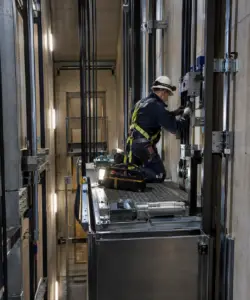
Training material has also been updated with equipment-specific safety information. The company introduced an interim requirement for personnel involved in lift maintenance to have completed basic safety training from the original equipment manufacturer or a third-party lift service supplier within the previous six months. A competency verification process has also been introduced.
The MAIB has made recommendation 2026/159 to Carnival UK Ltd: “Review the use of self-resetting lift door interlocks as a safety barrier to prevent activation of lifts during maintenance or inspection.”
With lifts becoming more commonplace on larger CTVs, SOVs, CSOVs and research vessels, the Arvia investigation provides a clear warning that lift maintenance needs to be treated as a specialist, high-risk operation that must have competent personnel, effective isolation, clear communication, formal reassessment when work changes and positive control of lift movement before anyone enters a lift shaft.
Related Articles
 OTHER NEWS
 DIVING SERVICES
 ACCESSORIES & EQUIPMENT