

All about letting go
A repair vessel may have just deployed a bight of telecoms fibre optic cable or similar product – but it’s still attached to the crane. So, how does it retrieve what may be a 1,000m length of load-carrying rope? After all, leaving it there is environmentally unfriendly if not downright wasteful while using divers or ROVs doesn’t come cheap.
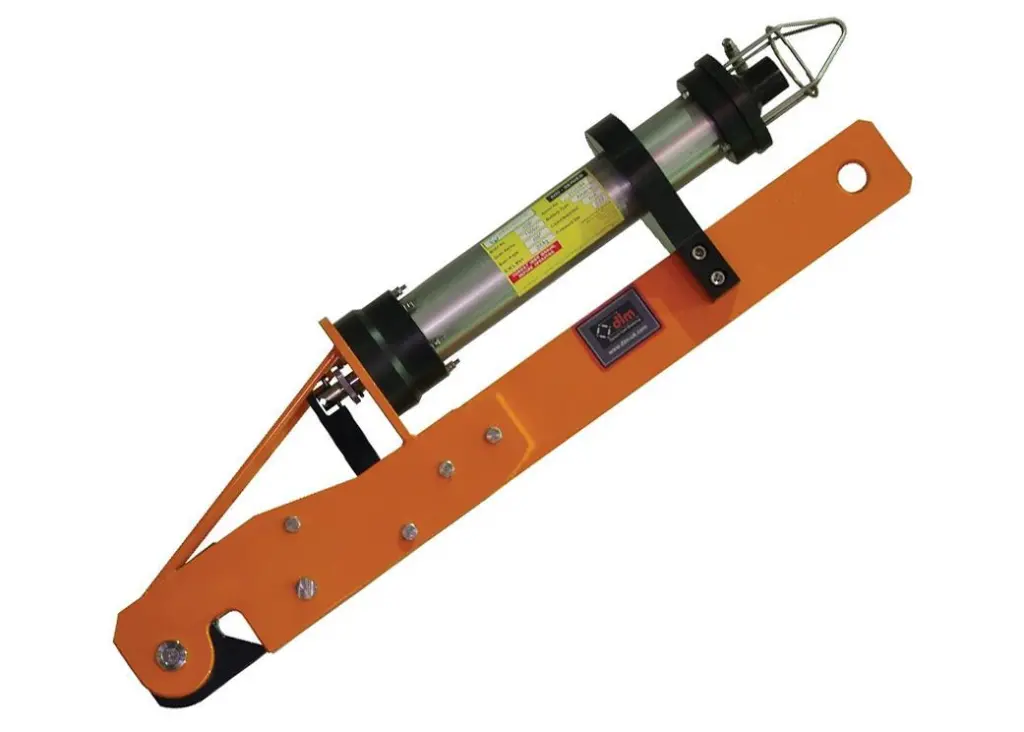
The problem has been that good, reliable signal-release hooks are also expensive… and using a less able version at the limit of its capacity risks losing the investment entirely if it fails to open and remains tied to the cable on the seabed.
DLM has worked hard with partner Applied Acoustics to find a solution. Martin Halford explained that their recently launched 10 tonne capacity acoustic release hook has been going through “a number of iterations” in order to increase reliability and, most importantly, decrease costs – which he said has brought the price down “by around 40%”.
The kit works simply enough: a standard surface control unit about the same size as a small briefcase (typically a 3510 PAM Portable) sends a message to the hydrophone suspended in the water over the side of the hull, which emits an acoustic signal. This is received by a motor on the hook which then rotates, opening the sturdy catch mechanism and allowing the load to slip away.
So, how did DLM manage to retain quality but make this hook more cost effective? After all, the hook’s 10 tonne capacity still yields a safety factor of four times that amount. Mr Halford explains that firstly it’s meant removing non-essentials such as the cage which surrounded the original design: “It wasn’t needed, the underwater unit itself has a heavy duty steel casing,” he explained.
On the other hand, the development has benefited consistency: the catch now disconnects faster and more smoothly “and we’ve also reengineered the trigger mechanism, a lot of work has gone in to making sure it releases every time – otherwise you’ve just lost over £10,000 worth of equipment” he added.
Although this acoustic release hook has already found a market in places such as Indonesia (as the country is engaged on a ‘connection’ initiative), there are also a number of other applications nearer home: for example wind construction operations which necessitate lowering work baskets or other subsea structures.
Further, while this 10 tonne capacity version is the first of DLM’s revived model, it will soon be followed by a bigger 50 tonne capacity unit which should be of interest to the power cable sector.
However, Mr Halford added that the rental market is also proving attractive “as it saves the operator the bother of maintenance” as well as the cost of upfront investment.
By Stevie Knight