



Catching (and keeping) the wind
Offshore wind turbines have trebled in size over a decade and another jump upward looks likely to come soon enough: so, how are ports responding to the step up in scale?
It has to be said, committing investment in such an uncertain world – a world riven with politics – takes boldness. After all, Bremerhaven’s fate has been sobering: just four years ago the port had big names like Weserwind, Areva and Powerblades tied to it and handled multiple projects at a time. Unfortunately, both Germany and the UK pulled back on their wind construction commitments leaving a tangle of debt, job losses and takeovers with the port a ghost of its former glory. Despite the raised finger of Adwen’s AD 8-180 mammoth sitting on the Fraunhofer IWES test bench, the need for Bremerhaven’s €180m offshore terminal (OTB) is being hotly disputed.
There is light at the end of the tunnel. Wind is poised for a transition into commercial business: “We are just at cost parity – almost on our own two feet now”, Chris Garrett of DNV GL told MJ. He added that lowered costs should make some projects worth revisiting: “The financial institutions now want to invest, so we may not be going along with a begging bowl for subsidies much longer.”
But even so, is optimism justified?
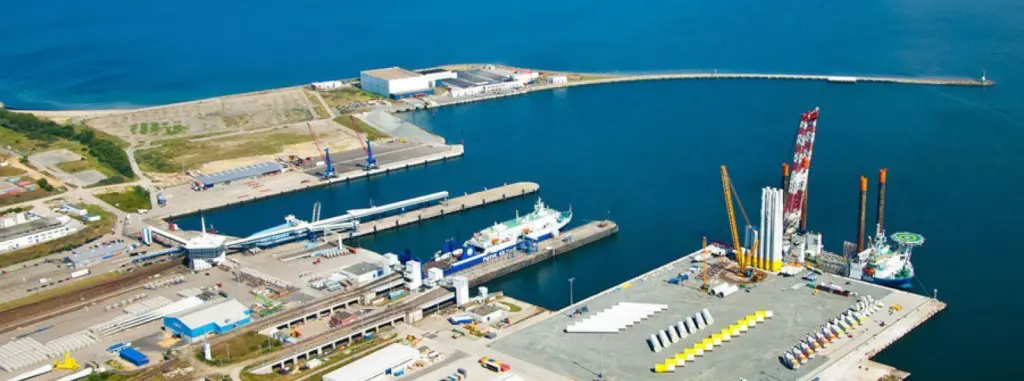
Fabian Hoppe of Mukran, Germany certainly believes so – if the other factors fall into place: to borrow a line from the estate agents, the three biggest factors are ‘location, location, location’. Mr Hoppe explained the port, sitting on the east side of Rügen Island, is in a very good position for handling larger components “especially for ships working in the Baltic”.
It does have a number of natural charms: although the facility is somewhat sheltered from the north by the long curve of the Jasmund Peninsula and the port’s sea wall, look east and the open sea is right on the doorstep. Both simple access and deep water means there’s no channel navigation or pilot services, giving big vessels an easy approach.
But it all needed work. Originally the Sassnitz ferry harbour, Mukran has had to reinvent itself.
As Fabian Hoppe explained, the South Terminal sprang from a land reclamation scheme completed in 2013. This gave Mukran’s first wind contract – the EnBW Baltic 2 farm – 100,000m2 of space to play with, the shape allowing for a pair of ‘standard’ berths, a ro-ro terminal and a couple of multipurpose areas: berth 3a’s forward edge yields a 190m quay length, topped by a strengthened concrete pad to reinforce it for loads of up to 50t p/m2. Further, it has a depth of around 9.5m, plenty for even large vessels to glide in.
Certainly Baltic 2 made extensive use of the ro-ro facilities, trundling components such as the 58m blades and 3.6MW, 200 tonne nacelles from the holds of delivery vessels on SPMTs into the yards where certain elements – like the 75m towers – would be pre-assembled before lifting on to installation vessels such as Taklift 4 and Vidar.
But the Baltic wind sector is inherently complex, explained Mr Hoppe. The region covers a wide range of seabed depths and the soil conditions on the bottom are non-homogenous, including everything from fine sand to gravel and large cobbles. Therefore a number of projects demand a varied construction: Baltic 2 for example had 39 monopiles for depths of 23 to 35m, with 41 jackets for deeper water.
Further, the current development at Mukran involves Iberdrola’s 350MW Wikinger (Viking) wind farm which is deploying some 70 jacket foundations.
These are big items: Wikinger’s turbines will be the tallest yet, at over 270m (including piles in the seabed, from seabed to top 225 m) to the top of the 67.5m blades. Moreover, the jackets weigh in at 630 tonnes each and have piles of 350 tonnes to fix them.
While these are designed for 5MW turbines they may herald a supersized future. Although the industry’s stretched the use of monopiles a long way, deeper water and the upcoming 10MW-plus turbines (which should arrive sometimes in the next three to five years) results in structural resonances that require the stiffness of jacket foundations explained Mr Garrett.
Certainly at Mukran, the new components have already brought with them a shift in operations explained Mr Hoppe: firstly, while the previous, somewhat smaller installation vessels had simply floated at the quay, the 132m Brave Tern needed to put its feet down for loading.
Therefore concrete reinforcements were placed on the seabed in front of the big multipurpose berth to stop the thousands of tonnes of pressure from the jackup’s feet undermining the quay’s footings. The difficulty here was stabilising the same kind of ‘non-homogenous’ soil that exists all through the Baltic to give the necessary 65t/m2 resistance.
Out of the water, the foundations presented another set of challenges: these are mammoths with four ‘legs’ resulting in a 25m-a-side footprint. As jacket manufacture is a slower business than deployment, the marshalling yard needs to keep a stock in hand – therefore ports like Mukran can occasionally be asked to hold a dozen or more at a time.
A floating solution made life simpler. As the jackets were towed from Denmark in sets of three, the ideal answer was to keep them on their own, specially designed concrete barges which allowed Mukran to moor them up across a variety of sites around the port, along with the piles. “This gave us flexibility when it came to storage,” explained Mr Hoppe.
Interestingly, the Wikinger project has a novel approach to blade fixing and is making the most of Mukran’s large yard area by pre-assembling the rotors before loading. Lifted onto Brave Tern’s rear deck and stacked horizontally in a specially designed carrier they are reminiscent of a child’s toy – although the sheer scale of the 135m rotor diameter is breathtaking.
This spring saw the last of Wikinger’s jackets installed: the turbines are now being fitted and the cable layers coming in to provide the electrical link, but Mukran is ramping up again, readying its new, 120,000 m2 North Offshore Terminal for the 385MW Arkona project which will begin construction this autumn.
The newly lengthened 125m quay has been reinforced for extremely heavy loading with areas strengthened to 50 t/m2. Although Mr Hoppe admitted this was “far more than needed by present wind components”, he added this will help future-proof Mukran for the next generation of turbines – and make the terminal attractive to other kinds of project cargo.
Further, the port is looking tie in wind farm developers for the longer term and has O&M projects in its sights. Therefore it’s constructing an offshore service area for CTVs and it has recently opened an operations hub for Ibedrola. This holds both monitoring offices for the Wikinger farm and several workshops as well as a materials warehouse: another, similar facility is being built to support the Arkona windfarm.
While other facilities may hesitate, it seems Mukran is engaged in giving its offshore wind ambition a very solid underpinning.
By Stevie Knight
Related Articles
 OTHER NEWS
 MARINE CIVILS
 MARINE CONSTRUCTION