


Damen deliver first Emergency Response Vessel to Sweden
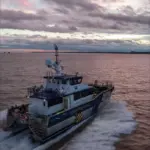
Damen Shipyards has delivered the first of three multi-functional patrol and emergency response vessels to the Swedish Coastguard – Kustbevakning. Named simply KBV001, the construction of the vessel and its two sister ships was project managed by the Damen Schelde Naval Shipbuilding division and construction entrusted to the Damen Galatz Shipyard in Romania. Extensive trials were completed in April and this first vessel prepared for delivery in May.
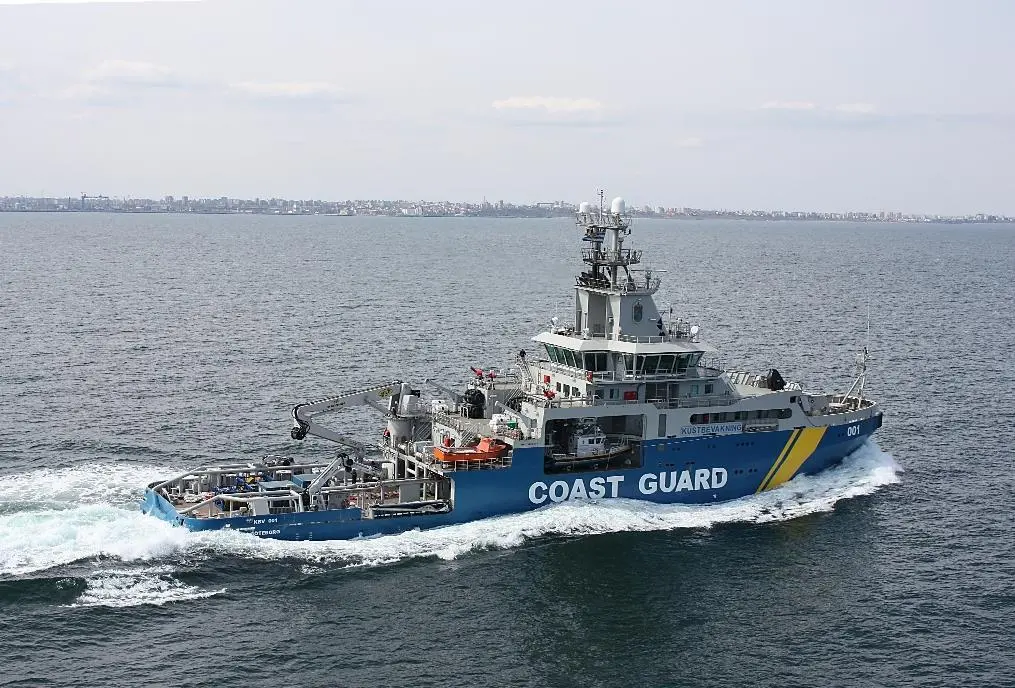
The Swedish Coastguard awarded a contract to Damen in December 2005, marking the commencement of a complex project to design and built three highly sophisticated vessels required to reduce the risk of major marine pollution on the Baltic coastline of Sweden and the narrow waters separating Sweden and Denmark.
Employed primarily to patrol Sweden’s territorial waters, KBV001 and its sisters are equipped to carry out environmental control duties, customs duties and conduct fishery and traffic control operation. All three vessels will be equipped to carry out emergency towing, fire fighting, oil spill recovery, rescue operations, environmental research, diving and ROV operations. The third and final ship to be delivered will also be equipped to carry out the demanding work of chemical recovery at sea.
An important feature of the specification was a requirement to ensure that the vessels themselves would be as environmentally friendly as possible. Emissions have been reduced to a minimum and there is a strong focus on fuel economy and heat/energy recovery. In order to meet that requirement a diesel-electric propulsion system was chosen, offering maximum flexibility throughout the operational envelope.
KBV001 and sister ships KBV002 and KBV003 meet the requirements of Ice Class 1A and measure 81.20m in length overall with a beam of 16m, a depth of 7.5m and a design draft of 5.00m. It was a major challenge for the designers to produce a robust vessel capable of incorporating the equipment and systems needed to support the many roles envisaged by the operators.
Two main engines of 3,300kW each are the main power source for the diesel-electric propulsion system, backed up by seven auxiliary generators, five of 1,665ekW each, one of 400ekW and a emergency set of 150ekW. The main electrical power network supplies 690v for the propulsion motors, in addition to the normal 440v and 230v systems at 50Hz. A pair of electrically driven fully azimuthing propulsion units are installed in the stern and two thrusters in the bow, one of which is retractable. This arrangement offers a wide range of options for propulsive power and enhanced manoeuvrability. A bollard pull in excess of 100 tons was achieved on trials and a free running speed of 16 knots.
The bollard pull performance complies with a operational requirement demanding that the vessels should be capable of towing a fully loaded tanker of 150,000dwt in Force 8 wind conditions, or hold it on station in Force 10. Among the many and varied tasks within their capability is to retrieve oil from the surface of the sea in the harsh and relatively cold conditions of the Baltic. This can be done using side sweep equipment with the vessels underway or by means of skimmers. Oil collected is stored in dedicated tanks.
KVB003, the third of the trio will be equipped for chemical recovery at sea and will have a unique system installed to ensure the safety of the vessel and crew in extremely dangerous chemical cloud environments. A ‘Citadel’ arrangement and a complete air filter installation for both the accommodation and engine room will be installed.
With KBV001 completed, the fitting out of KBV002 is well advanced with delivery scheduled for December of this year. The third and more complex KBV003 will follow in May of 2010.
Related Articles
 TUGS & SALVAGE
 EQUIPMENT
 MARINE CONSTRUCTION