




Spilled onions prompt salvors’ response
Salvors were called in to clear up a protected stretch of coast after a spilled cargo of onions alerted them to lost containers.

When Storm Goretti lashed the south coast of England on a rough night in January, two vessels in the same area both lost some of their cargoes within an hour of each other.
One of the vessels, the Liberian-flagged Lombok Strait, lost about 17 containers, and it was the onions from one of those that alerted salvors to the incident. The vessel itself remained afloat, continuing its voyage to Portsmouth.
More of a threat to the sensitive coastal habitats were the containers containing refrigerator panels, which included insulation foam and structural fragments from the damaged containers.
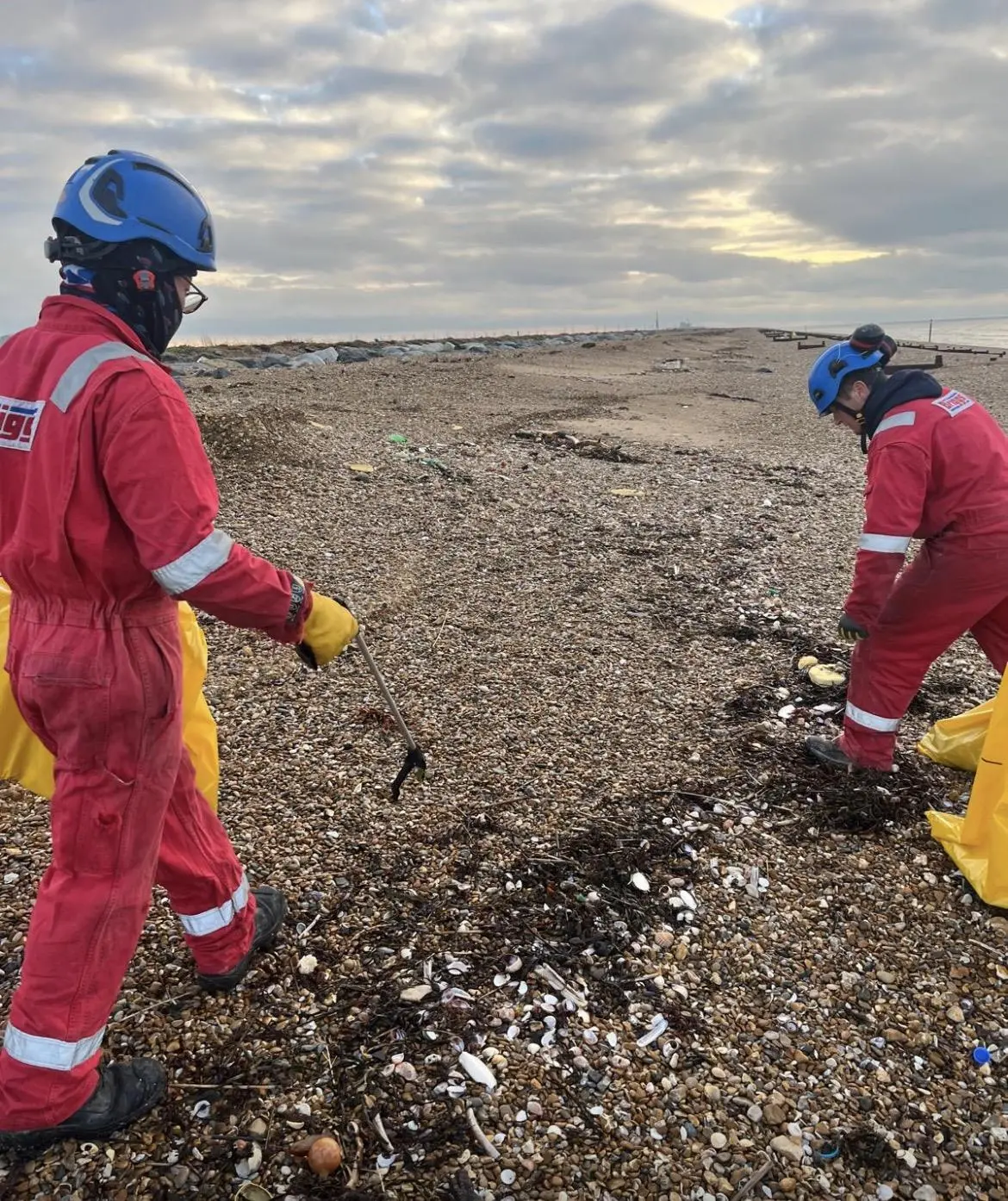
Because much of the affected shoreline falls within Sites of Special Scientific Interest (SSSIs), where strict environmental protections prohibit the use of heavy machinery, salvage teams from Briggs Marine had to carry out the entire clean-up by hand, working across uneven rock, shingle and tidal zones.
Crews covered a combined distance of more than 200 kilometres during the operation, walking several kilometres per shift while transporting debris to designated collection points. Larger items, including sections of container framing, had to be broken down on site to make them light enough for manual removal without damaging the terrain.
Second containership
About 45 minutes after the Lombok Strait lost some of her load, another cargo vessel, the Condor Valparaiso, reported a similar incident in the same general area, south-west of St Catherine’s Point. Unlike the Lombok Strait, the Condor Valparaiso’s containers were mostly empty and sank quickly, leaving minimal debris onshore.
There was no collision between the two ships, and the losses were attributed entirely to the extreme rolling and pitching caused by the storm.
The vessel continued its voyage safely, and there were no injuries reported.
Together, the two incidents resulted in roughly 24 containers lost. Maritime authorities emphasized that the events were independent, linked only by timing and weather severity. Clean-up efforts have focused on both environmental protection and recovery of floating debris, particularly the insulation foam and food cargo from the Lombok Strait.
While storms of this magnitude are relatively rare, they underline the need for continuous review of securing procedures and real-time weather monitoring to reduce cargo losses.
One project supervisor described the conditions as “physically demanding and slow-moving,” adding that “every item had to be assessed, lifted and moved without disturbing the surrounding habitat.”
Recovered debris
In total, Briggs Marine recovered around 70 cubic metres of insulation foam, more than 13 tonnes of onions, and container fragments equivalent to four full containers.
The insulation material presented particular difficulties. Lightweight and brittle, it fragments easily and can disperse into smaller particles, increasing the risk to wildlife and marine ecosystems.
Briggs worked with HM Coastguard, local authorities and partner contractors, as well as community volunteers, to respond.
An Environment Agency representative said the approach “demonstrated that even heavily constrained sites can be cleared effectively with the right planning and oversight.”
Post-operation surveys indicate that the majority of accessible debris has now been removed, bringing an end to a labour-intensive salvage effort carried out under some of the most restrictive conditions on the UK coastline.
Related Articles
 ELECTRICAL SYSTEMS
 ENVIRONMENT
 ENVIRONMENT