



Epoxy-hulled rigid inflatable
Netherlands-headquartered Damen Shipyards Group unveiled the latest addition to its portfolio at Europort this year. Damen says its RHIB 1050 represents ‘the next generation in rigid hull inflatable boats’.
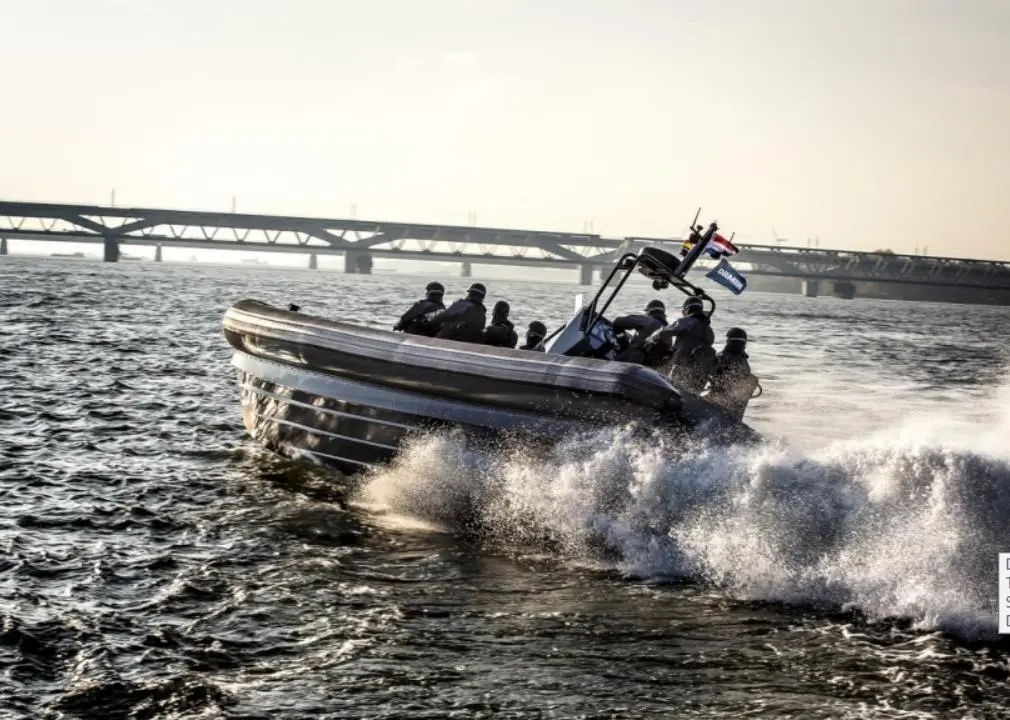
The 10.5 x 3.35 metre multi-mission vessel can serve as an independent platform or as support for a larger patrol vessel. The RHIB 1050 was developed at Damen Shipyards Hardinxveld – no stranger to such vessels having provided numerous examples to the Royal Netherlands Navy over the years. Newbuild Project Manager at the yard Roel Foolen is happy with a job well done: “This is not your average RHIB,” he stated. “For starters, it’s Lloyds approved. The hull is made of glass reinforced epoxy as opposed to polyester and provided with Lloyd’s approved closed cell, foam core.”
Damen’s use of epoxy for the hull will see the RHIB 1050 produced at the group’s specialist composite yard in Antalya, Turkey. The RHIB will be produced in series with a standard hull, open to flexible, client-specified outfitting requirements.
“Further to this, we are also able to provide training in its use,” continued Mr. Foolen. “Damen has many years’ experience in building boats for navies and other defence and security bodies,” he added.
Ergonomics are a strong theme running throughout the design. Damen developed the layout using a mock-up console, constantly tweaking the positioning of instrumentation, seating and controls until completely satisfied with comfort levels. Consequently, the wheel and throttle are perfectly aligned with the suspension seating and handles and grips are located strategically throughout the RHIB.
“We’ve aimed to cover every detail – for example including steps to facilitate easy, fast exit of the RHIB in boarding ops and integration of hoisting eyes into the bollards, simultaneously removing a trip hazard and taking advantage of every available bit of space.”
Another example of this philosophy at work is the unique use of D-shaped tubing, rather than the conventional cylindrical tubing. “Doing this allows us to combine the console and the engines into a single, space saving unit. Usually this would not be possible as such a unit would impede access to the fore of the vessel. However, with a section of tubing removed, there is still space for on board personnel to pass safely and comfortably fore to aft,” explained Mr Foolen.
The 2 x 350 litre fuel tanks are located beneath the 10 deck-based seats. The seats are fitted to a dedicated hatch so, in the event the tanks require removing, the seating is simply lifted clear.
Similarly, the entire console unit is hinged at the aft end so that it can be very easily moved clear when access is necessary to the 2 x 370 hp Volvo Penta engines. The mast is also hinged so that it can be quickly folded away for transport height.
Of course, with such a vessel, performance is also of fundamental importance. Here too, the RHIB 1050 is not found wanting. “During seatrials, the handling, manoeuvrability and balance have proven to be excellent. It’s very safe also, very forgiving and perfect in rough, harsh water. She’s quick too – able to sail at speeds of over 50 knots,” concluded Mr Foolen.
Damen is currently building a second RHIB 1050, which will feature 2 x 400hp outboard engines.
By Jake Frith
Related Articles
 OTHER NEWS
 MARINE RENEWABLES
 ACCESSORIES & EQUIPMENT