![MaritimeJournal[Seawork]](https://www.maritimejournal.com/wp-content/uploads/2026/09/MaritimeJournalSeawork.svg)





Could this hydrogen engine power next generation of harbour craft?
Chinese engine manufacturer Weichai Power has launched what it says is a hydrogen combustion engine as a direct alternative to diesel.
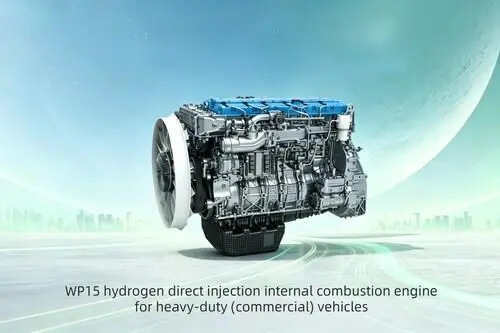
The company’s WP15 hydrogen engine is based on its 15-litre diesel platform and has been developed as an alternative for heavy-duty diesel applications such as tricks, port machinery, mining equipment and workboats.
Rather than replacing the internal combustion engine altogether, Weichai says it has retained the proven characteristics of its diesel platform while substituting hydrogen for diesel fuel.
At the heart of the WP15 is a 14.6-litre direct-injection hydrogen engine producing 447 kW (600hp) and 2,800 Nm of peak torque. According to Weichai, the engine achieves a peak brake thermal efficiency of 46.8%, a figure that compares favourably with many conventional heavy-duty diesel engines and represents one of the highest efficiencies yet announced for a hydrogen internal combustion engine.
The company also says the engine became the first hydrogen internal combustion engine to achieve full compliance with China’s China VI heavy-duty emissions regulations, demonstrating that hydrogen combustion can satisfy modern emissions standards while maintaining diesel-like performance.
According to Weichai, more than 90% of the engine’s components are shared with its conventional diesel equivalent. That level of commonality means manufacturers can retain much of the existing engine block, crankshaft, lubrication system, cooling circuits and manufacturing processes while adapting the fuel system, combustion system and engine management for hydrogen operation.
For commercial marine operators, this could prove particularly attractive. Harbour craft typically demand engines capable of producing sustained high torque under continuous heavy loads while remaining robust, easily serviced and familiar to engineers. By retaining the basic architecture of a conventional diesel engine, Weichai is attempting to minimise disruption to existing manufacturing, servicing and maintenance procedures.
Weichai has also unveiled a ‘flexible fuel’ WP15 platform capable of operating on multiple fuels through changes to relatively few components and revised electronic calibration. The company says this modular approach allows manufacturers to adapt a common engine architecture to different fuels while retaining much of the underlying mechanical design.
From a power perspective, the WP15 also aligns closely with many commercial harbour vessels with output of 600hp. Twin-engine installations would provide approximately 1,200hp, sufficient for numerous harbour service vessels and smaller tugs operating in sheltered waters.
Fuel system
Although the engine itself closely resembles a conventional diesel, the fuel system does not. Hydrogen requires dedicated high-pressure storage tanks, specialised pipework, leak detection systems and safety equipment that are considerably different from those used for diesel fuel. Vessel designers must also accommodate bulky storage cylinders that occupy much more space than conventional fuel tanks.
However, many harbour craft return to the same berth every day and operate within relatively short distances of a fixed base. This creates an opportunity for dedicated hydrogen bunkering infrastructure to be installed at a single port rather than requiring an extensive nationwide refuelling network.
Whether the WP15 ultimately finds widespread acceptance in the marine sector will depend as much on infrastructure as on engine technology. The engine itself demonstrates that hydrogen combustion can deliver diesel-like power, torque and efficiency using a familiar engine architecture. Yet operators would still need investment in hydrogen production, storage and bunkering, together with vessel designs capable of safely accommodating compressed hydrogen fuel.

Related Articles
 ACCESSORIES & EQUIPMENT
 OTHER NEWS
 EQUIPMENT