


NavComms market in for 50% hike – report
The market for marine onboard communication and control systems is projected to increase by 50% by 2028, driven by a rise in the size of marine fleets, according to the market research firm Markets and Markets.
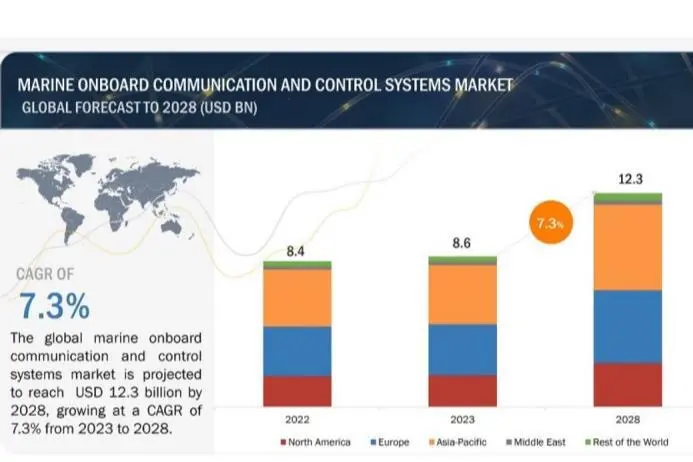
In a 220-page report, it projects the market will grow from a value of $8.6 billion in 2023 to $12.3 billion at a CAGR of 7.3% spurred on by the need for more advanced communication and control equipment, enhanced navigation, secure communications and operational efficiency.
By region, the report says Asia-Pacific will have the highest CAGR, and that ‘new product launches and contracts are expected to offer lucrative opportunities to market players in the next five years’.
“The market growth in Europe can be attributed to significant investments in R&D activities and the technological advancements taking place in the maritime industry,” it says.
As the market rises there will be restraints caused by cost, the report says, which as systems increase in complexity, will turn go higher and cause fleet managers to think twice about investing in such rapidly changing technology.
Evolving and retrofitting
Evolving communication systems mean vessels can remain in contact in more remote places than ever before, with 5G, satellite constellations and low-Earth orbit satellites all raising the development of onboard systems.
Situational awareness has been enhanced massively, with proactive responses now possible as opposed to simply reacting to things like adverse weather conditions.
It is also possible to retrofit older vessels with the newer technology although they were not designed to integrate them – a complex and challenging operation, the report says, but one that operators are addressing.
“Retrofitting requires considering the impact on a vessel’s overall stability and safety,” the report says. “The addition of new equipment and modifications to existing structures may affect the ship’s weight distribution and centre of gravity. Retrofit projects often require high investment in terms of time and resources, which becomes a vital challenge to integrate marine onboard communication and control systems.”