![MaritimeJournal[Seawork]](https://www.maritimejournal.com/wp-content/uploads/2026/09/MaritimeJournalSeawork.svg)






Navigating battery risks: Still a bridge too far?
 Part of our special report
Marine Batteries & Electrification · July 2026
All 8 features
Part of our special report
Marine Batteries & Electrification · July 2026
All 8 features
Are we there yet? Despite so many battery manufacturers hailing the benefits, the risks and problems of onboard and onshore battery systems identified in a recent Bureau Veritas report suggests not.

With 1,500 battery-powered vessels in operation and hundreds more under construction, the integration of lithium-ion (Li-ion) battery systems is accelerating rapidly. These systems offer higher energy efficiency, zero-emission operation in port and improved responsiveness.
However, despite being rolled out on boats and as Onshore Power Supply (OPS) systems, they also introduce new layers of complexity and risk.
A report by Bureau Veritas Marine & Offshore, Maritime Electrification: Maritime Battery Systems and Onshore Power Supply, emphasises that the successful adoption of these systems depends on rigorous safety standards, system integration and regulatory compliance.
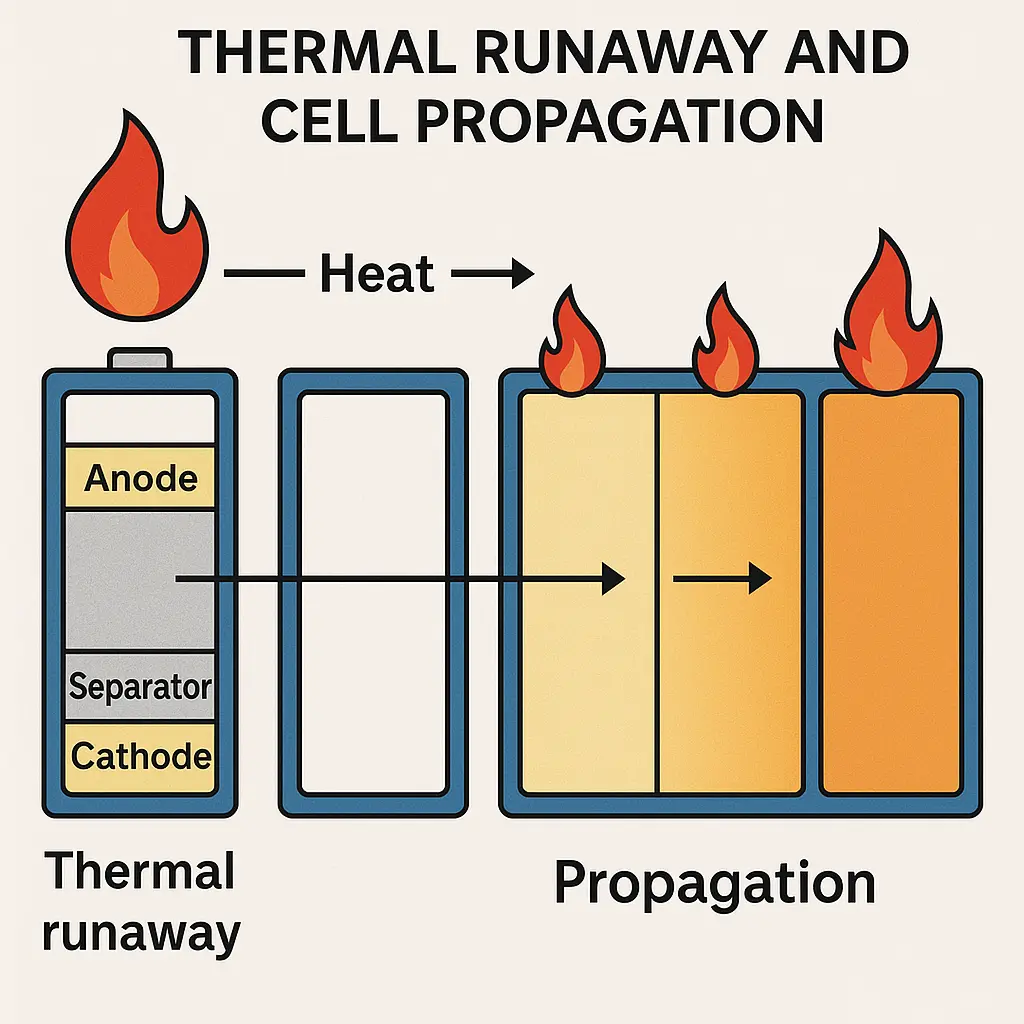
The most critical hazard associated with Li-ion batteries is thermal runaway, when a battery cell heats up and causes a reaction as cell after cell is heated until fire can break out. It can be triggered by internal short circuits, overheating, overcharging or mechanical damage.
Once ablaze, battery fires are extremely difficult to put out because of the generation of oxygen from the battery’s internal reactions.

Consultant George Brilmyer, an electrochemist with more than 45 years’ experience in the battery industry and owner of the consultancy Batt-Tek Consulting, is extremely sceptical about lithium batteries.
“Any battery can go into thermal runaway and explode,” he says. “But with lead-acid batteries, for example, they can go into thermal runaway but they won’t explode because the electrolyser is an acid.
“If lithium batteries come into contact with water, chlorine, a noxious gas, is released, and hydrogen comes off the other terminal – which can then explode.
“Lithium iron phosphate (LFP) was originally claimed to be safer but it’s not. It has a lower voltage cell but when one of those goes into thermal runaway, you have more problems, such as the chemistry releases more hydrogen, and the solvents are all flammable.”
“Batteries can also re-ignite after initial suppression of the battery fire,” says the BV report. “Therefore, an after-cooling strategy is needed to prevent re-ignition.”
Fire suppression must be both immediate and sustained, using systems that may include inert gases, aerosols, foam or water-based cooling.
As well as fire there is a risk of hazardous gases such as hydrogen, carbon monoxide, hydrogen fluoride and phosphoric compounds being released, creating explosion hazards.
“The accumulation of flammable off-gases in enclosed spaces represents a risk of explosion,” warns the report. Ventilation systems, it says, can in fact make the risk worse, because they introduce additional oxygen that could ignite the off-gases.
“The exact composition of gases will vary from case to case, and it is recommended that a composition analysis be performed, so gas detectors can be adapted and optimized to the expected composition,” it says.
System degradation and maintenance issues
Li-ion batteries naturally degrade over time, reducing energy capacity and increasing the chance of internal failure.
Ageing batteries are more susceptible to mechanical stress and may exhibit unpredictable behaviours.
“As the battery ages, the risk of hazards will also increase, alongside a decrease in performance,” says the report. “This is due to unwanted internal reactions and mechanical stresses that can lead to internal component deterioration and a reduced amount of lithium available for energy storage.”
A key safeguard is the Battery Management System (BMS), which monitors cell temperature, voltage and current. It can isolate malfunctioning cells, balance charge across modules, and communicate with the ship’s Power Management System (PMS).
Any malfunction or misconfiguration of the BMS significantly increases the risk of battery failure.
Battery placement also matters. Batteries must be housed in compartments with adequate ingress protection, cooling, gas monitoring and fire suppression. Increasingly, modular systems are favoured because it is possible to isolate them and contain hazards.
Green credentials
Brilmyer is also candid about the recycling reality of lithium batteries, which is in direct conflict with the ‘green’ claims, and the fact that they require rare earths that are only available in meaningful amounts in China.
“Rare earths can only be sourced from China. The world doesn’t like that,” says Brilmyer. “They are very expensive, but they are needed for the electric motors.
“The materials in batteries are single use and they are not green. You have to realise that. If you are doing this just to be green, you have got to think again. They are not recycled, the electricity is not coming from anywhere green unless you’re in Norway, where there’s a lot of hydropower, or Washington, DC, which has 80% hydropower.
“There’s got to be a better solution and I don’t think lithium is the ultimate answer for electric propulsion. Everybody’s working on it – from sodium to flow batteries – and the petrol guys are also working on making their fuels cleaner.”
Onshore Power Supply (OPS)
OPS systems have their own challenges.
OPS systems can place significant stress on local power grids. A large cruise ship, for instance, may demand up to 20 MVA while docked.
“These high-power requirements have the potential to strain the electricity grid, necessitating significant investment in grid reinforcement or energy storage solutions, says the report – adding that while Battery Energy Storage Systems (BESS) are sometimes used to buffer this demand, they also add to cost and complexity.
OPS frequency and voltage mismatches are also common, BV says. Ships often operate at 60Hz, while port grids may supply 50Hz. The inclusion of frequency converters and transformers introduces more failure points and complicates maintenance, not to mention increasing costs all round.
OPS systems involve high-voltage electrical equipment, often managed in busy port environments. Dodgy installation or operation increases the risk of electrical shock, fire, or system failure. Better training, protective systems and regular inspections are yet more necessary expenses.
Regulations and lack thereof
The BV report also says that current international regulations for OPS and maritime batteries remain fragmented.
While classification societies like Bureau Veritas provide guidance and standards (eg BV NR467), it says, there is no single, globally adopted framework. This regulatory uncertainty adds to operational risk.
The report says the transition to electrification in the maritime sector is both necessary and inevitable, but cannot be undertaken lightly.
“Safety and standardisation must be upheld as top priorities,” it says, and OPS needs to interface with a variety of connection equipment and different onboard power systems.
“Standards help ensure compatibility and interoperability between various components and systems, enabling seamless integration and operation across different ports and vessels,” it says.