




Opinion: How exhaust scrubbers can bridge the fuel gap
The maritime industry is facing huge challenges.
It’s clear that the IMO is increasingly committed to making decarbonisation a top priority, while regional policy makers in Europe and North America are exploring and implementing stricter regulations.
In the aftermath of MEPC80 (the Marine Environment Protection Committee meeting, held in July), international benchmarks have been established, creating a regulatory framework and ambitious goals with the maritime industry now striving to achieve a 20% reduction in all greenhouse gas emissions by 2030, 70% by 2040 and ‘net zero’ by 2050.
The exposure to these regulations, carbon pricing and CII ratings will be essential commercial considerations for any vessel owner or operator. They will need support to develop innovative and sustainable (green, efficient and smart solutions to comply with tightening upcoming rules.
The supply of low-carbon alternative fuels will take time to emerge, and these fuels are expected to be costly, hence many ships will have to operate on fossil fuels for many years to come.
In this evolving scenario, ship owners and operators will be forced to adopt clean technologies to reduce carbon emissions and enhance efficiency by improving vessel performance to bridge the gap.
Others will focus on altering their vessels’ operational practices, optimising routes and speeds to achieve a balance that maximises efficiency when arriving at port.
Grounds for optimism
Yet there is new ground for optimism in terms of bridging the fuel gap.
Beyond tackling SOx, scrubbers serve as a platform from which multiple technologies work together in the stack and throughout the exhaust chain.
This includes tackling NOx emissions by adding selective catalytic reduction systems or exhaust gas recirculation systems to ensure compliance with MARPOL Tier III requirements. Scrubbers can also reduce particulate matter (PM) and be primed for onboard CCS (carbon capture and storage), making them a future-proofed investment for rapid marine decarbonisation.
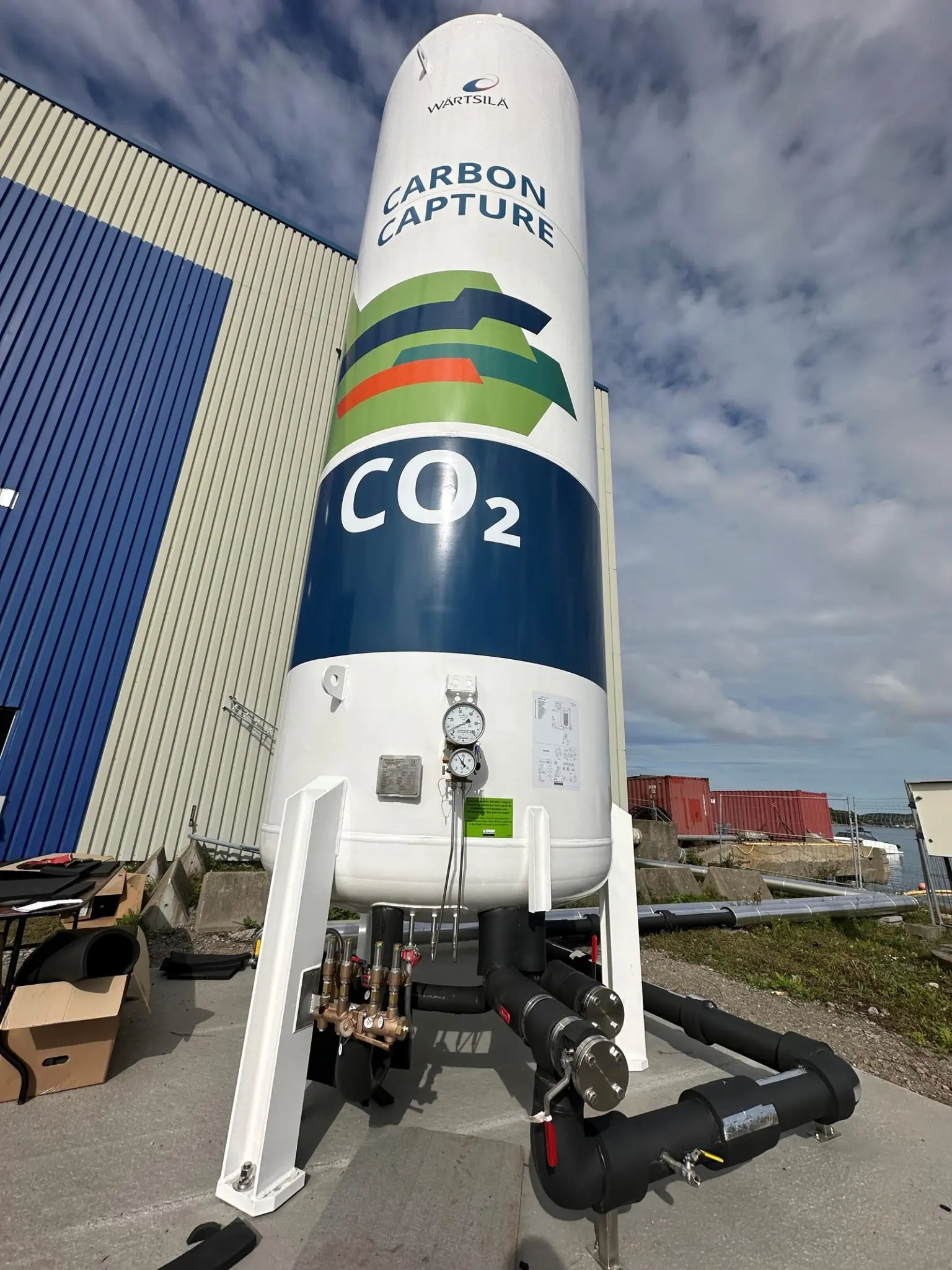
For CCS to work within ship exhaust systems, non-CO2 pollutants must be removed before reaching the CCS system.
Consequently, scrubbers have evolved from technologies primarily aimed at reducing sulphur emissions for human health reasons into versatile platforms ready to address shipping’s comprehensive environmental challenges, including NOx, and PM.
Installing scrubbers on vessels can therefore serve as a cost-effective and forward-thinking approach.
Far from being an ‘environmental diversion’ down the path of reducing SOx, NOx, and PM for human health reasons, we instead now have a familiar technology that can be adapted to meet our environmental challenges. The days of scrubbing being solely designed and operated to cut SOx below 2020 sulphur cap requirements have passed.
CCS-ready scrubbers offer the first building block as they allow for an efficient retrofit of a CCS system once the full system is launched to market and the technology becomes commercially available within the next two years.
State of play
Wärtsilä Exhaust Treatment is testing its CCS system at a shore-based test facility in Norway, aiming for a 70% CO2 capture rate, with a pilot installation scheduled within the next 12 months.
This testing phase has provided valuable insights into its operation and the advantages and disadvantages of various CO2 capture solvents.
While developing technology is one aspect, there is another challenge in understanding how to integrate the technology onto ships.
There are unique limitations, such as space and energy requirements, storage infrastructure and exhaust pre-treatment, that become relevant when dealing with CCS systems.
Wärtsilä offers the shipping industry its pioneering CCS feasibility studies, conducted by expert engineers who dedicate four to six months for research and design work. Their objective is to help vessel owners comprehend how to seamlessly incorporate CCS technology into their vessels when it becomes available.
These CCS feasibility studies encompass both newbuild and existing vessels. Once completed, they offer a comprehensive commercial proposal, which can be shared with shipyards to obtain precise installation quotations. The studies also serve as an educational tool, helping customers to understand the benefits and specific factors associated with installing CCS on their vessels.
Our industry’s path towards decarbonisation requires multiple solutions, and the integration of scrubbers with CCS technologies has the potential to be a vital and essential step towards achieving net-zero objectives and fostering a more environmentally friendly future for shipping.
This gives us good reason for optimism as we collectively strive to meet the IMO’s new environmental requirements.
Related Articles
 ACCESSORIES & EQUIPMENT
 ACCESSORIES & EQUIPMENT
 OTHER NEWS