

French panache for Thames Estuary pilots
Estuary Services Ltd (ESL) has celebrated the entry into service of two new French designed, British built pilot launches for operation in the demanding waters of the Thames Estuary.
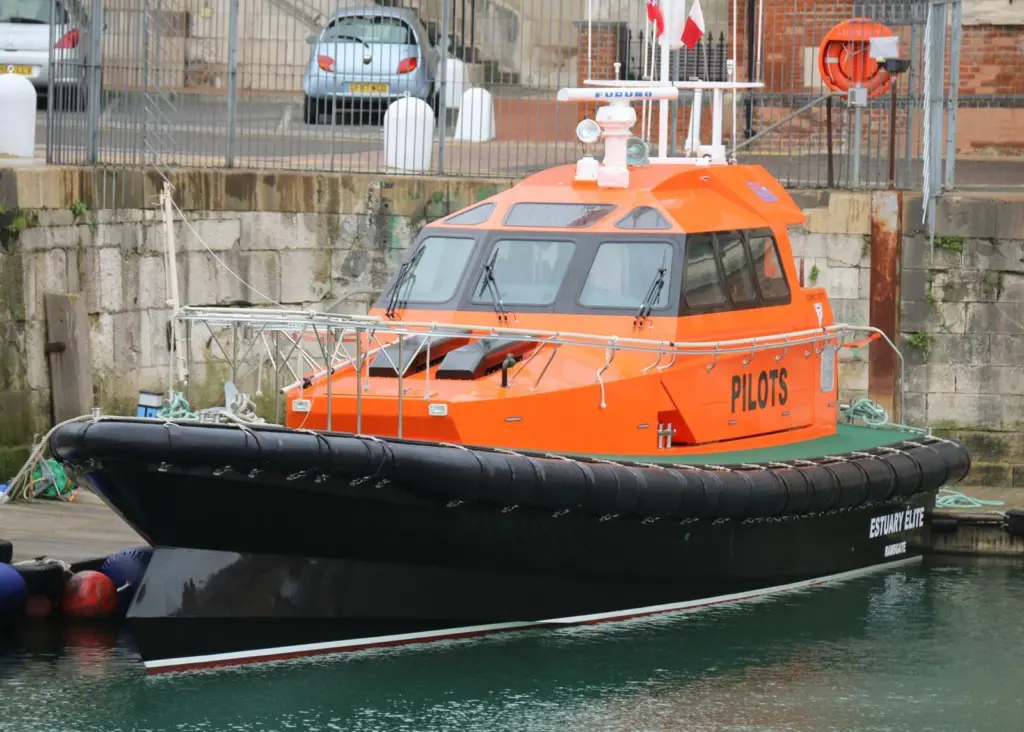
ESL is a 50/50 joint venture between the Port of London Authority and Port of Sheerness Ltd and operates pilot launches from Ramsgate and Sheerness serving shipping trading in and out of the busy ports of London and the Medway as well as Ramsgate.
In a low key, yet not insignificant event held recently at Ramsgate harbour, the two launches, Estuary Élan and Estuary Élite were namedby Lady Boyce, wife of former First Sea Lord and Admiral of the Cinque Ports, The Lord Boyce KG GCB OBE and Julia Everitt, wife of the Chairman of ESL, Richard Everitt.
Delivery of the Estuary Élan and Estuary Élite involves a £2m investment by ESL and can be viewed as significant in a number of ways. The ORC171.P 17m pilot launches are designed by Pantocarene Architecture Naval of France and built by Great Yarmouth UK based Seawork exhibitor Goodchild Marine Services Ltd, making the vessels the first of the design to be built by a British builder and the first to operate in UK waters. Both vessels were presented at recent Seawork International exhibitions. ESL is far from being pioneers of the design however, more than 50 examples built to various configurations now operating worldwide.
The hull is built from glass reinforced polyester with a double chine, the most visual feature of the design however is the forward beak bow, producing a combined planing and semi-planing hull. Vertical accelerations and slamming are reduced with this feature compared to conventional semi-planing hulls. The results are boats that are faster, more seaworthy and have greater range than their predecessors.
Both boats are working out of Ramsgate for the NE Spit pilot station, their area of operation presenting particular environmental conditions resulting in what at times can best be described as challenging conditions. Over 10,000 pilot transfers are carried out annually by the NE Spit pilot launches, serving ships sailing to and from the Thames and Medway. A typical round trip can be 20 or more nautical miles and the area includes busy anchorages in the Margate Roads and Tongue Anchorages. Areas of shallow water and conflicting tidal streams can at certain times lead to short steep seas demanding a boat able to deliver a comfortable ride at high speed while at the same time maintaining an efficient and, importantly, safe operation. The orientation of the tip of the north east Kent coast, and subsequent lee from south-westerly storms can result in the NE Spit station being the only one in the region able to remain on service and they are often called upon to land over-carrying pilots unable to disembark at pilot stations in Belgium and the Netherlands.
FUNCTIONAL LAYOUT
The wheelhouse is mounted on cushioned feet making an acoustically separate module adding to crew comfort at high speed. A degree of thought has clearly been given to the visual design of the wheelhouse resulting in a form that accommodates the requirement to avoid contact when alongside ships, while at the same time producing a pleasing and aesthetic visual impact.
Four watertight bulkheads separate the compartments below deck, access to which is via a ladder located port side aft (behind a watertight door); outside of the wheelhouse door itself. Immediately beneath the wheelhouse is the tank space containing among other things the battery compartments. Aft of this is the steering gear compartment. Forward of the tank space is the spacious engine room allowing easy access both inboard and outboard of the main engines. The engine exhausts are routed aft, each side of the boat through the tank space and steering gear compartments to overboard terminals in each quarter below the fender line. Immediately forward of the engine room is the accommodation space which with these examples contain only a Jabsco WC and wash hand basin along with the anchor cable reel, the line fed up to the deck through a spurling pipe. The final compartment is the forepeak.
A Hadrian Safety Rails system for the boats crew and pilots runs around the working deck and two Freeman Marine hatches allow access to the steering gear and accommodation compartments. The coach roof forwards of the wheelhouse houses a rope locker and air vents for the engine room.
The wheelhouse is spacious, light and well-appointed, a noticeable touch being the durable, teak effect laminate flooring. KAB 524C suspension seating with full restraint provision is provided for two crew and seven passengers, the coxswain’s position slightly raised and on the boats centreline forward. Doors and windows are supplied by Seaglaze. Cabin heating and front screen demisting is from a Passad heat exchanger system, a Dometic 240V AC air-conditioning system is also included. The wheelhouse interior is lined with Vinacoustic sound deadening vinyl.
The hull was built to Bureau Veritas HSC Code approval and build classification is to MCA SCV Code, MGN 280(M). Vital statistics include a length overall of 17.63m, hull length 16.44m, beam overall 5.36m, hull beam 4.74m, draught 1.48m and air draft of 6.6m. Vessel displacement is 23.6 tonnes light ship.
SPACIOUS ENGINEROOM
Power is derived from two Scania DI16 42M diesel engines, each developing 600bhp at 1,800rpm. The transmission line continues with two Twin Disc MGX 5135A 1.79:1 ratio gearboxes, Centaflex gearbox couplings and twin F51 stainless 2.5” diameter prop shafts driving CJR Propulsion 5 bladed MRKREVOLUTION.85 propellers. CJR Propulsion was also responsible for the twin semi-balanced rudders, powered by a Hypro Marine ECS twin-motor steering gear including twin option emergency steering provision. Stern gear also includes twin hydraulic 1,500mm x 350mm trim planes. Back in the engine room, exhaust silencers are Halyard lift-type complete with exhaust alarms. The port engine drives an Aura Systems AuraGen HD 8.5KW mains power generator which among other things powers two, 240V AC engine room fans. Engine room air filtration is provided by KPM-Marine. Throttle control is achieved via Twin Disc EC300 Quick Shift controls with a compact control head positioned to starboard of the coxswain’s seating position and includes a selector for trolling (maximum two knots), synchronised lever operation and cruise speed.
Two fuel tanks are positioned outboard, each side of the tank space with a capacity of 1,250 litres in each tank. At maximum speed (28 knots) fuel consumption is quoted as 206 litres/hour, at a service speed of 26 knots consumption falls to 152 litres/hour, ESL’s operational consumption is listed as 108 litres/hour. Service speed endurance is 15 hours with 10% reserve. Fresh water capacity is 60 litres.
The electronics fit is particularly well suited to the operational requirements of the boat. A Furuno NavNet system comprises two main screens with inter-switchable functions including radar, chart plotter, AIS, Furuno WS-200 weather station and interior and exterior CCTV cameras. The boats’ area of operation includes a number of VTS zones often requiring multiple VHF channel monitoring and two Sailor DSC/VHFs are fitted along with two handheld sets. A Sea Marshall MOB alert system is provided comprising individual lifejacket beacons and an on-board DF facility. The three heavy duty panorama pantograph DuroWipers fitted on both vessels are supported by a three year warranty. Three battery sets are provided: start, service and emergency with electrical distribution from a Swedish EmpirBus NXT system.
Returning to the spacious deck area, the nature of the work naturally requires a robust fendering system and a substantial cylindrical Ocean 3 fender has been selected, protecting the entire boat apart from in way of the Pantocarene designed MOB platform on the transom (operated from either the wheelhouse or a wandering lead control unit aft). A stainless steel, foldable mast houses Lopolight LED navigation lights and the wheelhouse roof is also home to a DHR 210 searchlight controlled via a joystick at the coxswain’s position.
Andrew Thompson, ESL operations manager said: “The Thames and Medway together form one of the largest port complexes in the UK, handling food, fuel and other of life’s essentials for people across London and the South East. Our job is to make sure that we provide a reliable service getting the pilots to and from the ships. The new launches will help us do that. They are more reliable, faster and use less fuel than our old boats. And most importantly they get the pilots to and from the vessels in greater comfort”.
Technical specification
Length overall: 17.63m
Beam overall: 5.36m
Draught: 1.48m
Power: 2 Scania DI16 42m
Service speed: 26 knots
By Peter Barker
Related Articles
 OTHER NEWS
 MARINE RENEWABLES
 ACCESSORIES & EQUIPMENT