![MaritimeJournal[Seawork]](https://www.maritimejournal.com/wp-content/uploads/2026/09/MaritimeJournalSeawork.svg)



Officer’s leg amputated after crane accident: Report
Operating a crane without safeguards on board a survey and supply vessel resulted in an officer’s leg being crushed then amputated, a report by the Marine Accident Investigation Branch (MAIB) has concluded.
In August 2022, the second officer of the UK-registered Kommandor Orca had his lower left leg crushed while operating one of the vessel’s rail-mounted deck cranes.
“His leg became caught in the crane’s rack and pinion traversing mechanism when he moved the crane aft for a lifting operation,” the report says. “A helicopter transferred the second officer to hospital, where his leg required amputation below the knee.”
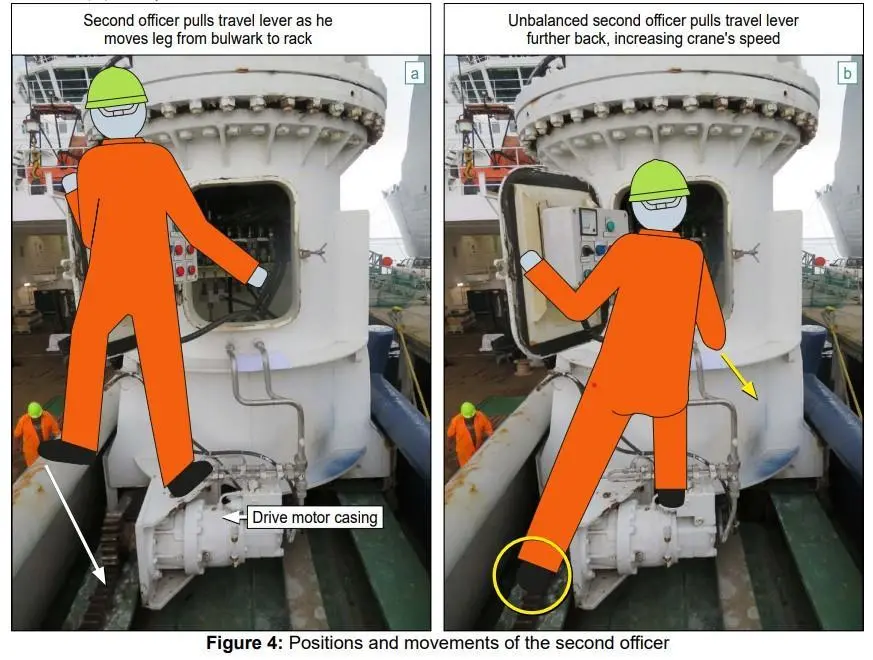
The second officer had already manoeuvred the crane to reposition two loads on deck, the report says, and while carrying out a third left, stood with his left foot on the inboard bulwark and his right foot on the crane drive motor casing so that he could see both the fitter and the load below, on the main deck.
He pulled the travel control lever to move the crane, at the same time moving his left foot from the bulwark to the rack – when he ’felt his left leg overalls being pulled, which unbalanced him and forced his right leg closer to his body’.
“He held onto the crane travel lever for balance, unintentionally pulling it further backwards, which increased the speed of the crane’s traverse,” says the report. “As his left foot and leg were dragged further into the rack and pinion drive, he let go of the travel lever, which stopped the crane, and then fell backwards,” trapping his left leg between the rack and pinion.
Emergency services were called and a helicopter took the second officer to hospital.
Instructions and measures
The report goes on to say that the crew’s ’inappropriate use of the crane controls’ – ie using controls designed for emergency only – was ’normalised behaviour’ and had been adopted for convenience.
“There were no instructions on board for the use of the crane beyond those stated in the manufacturer’s operating manual,” it says.
“The 2/O had 12 years’ experience at sea and had worked on inter-island ferries before joining the company in 2021. He had completed a 9-month contract on board Kommandor Iona (sister vessel) and had joined Kommandor Orca 13 days before the accident.”
He had used the crane three or four times before the accident, the report says.

“This tragic incident highlights the need for senior ship’s personnel to fully familiarise themselves with the correct operating procedures for all equipment onboard when joining a vessel,”said Captain Gary Clay, of Fathom Safety. “The manufacturers’ manuals are far too often overlooked or ignored, which in turn leads to ad hoc workarounds becoming established standard operating procedures.
“This incident also highlights the responsibility we all have for our own personal safety afloat. Ships have an abundance of potentially dangerous equipment on board. If an activity simply doesn’t feel safe or makes you uneasy then we need to stop the job and question our own actions.
“This young man’s life-changing, career-ending injuries underline the responsibility we all have to ensure shipboard safety is at the heart of everything we do and not merely a tick box exercise.”
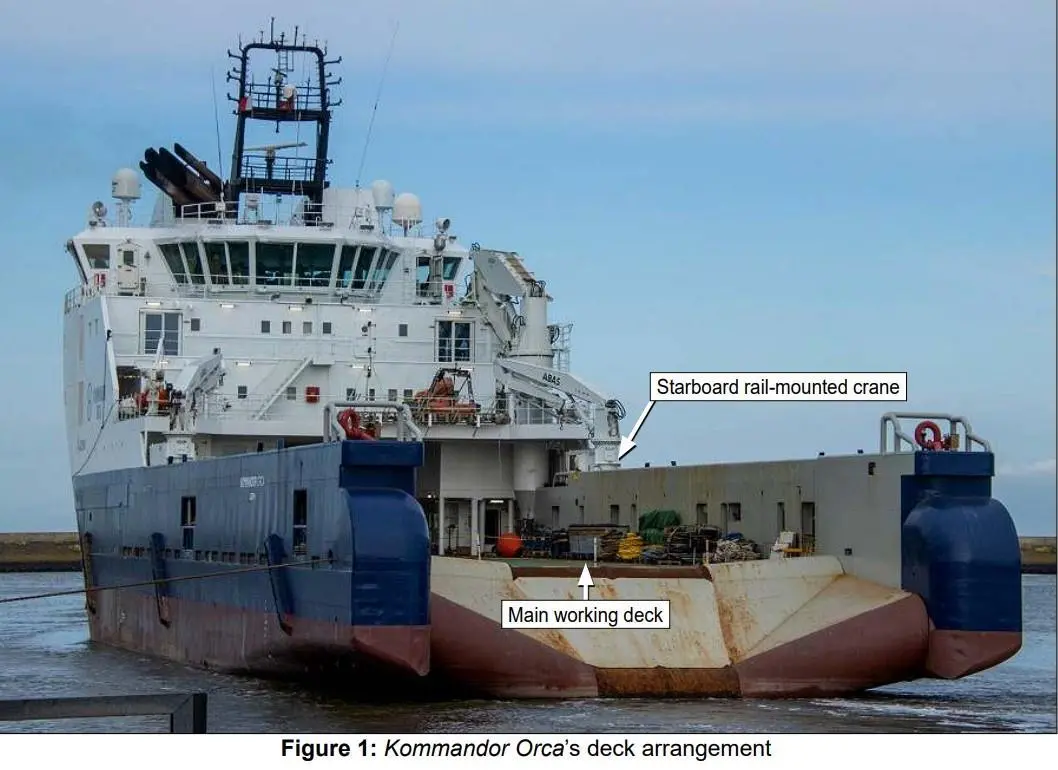
Hays Ships, the owner of the vessel, has introduced measures to prevent a re-occurrence, the MAIB report says, including fitting the vessel with guard rails and pinion guards, providing crews with instruction by an approved training organisation and amending sections in its SMS (Safety Management System) on crane operations.
Kommandor Orca was originally built as an anchor-handling tug supply vessel and had been in cold lay for up to 18 months with no crew on board, the report says, before Hays Ships bought it in September 2021.
After extensive preparations it sailed to Teesport, England, for surveys and inspection activities by the Maritime and Coastguard Agency. It was then converted to a survey and research vessel at a shipyard in the Netherlands before returning to the UK.
The full MAIB report can be seen here.

Related Articles
 SEAWORK NEWS
 INDUSTRY NEWS
 OTHER NEWS