![MaritimeJournal[Seawork]](https://www.maritimejournal.com/wp-content/uploads/2026/09/MaritimeJournalSeawork.svg)




Van Oord admits struggles in offshore wind sector
Net profits for 2024 were just a third of 2023’s record earnings, Van Oord CEO Govert van Oord, who replaced Pieter van Oord last year after 15 years at the helm, has admitted in the company’s annual report.
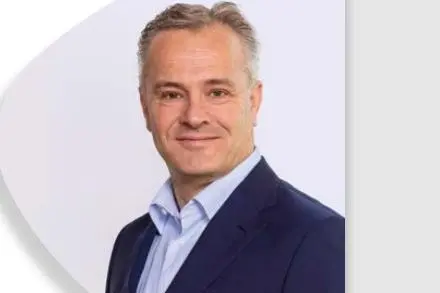
“Despite an overall strong operational performance, our net result fell short of expectations,” he said. “Revenue was €2.4 billion, in line with the annual plan but lower than the €2.9 billion record turnover in 2023. Our net profit was €42.5 million compared to €127 million in 2023.”
The Offshore Energy business unit, he said, ‘had a difficult year’, in large part because of problems with the Sofia Offshore Wind project, owned by RWE, off the east coast of the UK.
Van Oord was contracted to install 100 monopile foundations for the wind farm.
“The combination of unfavourable contract conditions and operational challenges resulted in substantial losses on this project, one that in every other respect is a significant positive contribution to the energy transition and society,” van Oord said.
However for this year, he said the Offshore Energy business unit is expected to see an increase in revenue driven by high fleet utilisation, ‘notwithstanding unforeseen circumstances in an increasingly uncertain offshore wind market’.
He also announced that Offshore Energy managing director Arnoud Kuis is stepping down.
Dredging, on the other hand, while also slightly down, remained stable, van Oord said, with healthy orders for 2025.
Calls for standardisation
The offshore wind market, van Oord said, has faced serious challenges because of technological advancements – notably with Chinese firms developing bigger and bigger turbines before the previous iteration even become standard.
“The value chain is calling for standardisation – specifically in turbine sizes, components and contract conditions – as it struggles to keep up with, and plan ahead for, rapid technological developments” he said. “We join that call for standardisation and believe it will provide the long-term perspective needed to move the industry forward. A positive step in this direction was made in 2024 when the International Marine Contractors Association established standardised contract conditions, signalling progress for the industry.”
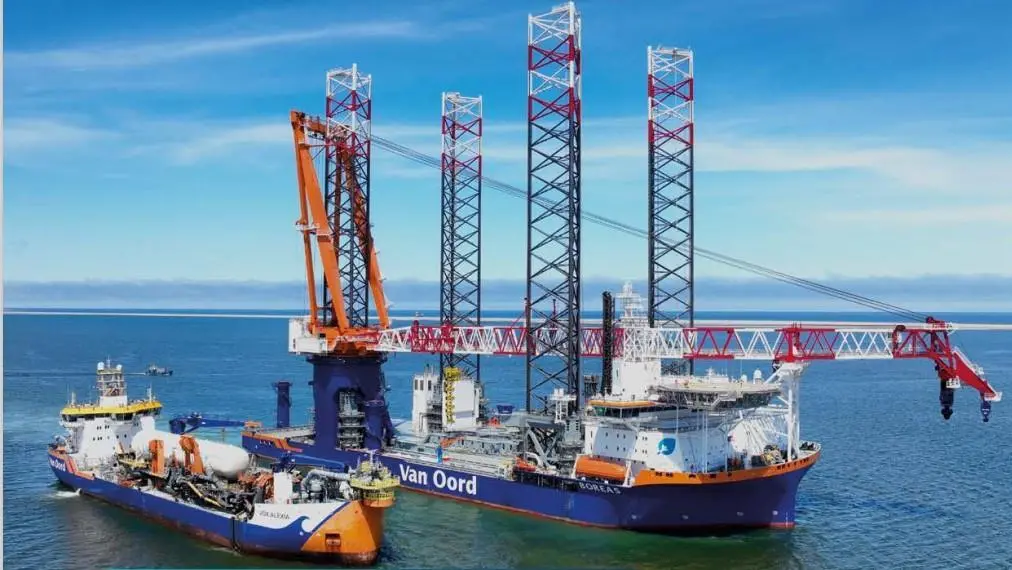
Van Oord highlighted the extension of its heavy-lift installation vessel Svanen, which the company says can install the newest generation of monopile foundations, and the sea trials of installation vessel Boreas, which is the biggest investment in the company’s history.
Other hurdles
Van Oord said there had been ‘a very difficult situation’ in 2024 with trailing suction hopper dredger Vox Maxima, which allided with a bunker vessel in Singapore, leading to a significant oil spill.
“The incident and subsequent oil spill was very unfortunate and has had a lot of impact,” he said. “While we are grateful that the incident did not result in any personal injuries, we acknowledge the hardships it has caused.”
Instability in the Middle East had also resulted in higher costs, with vessels having to be diverted away from the Suez Canal, van Oord said.
He also said that 2024 had seen an increase in the number of work incidents, although ‘the severity of the injuries was fortunately relatively low’.