


Inis Cealtra to help shape the Shannon
Mooney Boats has completed a new 22m Inland Waterways Support Vessel for Waterways Ireland, the body which has responsibility for the management, maintenance, development and restoration of the countrys inland navigable waterways.
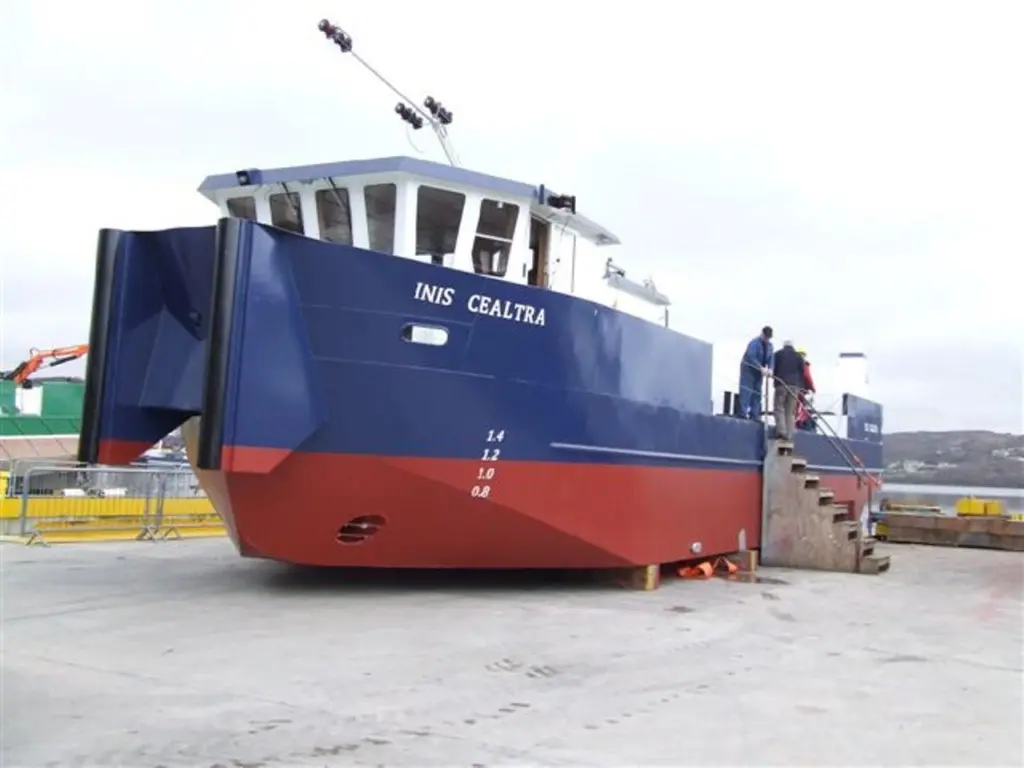
‘Inis Cealtra’ has been developed by a team working closely together to incorporate the operational experience of the owners with the newbuild development prowess of Mooney Boats and the design capabilities of Marine Design International (MDI).As is the case with many marine operators, Waterways Ireland gave high priority to the ability to fulfil multiple roles in order to keep capital outlay and operational costs to a minimum, without reducing capability.
Although Inis Cealtra must act as a traditional multicat type vessel, the hull form is developed to reduce wash as far as practicable for operations in Ireland’s narrow rivers while maintaining the high capacity of the more common square bow design.
As with the majority of MDI’s new designs, the steelwork was delivered as a kit of parts to help Mooney Boats to meet a tight build schedule and obtain a high level of accuracy in the finished product. The all steel tructure is designed to Lloyds Special Service Craft rules and survey was carried out by the Irish MSO.
The major restriction on Inis Cealtra’s dimensions was the Ardnacrusha Lock, which leads into the River Shannon system. The vessel will rarely transit this lock, so dimensions were set to allow it to enter the system with care. This provided the overall length of 22m and beam of 5.6m on a draught of just 0.98m.
The second design restriction was air draught throughout the Shannon system. In order to maximise vessel usability and the capability to access all sections of the system, a water level range was defined to cover the majority of conditions but excluding extreme high levels rarely encountered. An arrangement of four ballast tanks, two forward and two aft, allows the vessel to correct its trim and draught for a wide range of loading conditions.
One of the vessel’s main functions will be to undertake piling works during the replacement of navigation marks, an operation which dictated the inclusion of a model M230.20 Guerra marine crane, with 20.9 t/m capacity. It is mounted in a recess in the deck to keep within the air draught.
As on their recently completed workboat, Inish Davar, Waterways Ireland specified the inclusion of a Kranskan marine crane safety indicator for Inis Cealtra, supplied by Hook Marine in Scotland.
This device provides the crane operator with continuous visual indication of the load moment on the crane and of the vessel heel angle. Audible alarms warn of the approach to safe limits, leaving the operator free to concentrate on the moving load.
In addition, Waterways Ireland also specified an automatic cut-out function for this unit, ensuring that the load cannot be taken beyond the safe working envelope for the crane and boat.
Power for the vessel is provided by two Caterpillar C3056TA marine engines developing 185hp at 2,100rpm driving conventional shafts and propellers to enable a cruising speed of 7 knots and a bollard pull of 3.5 tons. Clements Marine supplied the stern gear and propellers.
Also to be found in the spacious engine room is a Caterpillar C2.2 marine generator. All engines are cooled by Klima box coolers recessed into the hull. At the front end of each engine, two separate electromagnetic Logan clutches are coupled to separate variable displacement hydraulic pumps driven through fenner couplings. These can be operated from the wheelhouse at the touch of a button.
The stainless steel hydraulic oil storage tank in the engine room has been fitted with return line and pressure line filters to maintain the quality of the biodegradeable hydraulic oil which supplies the entire hydraulic system and all machinery. The hydraulic system is also fitted with an offline cooling system which is automatically clutched in when the oil reaches a specific temperature to protect it from overheating.
There is a 270 litre air compressor fitted in the engine room which is run of the generator for the operation of air tools. Two fuel tanks of 3,700 litres each are also fitted in the engine room.
Forward of the engine room is a large storage room which has access from the main deck through a Hercules flush deck hatch. Forward of this compartment is the tank room, which contains a calorifier providing hot water to the toilet/shower room and the mess. The compartment below the deckhouse contains the freshwater, grey oily bilge water, and black water tanks. Each of these tanks is manufactured from stainless steel and all have been piped with separate discharge pumps. In this same compartment, ballast tanks have been built in as part of the structure. Ballast water is the only overboard discharge of any kind from the vessel.
The forepeak houses a Sidepower SP300 hydraulic bow thruster providing 270kg (660lbs) of thrust to allow accurate vessel positioning while working in fast flowing water. The thruster can be operated from both inside and outside the wheelhouse. The forepeak also has a flush deck hatch which allows the area to be used for storage.
On deck there are removable rails on the transom and large lengths along the side to allow working in a variety of positions. The deck is kept clear for cargo, with a load rating of 2.2 tons per square meter. There is a cruciform on the aft deck for use with the towing hook or the 3 ton towing winch. Position can be held by two 8m spud legs stowed on deck and put in position by the deck crane. Forward is a powerful anchor windlass used to help position the vessel in flowing water while undertaking marine civils operations. Two large pusher bows form the forward extremity, which will be used for moving barges carrying materials required for works being undertaken.
The deckhouse is kept well forward with access all round. To give aft vision over them from the wheelhouse, the workshop and toilet are sunk into the deck. This well equipped workshop is fitted with welding equipment and benches for a wide range of repair and maintenance tasks. This area has also been fitted with heating and lockers to keep the crew’s clothing and tools dry.
Forward is the mess, galley and a spacious helm area fitted out with wood effect veneer and oak trim, offering a high standard of appearance and comfort for crew and passengers. The galley area is fitted with electric cooker, fridge, sink and storage. There is seating for six at the table.
The skipper has a comfortable Nor Sap 1000 chair from which to watch over his electronic equipment. This includes an Icom M-401 waterproof VHF fixed transceiver, Furuno depth and speed smart transducer system, Furuno GP-7000 colour LCD GPS plotter, a CCTV System, two Entel HT640 handheld VHF radiotelephones, and a Furuno Model 1623 daylight viewing radar and compass. The skipper has control over all electrical systems, lighting systems, engine controls, thruster control and ballast pumping system, which can all be controlled from the wheelhouse through solenoid operated air valves.
The vessel has been built to a very high specification and will enter service after the completion of sea trials and a stability test this month, greatly increasing the capability of Waterways Ireland on the Shannon system.
Related Articles
 OTHER NEWS
 MARINE RENEWABLES
 ACCESSORIES & EQUIPMENT