![MaritimeJournal[Seawork]](https://www.maritimejournal.com/wp-content/uploads/2026/09/MaritimeJournalSeawork.svg)


Innovative harbour clean-up underway at Antwerp
The Flemish Government and the Port of Antwerp have launched AMORAS, one of the largest silt dredging and treatment projects of the world.
The project, launched in order to guarantee sufficient draught to shipping traffic in the Port of Antwerp for the coming decades, covers the entire process from dredging to responsible storage of the contaminated material, of which high volumes have to be dredged and stored annually. The process starts with one of the current dredgers of the Port of Antwerp depositing silt and sludge in a closed part of the harbour, the underwater depot.
AMORAS stands for Antwerpse Mechanische Ontwatering, Recyclage en Applicatie van Slib, which translates as Antwerp Mechanical Dewatering, Recycling and Application of Silt.
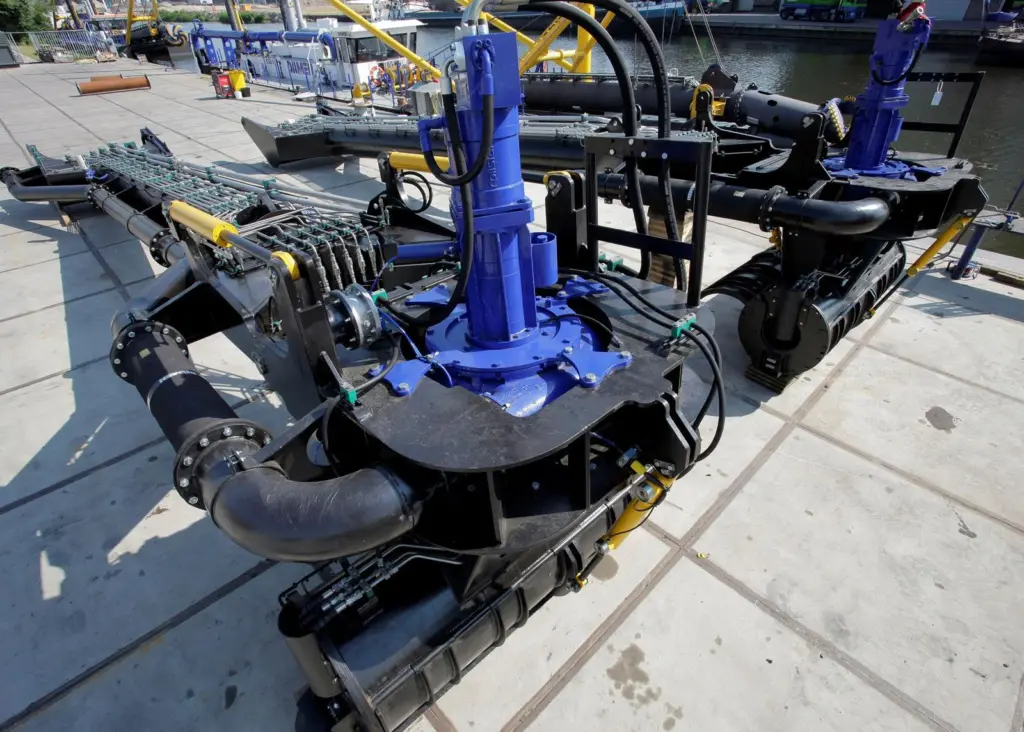
One phase is the storage of silt, which is to be consolidated at near its in-situ density. This storage is done in four wedge shaped settling tanks of 120,000 m3 capacity each. Over these storage tanks runs a fixed 173m long, 24m high bay, to which two controllable trolleys are connected. Attached to each trolley is a Damen Dredging Equipment ladder with integrated DOP submersible dredge pump.
Damen Dredging Equipment has delivered the two customised DOP submersible dredge pumps plus their ladders to joint venture company SeReAnt for the Antwerp harbour clean up project. Standard Damen DOP pumps are thus used in a customised application.
SeReAnt is a joint venture company in which Belgium’s two major dredging contractors, Dredging International and Jan de Nul, have combined the forces of their respective specialised environmental subsidiaries DEME Environmental Contractors and Envisan. SeReAnt will design and build the silt treatment and storage system, followed by the exploitation of the project for the next 15 years.
A Damen cutter suction dredger is located to pump the sediment continuously to a shore based plant where the sand is filtered from the sludge. The silt is then pumped to settling tanks where it dewaters to decrease volume. Then the two Damen DOP pumps fitted out with auger heads pump the material to a plant where the fully dewatered silt is pressed to filter blocks. These dry filter blocks are stored on land for eventual use in infrastructural works.
The standard 150 kW hydraulically driven dredge pumps of type DOP2320 have an average production of 1,000 cu/m per hour each. The working angle of the DOP pumps, which are identical and interchangeable, can be adjusted by means of a hydraulic cylinder. Depending on the amount of silt stored, it works at a maximum dredging depth of -6 m.
The ladder based DOP pump is fitted out with a hydraulically driven auger head to maximise the mixture concentration. The ladder integrates the DOP pumps discharge piping, plus its hydraulic piping and signal cables. The customer has chosen the DOP pump because of its compactness and because it has proven itself to be a reliable part of the long production line.
Related Articles
 ACCESSORIES & EQUIPMENT
 ENVIRONMENT
 MARINE CONSTRUCTION