![MaritimeJournal[Seawork]](https://www.maritimejournal.com/wp-content/uploads/2026/09/MaritimeJournalSeawork.svg)


Kanal Istanbul to go ahead
Turkeys Environmental Minister Murat Kurum recently confirmed that the country has approved development plans for a huge canal that would run parallel the Bosphorus.
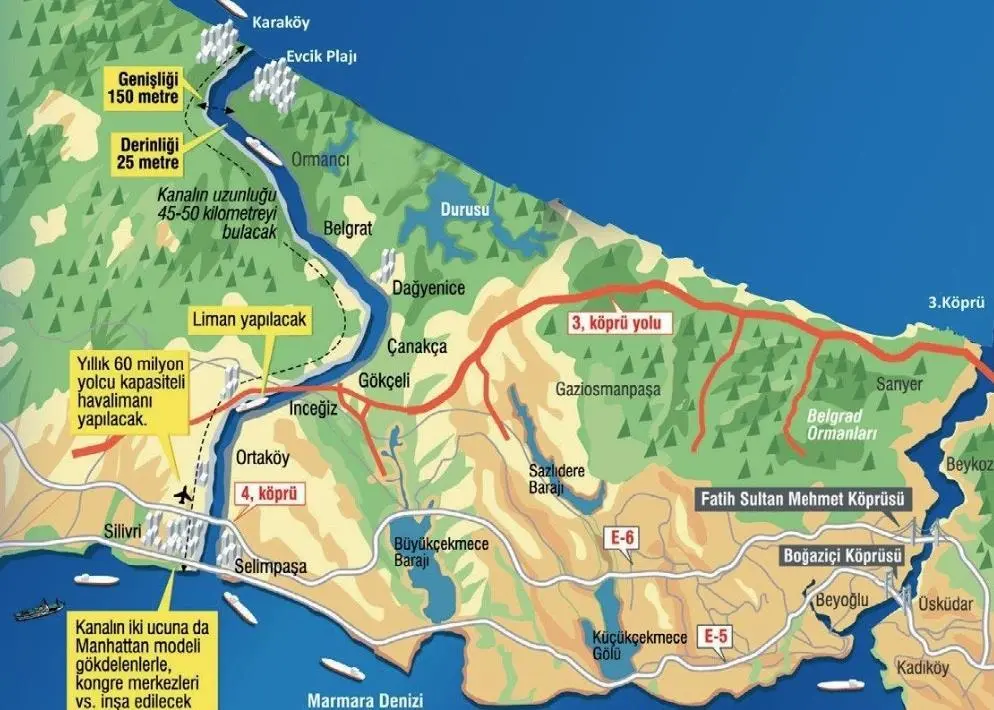
Kanal Istanbul is planned to run more or less north to south over a distance of approximately 25 nautical miles and it will increase the capacity for shipping to and from the Black Sea, connecting it to the Marmara Sea in the south and then on to the Eastern Mediterranean.
Proposals to build a canal linking the two seas have been talked about for many years. The canal is aimed at by-passing the busy Straits of Bosphorus and to reduce the delays for shipping on this route which features sharp bends and shallows. There have been proposals for four alternative routes for the canal and now after years of discussion and research the final route for the canal has been selected and the final approvals are underway.
The route planned is west of the Bosphorus Strait, and includes the area from the Kucukcekmece Lake to the Durusu region. This is on the outskirts of the city and it would be a sea level canal with no locks. Based on the current specifications for the canal it will have a depth of 25 metres and the width will vary from 250 to 1,000 metres. Spoil from the excavation work with be used to create new islands in the Sea of Marmara.
Studies are continuing about the potential earthquake risks on the waterway and the need to protect the entrances at both ends with breakwaters. Included in the project are up to five high level bridges and the development of the canal’s banks into a major logistics hub serving the Black Sea. It is expected that the total cost will be in the region of $9 million and it is likely that it will be financed by public-private partnerships.
Currently the Bosphorus handles around 160 transits per day with no charge for a transit under the Montreux Convention. It is anticipated that there will be a charge for the transit of the new canal with restrictions on the size and number of vessels allowed to transit the Bosphorus in the future.
By Dag Pike
Related Articles
 OTHER NEWS
 MARINE CIVILS
 MARINE CIVILS