![MaritimeJournal[Seawork]](https://www.maritimejournal.com/wp-content/uploads/2026/09/MaritimeJournalSeawork.svg)






Dutch combine flood defence with marine life
A Dutch engineering project is to be expanded following ‘an explosion of marine life’ that has been recorded in the four years since it started.
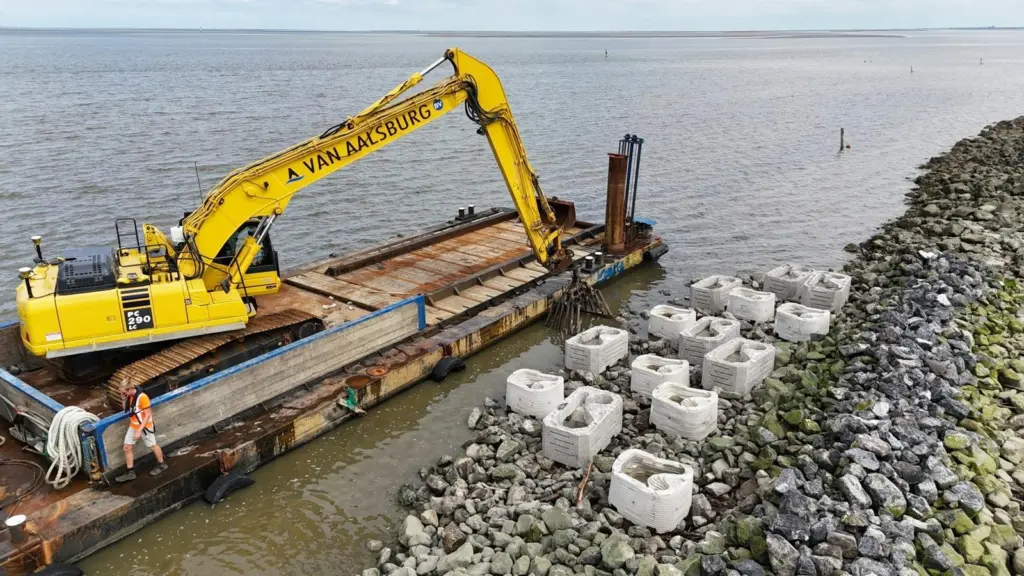
Artificial reefs and tidal pools have been created along the Lauwersmeerdijk, the largest artificial reef along a Dutch sea dyke.
“Since its first placement in 2021, an explosion of marine life has occurred,” says the Dutch water board, or Rijkswaterstaat.
“Fish, crabs, shrimps, shellfish and algae have now established themselves in and around the structures.”
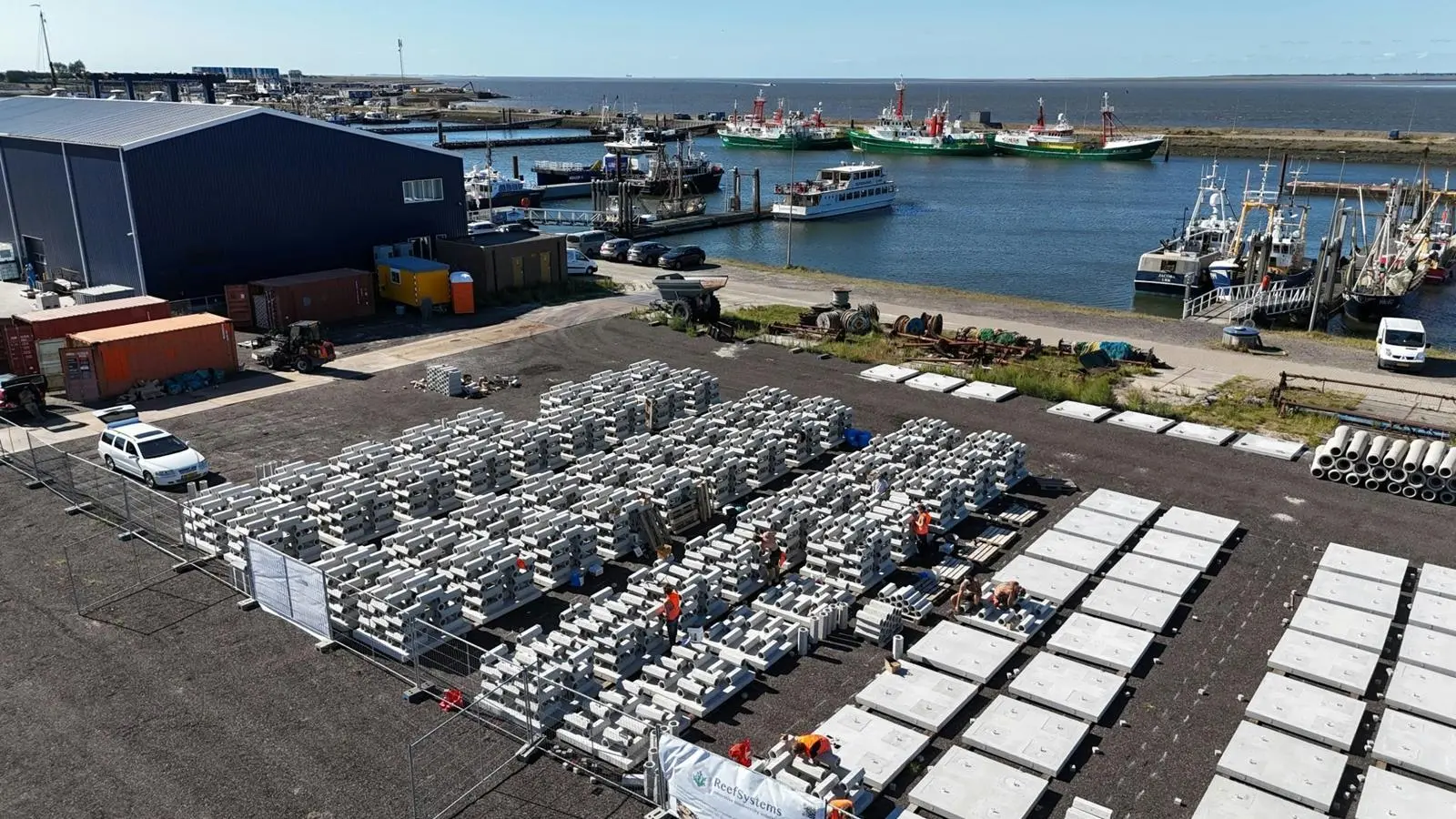
This autumn, the Noordersijlvest Water Board will expand the reef with another 290 reef elements and 132 tidal pools, giving the reef a permanent place at the foot of the dyke. Preparations are being made on the quay in Lauwersoog (pictured below).
“We see that the artificial reefs and pools are ecologically successful and form a new habitat for species. They provide shelter, resting and spawning places for fish and other organisms,” said Lies van Nieuwerburgh, ecologist at Rijkswaterstaat.
“Oysters, mussels, anemones, hydroid polyps and seaweeds attach themselves to the structures. This ensures more biodiversity and a more robust food web and ecosystem. In this way, the reefs are a valuable addition to underwater nature.”
As well as the reefs, a tidal area will be built to expand salt marshes along the dyke that will help reinforce it.
The project is part of the Lauwersmeerdijk Reinforcement and has been carried out in part by the Programmatic Approach to Large Waters (PAGW) and the Wadden Fund.
The reefs and pools are from ReefSystems, Econcrete and Moreef. The Waddenkwartier contractor combination of GMB and Heijmans is responsible for the construction of the reefs and tidal pools.
As well as the artificial reefs and tidal pools, a dyke passage and tidal area some 70 hectares in area is being created. The dyke passage connects a nature reserve in the Marnewaard with the Wadden Sea.
The tidal area provides a better habitat for various species of plants and animals. With the tidal area, we give the Wadden Sea a little more space.
For flood protection, the dyke passage will have a loch that can be closed at high water. A high-water quay will also be built.
Related Articles
 INDUSTRY NEWS
 MARINE CIVILS
 MARINE CIVILS