![MaritimeJournal[Seawork]](https://www.maritimejournal.com/wp-content/uploads/2026/09/MaritimeJournalSeawork.svg)





Engineers use tide as a tool to install city bridge
Few cities witness the arrival of a 3,000-tonne bridge deck by river. But in Nantes, residents watched as a steel span 150 metres long and eight storeys high was floated into position with remarkable precision, using the tide as a tool.
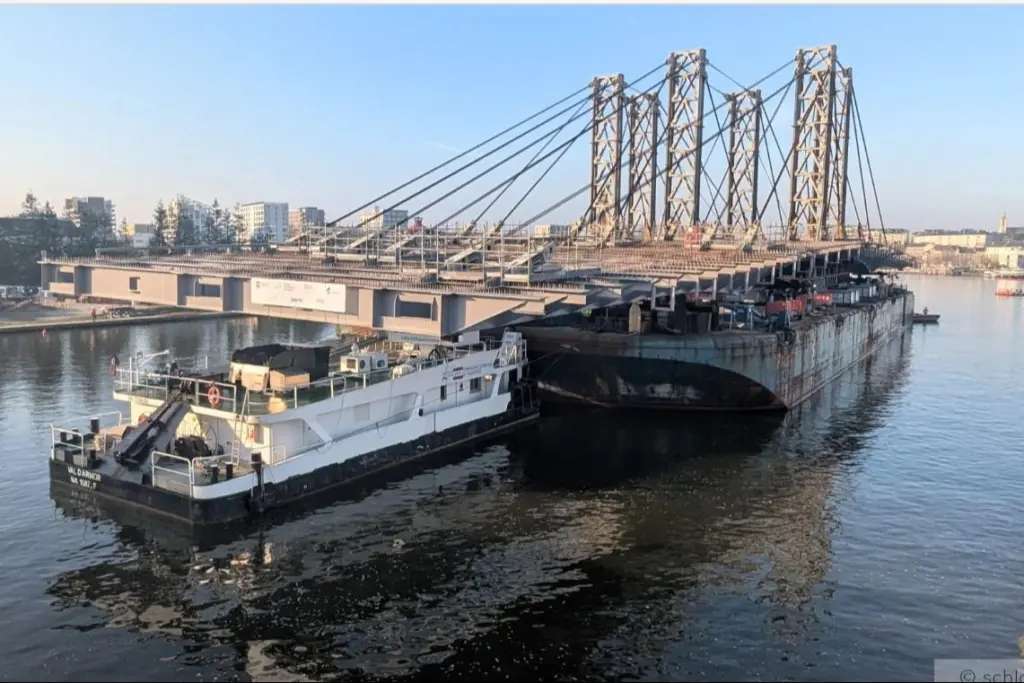
The installation of the new span for the Anne-de-Bretagne Bridge was not just another bridge lift. In several respects, it represented one of Europe’s most unusual urban marine engineering operations of recent years, according to civil engineers Schlaich Bergermann Partner (SBP), the brains behind the operation.
The project began with the need to replace or renew the river crossing, but rather than demolishing the the existing 1975 crossing over the Loire, the Nantes Métropole public authority decided to preserve it, lowering and repurposing the old pre-stressed-concrete bridge while building a new steel deck alongside it.
When finished in 2027, the combined structure will be roughly 53-54 metres wide – possibly the widest bridge in Europe – and carry tramways, cars, cyclists, pedestrians and even planted public spaces.
From fabrication to arrival
The steel superstructure was fabricated in northern Italy by engineering and fabrication specialist Cimolai. It was then shipped whole rather than assembled piecemeal on site, which is considered an unusual decision for such a dense urban setting as the French town of Nantes.
From the Adriatic, the deck crossed the Mediterranean and eventually headed into the Atlantic through the Strait of Gibraltar. It was here that inclement weather forced the project teams to adopt what they call an extraordinary logistics solution.
In Cádiz, the 3,000t, eight storey-high structure was placed on a semi-submersible heavy-lift vessel to go around the southwest coast of Spain and then safely across the Bay of Biscay, despite rough seas frequently delaying the voyage.
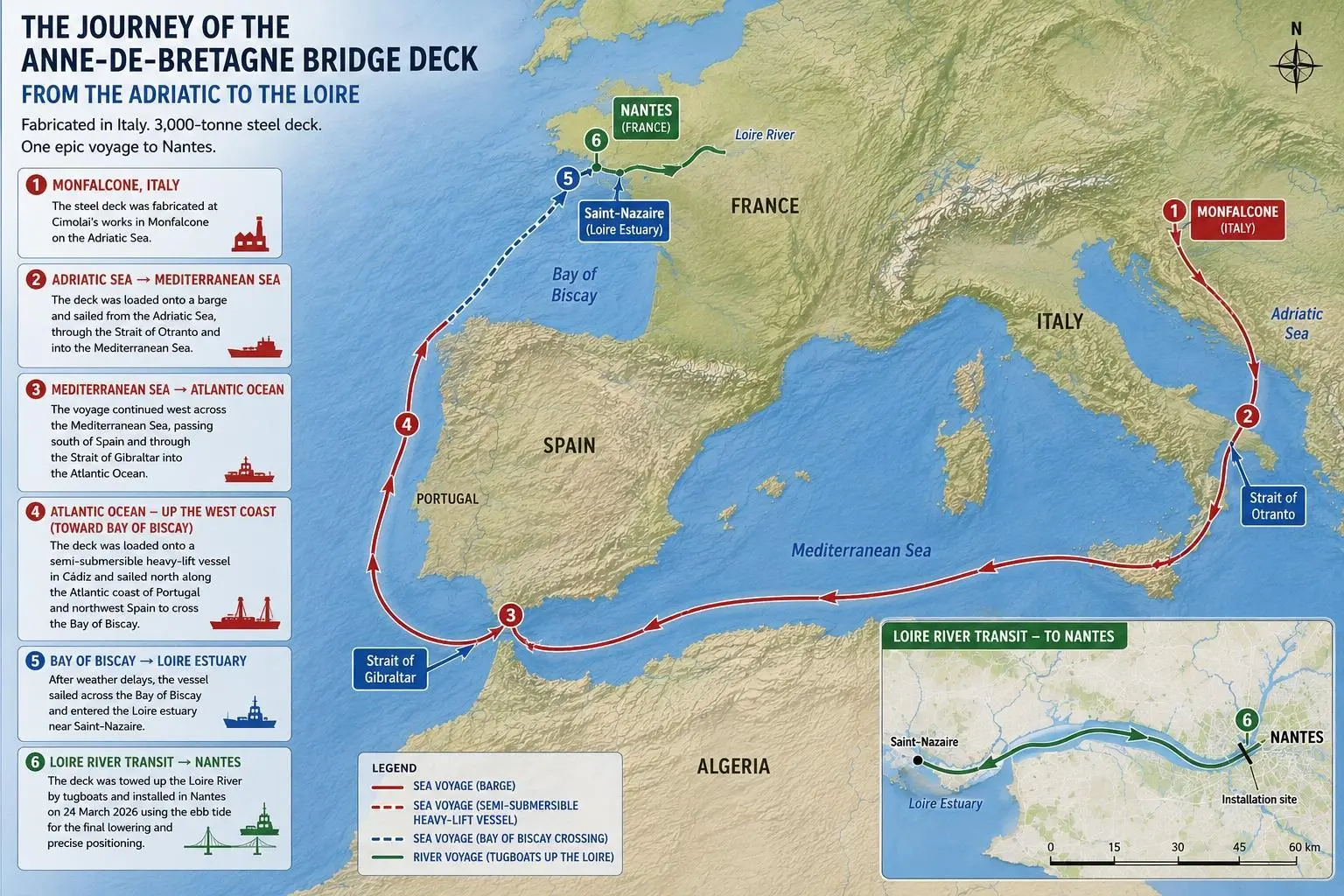
After arriving in the River Loire estuary, the structure was towed upriver to Nantes, its final resting place, where hundreds of residents lined the river banks to watch.
Using the river as a tool
Unlike many bridge installations, where giant crawler cranes or jack-ups take charge, Anne-de-Bretagne relied on the river itself as part of the lifting system. After tugs brought the deck upriver and into position, engineers transferred it onto self-propelled modular transporters (SPMTs), rotating the massive structure through a quarter turn before inching it toward its final alignment. The process demanded careful choreography in confined urban conditions.
Then an ingenious engineering detail: the Loire’s ebb tide became a natural hydraulic lowering mechanism. Instead of relying solely on mechanical jacking systems to place the deck onto its bearings, engineers deliberately timed the operation with the falling river level.
As the tide receded, the deck gradually descended under controlled conditions onto prepared supports, effectively allowing gravity and tidal variation to complete the final placement.
“Upon arrival at its destination, the deck underwent a meticulously choreographed installation process,” said SBP. “After a precise quarter‑rotation on mobile transporters, teams executed carefully controlled movements adapted to fluctuating water levels.
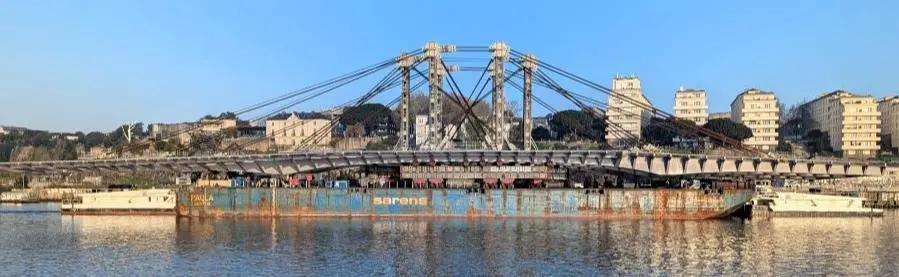
“In a final coordinated step, the structure settled naturally onto its supports, taking advantage of the ebb tide.”
The project also involved unusually demanding foundation work. The new deck sits on river piers founded on exceptionally large 2.4-metre-diameter piles drilled into the Loire, while the existing bridge still has to be lowered by 60cm and strengthened to align with the new structure.
The whole project is due to be completed in 2027, with phased openings possible before full commissioning next year.