![MaritimeJournal[Seawork]](https://www.maritimejournal.com/wp-content/uploads/2026/09/MaritimeJournalSeawork.svg)





INTERVIEW: In defence of coastlines – the asphalt answer
For more than three decades, Roger Smith has worked in developing solutions to coastal erosion and flood defence.

Now managing director of the UK-based erosion protection and hydraulic engineering company Hesselberg Erosion Protection, which is part of the international Ancora Group, one could say that fears over rising sea levels have made his career rather fortuitous.
Hesselberg designs and installs asphalt-based and rock-asphalt systems for coastal defences, reservoirs, dams, rivers, ports and inland waterways, providing early-stage technical advice through to construction, with a focus on durability, constructability, maintenance and low-carbon performance.
In an interview with Maritime Journal, Smith talks about his company’s asphalt erosion solutions, storms, and reservoirs.
Asphalt solutions
Hesselberg, originally a Norwegian company, was run by two Dutch directors before Smith came along. The technology developed was Dutch, and they used excess bitumen from refineries as their material because there wasn’t a lot of rock available.
“Some clever chap realised that if they could use a bit of rock and bitumen you could provide a defence rather than using a lot more rock,” Smith says.
And this is Hesselberg’s main answer – stone asphalt, which Smith argues is in many cases a better bet than rock.
“It’s a porous asphalt we use on sloped revetments, sea walls, dams, reservoirs, says Smith. The porosity is key.
“When waves hit it, the voids absorb energy,” he says. “But just as importantly, it relieves hydrostatic pressure when the tide goes out. That means we can design thinner structures using less material, and they last longer.”
Smith says the reality of asphalt is different from the perception that because it is oil based, it is worse for the environment than rock.
“People think bitumen equals high carbon, but that’s not necessarily true,” he says. “Compared to reinforced concrete, we’re about a quarter of the carbon. Even compared to rock armour, we’re often significantly lower.
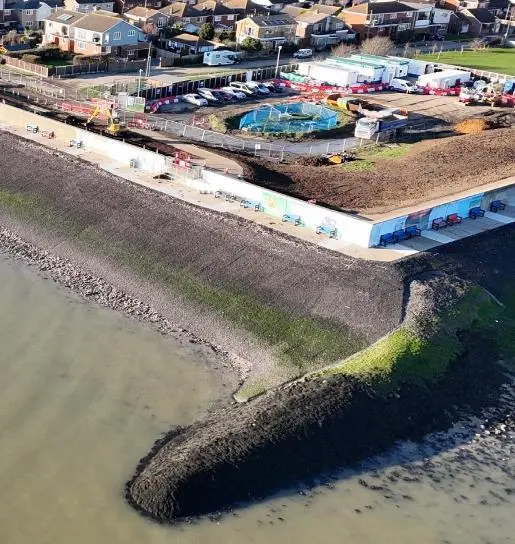
“We completed a huge scheme on Canvey Island last year, where we used in the order of 90,000 tonnes of asphalt. The Environment Agency’s carbon assessment showed our solution at about 12,500 tonnes of CO₂ equivalent, compared with nearly 19,000 tonnes for a rock armour option – which would also have meant importing rock from Norway.”
Reservoirs
Hesselberg has also played a major role inland, particularly in reservoir engineering, which will become more important in times of water scarcity even in a country as wet as the UK.
“Reservoirs are an incredible asset,” Smith says. “They last hundreds of years, they create habitats, support recreation. I’ve never stood next to a reservoir and thought, ‘this is horrible’.”
But they can take years to even get approval for, let alone build, he says, citing examples of approvals and planning taking years to get nowhere.
One flagship project was the expansion of the Abberton Reservoir in Essex, which was not completed until 2013 despite being conceived more than a decade earlier.
“They raised the water level by 3.2 metres,” Smith says. “The circumference was about 10 or 11 kilometres. They had to raise a causeway, build four new auxiliary dams – it was huge. We were involved from the concept stage in 2004, but didn’t go on site until 2011. That’s not unusual.
“If clients bring in contractors and specialists early, it leads to smoother construction and better outcomes. Too often we’re still designing for the short term, when habitats and coastlines evolve over centuries.”
Vulnerable countries and coastlines
While the low-lying Netherlands is often thought of as the gold standard in flood defence engineering, Smith says the UK faces similar – if less dramatic – challenges.
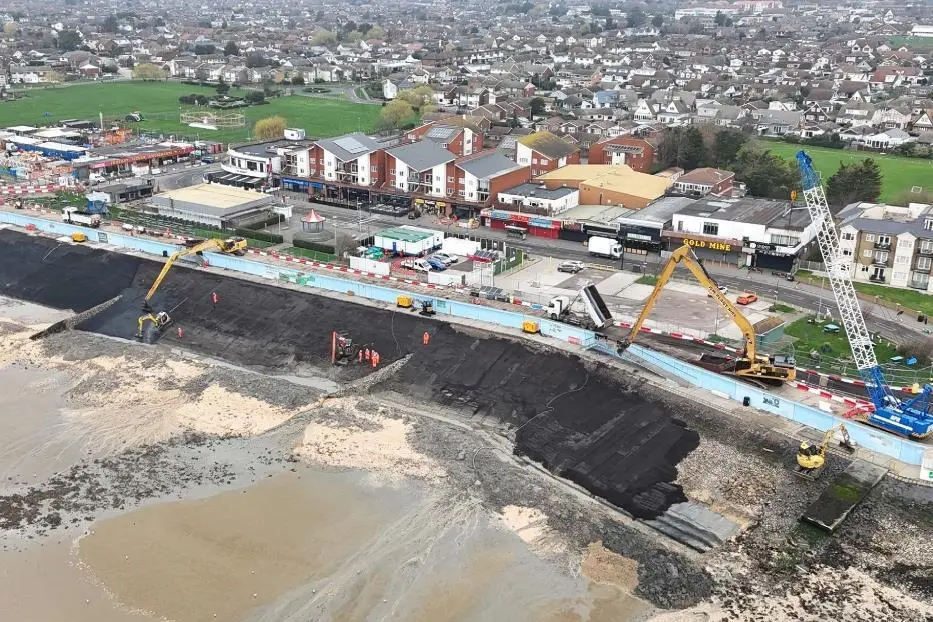
“We’re not as extreme as the Dutch, but the principle is the same,” he says. “Large areas of farmland and whole communities depend on embankments holding firm.”
Hesselberg’s erosion solutions are particularly aimed at vulnerable coastlines.
“That’s where the increased load loading, hydraulic loading from storms, is – storms don’t just mean bigger waves – they also have an effect on beach levels, lower foreshore levels, expose existing structures and that can lead to rapid failure of sea walls.”
So which are the most at-risk areas in the UK, especially given that the UK appears to be ‘tipping’ slightly, with Cornwall in the southwest rising and the southeast sinking?
“North Kent, Essex, Suffolk, Norfolk and Lincolnshire,” he says. “These are soft coastlines, often reclaimed land, and in many places the land is actually below mean sea level. Embankments are critical for maintaining arable land there, and also the communities there.”
As storms intensify and political urgency waxes and wanes, Smith believes action will come when people see the change with their own eyes.
“Every big flood raises awareness,” he says. “People can see it happening. If we want safe communities and reliable water supplies, we have to invest – and we have to do it properly.
“Every winter there’s a flood, storm damage, something in the news almost daily. One of my first projects was repairing a revetment damaged by the great storm of 1987. That kind of event used to be exceptional. Now it’s part of the pattern.”