![MaritimeJournal[Seawork]](https://www.maritimejournal.com/wp-content/uploads/2026/09/MaritimeJournalSeawork.svg)


Phase B of Yangtzekanaal widening begins
The second phase of major works to expand the Port of Rotterdam to accommodate larger and an increasing number of vessels has begun.
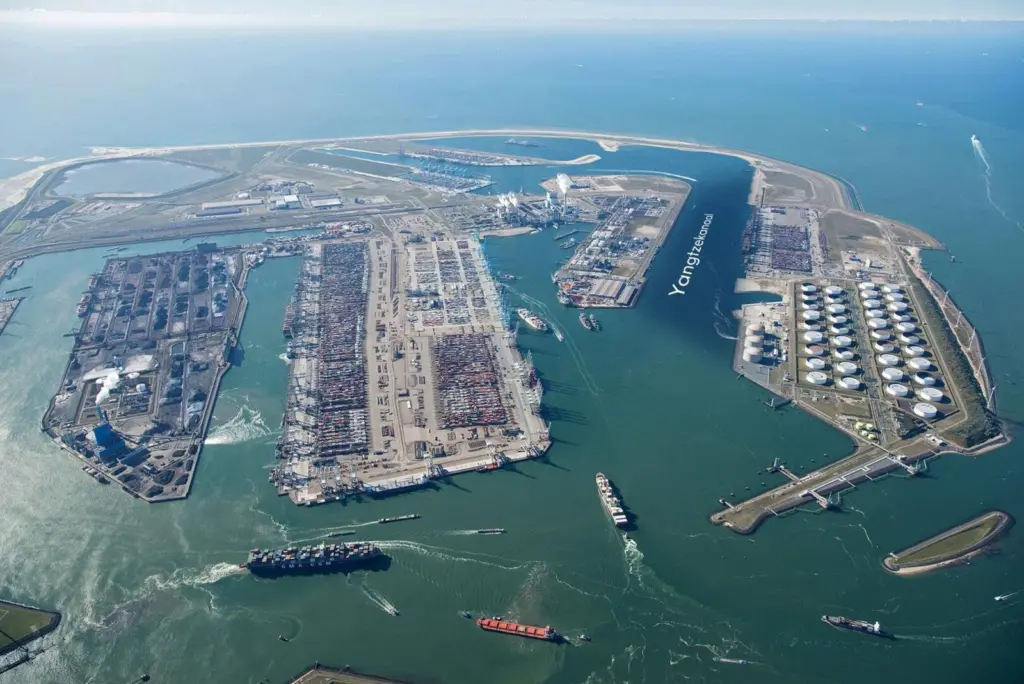
Phase B of the Yangtzekanaal Widening Programme has begun so that container ships can navigate the so-called Yangtzekanaal in greater numbers and dimensions towards the Maasvlakte 2 terminals.
The entire length of the 600m Yangtzekanaal, which was created in 2012 to connect the Beerkanaal with the Maasvlakte II port basins and provides access to Prinses Amaliahaven, Prinses Arianehaven, Prinses Alexiahaven, and Prinses Margriethaven, will be widened over the next few years.
In Phase A, which is coming to an end, 500 metres of quayside for 12 tugs, including shoreside power, has been built – but this is dwarfed by Phase B, which will see 1,450 metres of quayside built for inland vessels, also including shore power. This will have 30 berths for various vessel sizes.
The works have not been without challenges.
“Despite thorough preparation, the ground reacted unpredictably during the piling of the quay wall with 30-metre-long pipe tubes,” said Adriaan Smitsman, project engineer at the Port of Rotterdam Authority, referring to Phase A.
“The vibrations turned out to have too great an effect on the surroundings, as the layering of the sand and clay produced unexpected effects,” said Construction manager Gauke de Vries. “A nearby warehouse was at risk of subsidence as a result. We had no choice but to temporarily suspend the works.”
The construction team solved the issue by digging a 30m deep trench and pumping a mixture of cement and bentonite into it, resembling the texture of yoghurt, then sinking the foundation pipes and sheet piles in place. De Vries said the procedure, which was done by engineering firm Witteveen + Bos, had never been done before on such a large scale for a structural wall.
The final phase, Phase C, will begin after 2028 and will involve dredging to widen and deepen the waterway, allowing two-way traffic for two Future 1 vessels up to 30,000 TEU with a maximum draught of 17.3 metres.