![MaritimeJournal[Seawork]](https://www.maritimejournal.com/wp-content/uploads/2026/09/MaritimeJournalSeawork.svg)
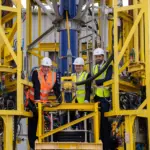

Royal send-off for a decommissioned lighthouse
The removal of the Royal Sovereign Lighthouse combined heavy lifting, diamond wire cutting and real-time engineering adaptation to deliver one of Britain’s most technically demanding marine decommissioning projects, offering lessons for a rapidly emerging offshore decommissioning market.
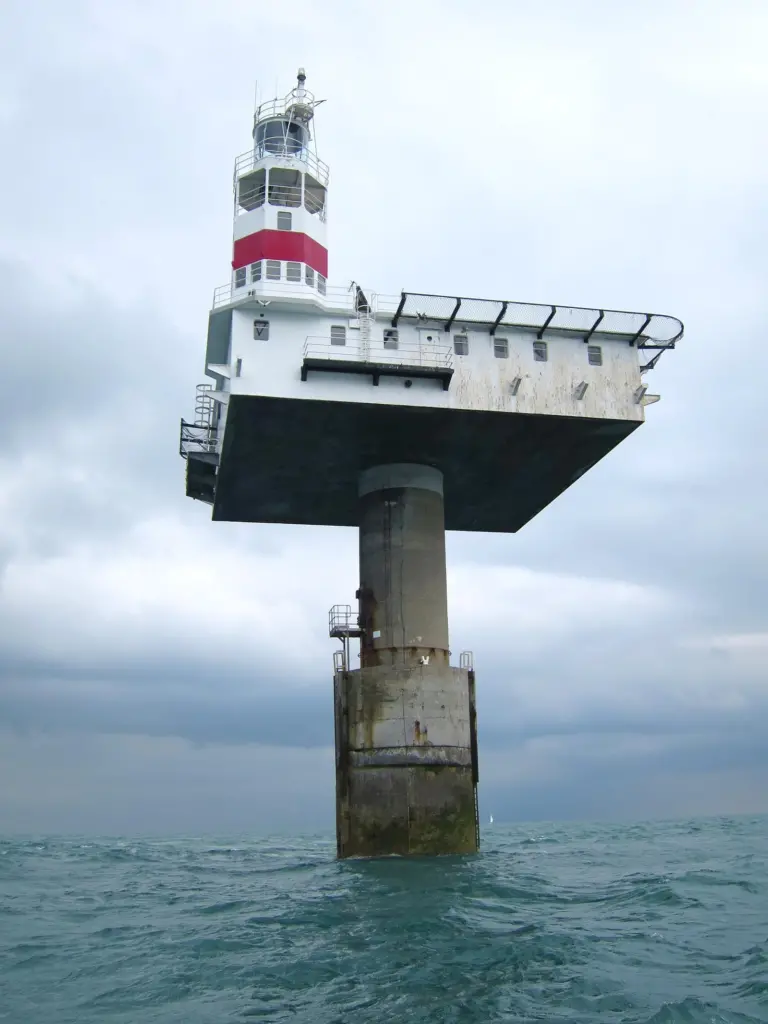
Seven miles off the Sussex coast, engineers faced an unusual challenge: dismantling a 50-year-old lighthouse that had become a familiar fixture of the English Channel.
The outcome wasn’t just a demolition project: it was a case study in how the marine construction sector may approach an increasingly important market – the removal of ageing offshore assets.
Dismantling a landmark at sea
For more than half a century, the Royal Sovereign Lighthouse stood guard over one of the busiest stretches of water in Europe.
About seven miles offshore East Sussex, in the English Channel, the structure had operated as a navigational aid since 1971, a landmark for mariners and coastal communities alike.
But like much of Britain’s first generation of offshore infrastructure, its operational life had come to an end.
The decision by Trinity House to decommission the lighthouse presented a challenge that extended far beyond conventional demolition: Royal Sovereign was not within a sheltered harbour, accessible dock or protected estuary; and it occupied an exposed offshore site where engineering decisions would be influenced by tide, current, vessel movement, weather and the unpredictable behaviour of an ageing asset that hadn’t been designed to be dismantled.
For Herbosch-Kiere, appointed to undertake the works, the task effectively became an exercise in reverse engineering.
The project was ultimately delivered in two distinct phases. The first involved removing the lantern tower and accommodation unit. The second centred on dismantling the lighthouse’s substantial post-tensioned concrete support pillar, a process that would eventually require the structure to be cut into nine individual sections before being lifted, transported ashore and recycled.
Neither phase could rely upon standardised methodologies.
The challenge of removing the lantern tower and accommodation unit was not principally one of weight.
“It was incredibly challenging because we were effectively lifting a structure that had been standing offshore for more than 50 years,” Business Development Manager Ash Hurrell told Maritime Journal.
“The key issue wasn’t simply the weight of the asset; it was understanding how the structure would behave as it transitioned from its original support arrangement to becoming a suspended load.”
The topside structure had spent decades responding to wave loading, wind action and the gradual deterioration associated with a harsh marine environment. Once disconnected from its original support system, its load paths would fundamentally change.
The temporary works design therefore became a critical element of the project.
“The temporary works solution had to safely support the topside throughout the cutting process, control load transfer and ensure that once separation occurred, the structure behaved exactly as predicted,” Hurrell said.
“Offshore lifts of this nature leave very little room for error. Everything from structural behaviour and lifting geometry through to wind conditions and vessel movements had to be understood and managed.”
To undertake the operation, Herbosch-Kiere assembled a highly specialised fleet.
Phase One used a 1,000-tonne jack-up barge alongside the heavy-lift vessel Gulliver, capable of lifting up to 4,000 tonnes. Supporting marine crews, lifting specialists, surveyors and project engineers worked within narrow operational windows dictated by offshore conditions.
The eventual successful recovery of the lantern tower demonstrated that complex offshore structures reaching the end of their service lives can be dismantled in a controlled manner while preserving important heritage elements.
Indeed, rather than being scrapped, the lighthouse lantern itself has been retained and is intended to form part of Bexhill Maritime’s proposed Maritime Coastal Environment Centre, ensuring that an important piece of maritime history survives beyond the life of the structure itself.
But if Phase One demanded detailed planning, Phase Two would test engineering adaptability to an even greater extent.
Engineering for the unknown

The removal of the lighthouse’s post-tensioned concrete support pillar had been designed around a carefully developed methodology involving diamond wire cutting and sequential lifting operations. However, as work progressed, engineers began to uncover conditions that had not been anticipated.
“The most significant discovery was the condition of the post-tensioning tendons within the concrete pillar,” Hurrell said.
“As works progressed, we encountered loose tendons within ungrouted sheaths, which introduced both structural uncertainty and practical challenges during the cutting operations.”
The implications were potentially serious.
Diamond wire systems depend on predictable cutting paths. Loose tendons created the possibility that strands could snag, interfere with the wire or damage cutting equipment. More fundamentally, they raised questions regarding the residual behaviour of the pillar as individual sections were progressively removed.
In many construction environments, discovering such conditions midway through a project can trigger significant programme disruption, redesign delays and contractual disputes.
Offshore, where vessels, crews and equipment are mobilised at considerable cost, the stakes are even higher.
Hurrell said the project team deliberately resisted the temptation to push ahead with the original plan.
“Rather than forcing the original methodology, the team adopted an evidence-led approach.
“Additional inspections, engineering reviews and lift-capability assessments were carried out throughout the works, allowing the removal sequence to be adapted as our understanding of the structure developed.”
That philosophy became one of the defining characteristics of the project.
“Offshore projects rarely go exactly as planned, particularly when dealing with ageing assets that were never designed to be dismantled,” said Hurrell.
“The key was maintaining close collaboration between the client, designers and delivery team, ensuring decisions could be made quickly while preserving safety, programme certainty and operational control.”
Cutting concrete in a moving environment
Dismantling the post-tensioned concrete support pillar required engineers to manage a problem that was arguably even more complex: cutting apart a marine in a constantly moving environment.
Diamond wire-cutting techniques are well established within heavy civil engineering, but applying them offshore introduces an entirely different set of constraints. Every operation must be synchronised with tidal cycles, sea states, diving windows and lifting capacity, while also accounting for the behaviour of a structure that is progressively losing its original continuity.
“This was one of the biggest engineering challenges on the project,” Hurrell said.
“The pillar wasn’t simply cut and left unsupported; every stage of the sequence was carefully engineered and verified before work proceeded.”
On land, engineers can often stabilise partially dismantled structures with extensive temporary works anchored to the ground. Offshore, opportunities for intervention are much more limited. Any instability can quickly become a marine hazard, particularly when heavy lifting operations are under way.
To mitigate these risks, the project team developed a carefully controlled transition process that ensured individual sections remained under positive control as they moved from being part of the standing structure to becoming crane-supported loads.
“We installed lifting trunnions into each section before cutting was completed, allowing the crane to effectively take control of the section as it transitioned from being part of the structure to becoming a lifted load,” Hurrell said.
The trunnions were only one component of a wider temporary works solution. Engineers also designed a bespoke cutting frame intended both to stabilise the pillar during the cutting process and to maximise available working time above the waterline.
“Offshore, you can have the best plan in the world, but weather, sea state, current and tidal conditions ultimately dictate what you can safely achieve,” Hurrell said.
The project’s diving operations were confined to narrow slack-water periods, typically extending for around an hour either side of slack tide. During these periods, divers installed lifting components, undertook inspections and supported cutting operations.
Meanwhile, lifting activities themselves were managed through strict operational criteria.
“Lifting activities were only undertaken when conditions met strict Go/No-Go criteria,” Hurrell said. “If conditions changed, we stopped.”
With offshore projects operating under considerable commercial pressure, mobilised heavy-lift assets, specialist crews and jack-up barges represent substantial daily costs, creating an inherent temptation to maximise deployment. The Royal Sovereign team took a different view, prioritising procedural discipline over production targets.
“Every component was selected and engineered specifically for the challenges of working safely on an ageing offshore structure in an exposed marine environment,” said Hurrell.
The result was the successful dismantling and removal of all nine concrete sections, allowing the project to progress into what has become one of its most notable achievements: an almost complete recovery of materials.
Offshore decommissioning blueprint
The UK now faces an emerging wave of decommissioning activity. Oil and gas installations continue to approach the end of their economic lives, while the country’s first generation of offshore wind assets will increasingly require removal, repowering or replacement over the coming decades. Foundations, substations, transition pieces and associated marine structures represent a substantial pipeline of future work.
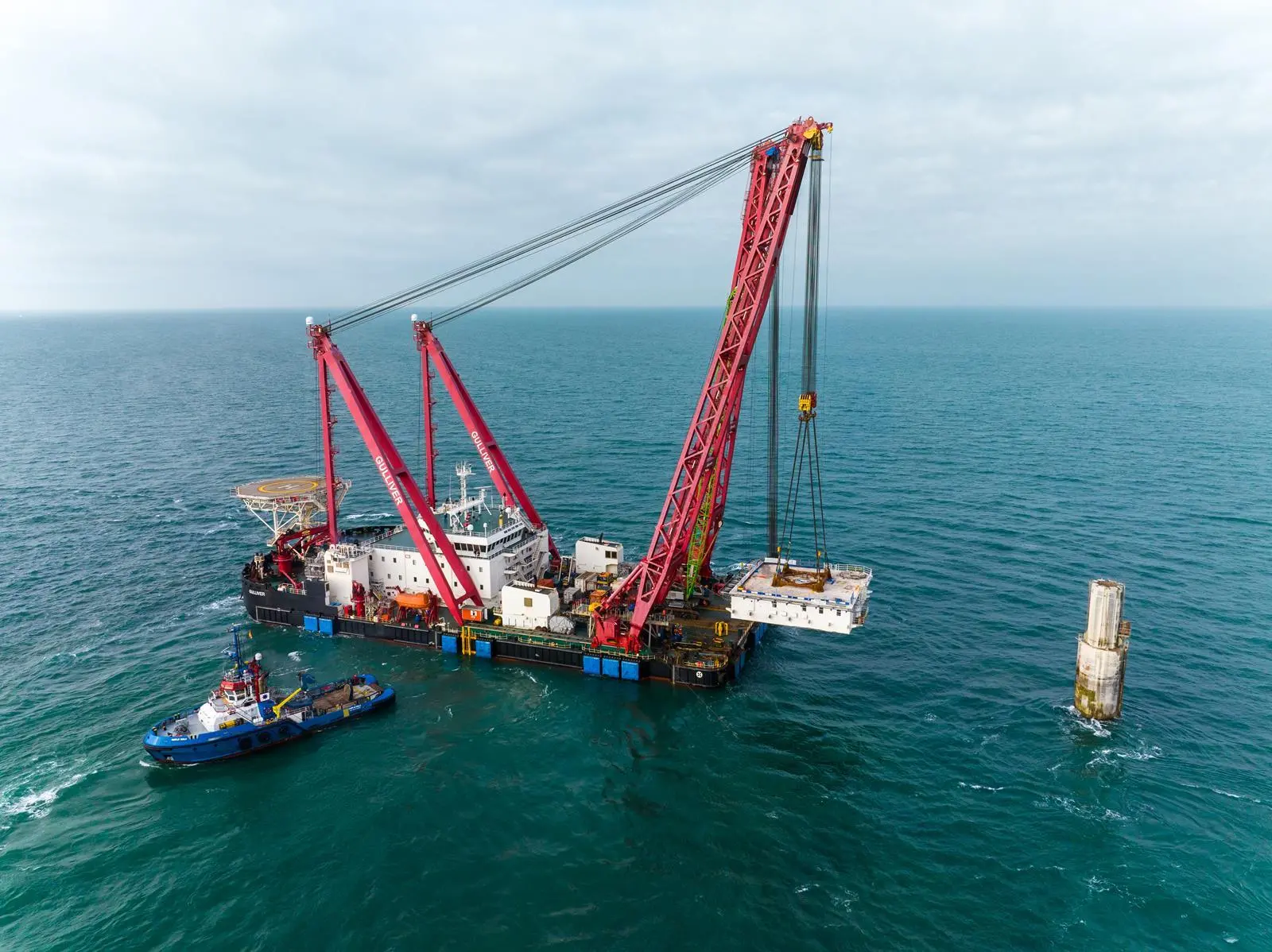
Herbosch-Kiere believes many of the techniques developed at Royal Sovereign are directly applicable to this growing market.
“Many of the lessons learned are directly transferable,” said Hurrell.
“The principles of offshore lifting, temporary works design, structural verification, controlled cutting, marine logistics and sustainability-led decommissioning are highly relevant to offshore wind assets approaching the end of their operational life.”
“Where things differ is scale.
“Offshore wind foundations, substations and transition pieces are typically significantly larger, heavier and often in deeper water and more challenging environments.”
Nevertheless, the underlying challenges are similar. Much like Royal Sovereign, many future decommissioning projects will involve structures that were designed for installation and operation rather than removal. Corrosion, fatigue and marine growth may all influence dismantling strategies.
The Royal Sovereign project arguably demonstrates that engineering adaptability may become one of the defining competencies of the decommissioning sector.
“Projects like Royal Sovereign provide valuable experience in managing uncertainty, maximising material recovery and delivering complex removals safely offshore,” the company says.
“Those lessons will become increasingly important as the UK’s first generation of offshore wind assets reaches the end of its operational life over the coming decades and is an ever growing market for us as a Group.”
Post decommissioning
Sustainability formed another important component of the project. Once ashore, the concrete sections entered a controlled demolition and materials recovery programme. Concrete was crushed for reuse, while steel reinforcement and associated components were segregated and directed into established recycling streams.
“We’re incredibly proud of the sustainability outcomes achieved on the project,” said Hurrell. “The recovery rate demonstrates what can be achieved when circular economy principles are embedded into a project from the outset rather than being treated as an afterthought.”
The overall project achieved a recycling rate of 99.05%, while the removal of the concrete pillar alone delivered a material recovery rate of 99.96%.
“There is no reason why similar projects cannot achieve very high recovery rates when sustainability is considered during the engineering and planning stages,” said Hurrell.
Royal Sovereign could offer a glimpse into a sector that is only beginning to gather momentum: the systematic retirement of ageing marine infrastructure.
It is perhaps unsurprising that the project has now been recognised with the Institution of Civil Engineers South East England Award for Best Infrastructure Project (Large) 2026.
Related Articles
 MARINE CIVILS
 MARINE CIVILS
 OTHER NEWS