

Battery tugs: Hailed as the perfect solution – so where are they?
The Netherlands-based Maritime Battery Forum recently announced that the world’s battery-powered commercial ships have passed the 2,000 mark, whether delivered or on order.
“For years, pure electric applications were primarily limited to small ferries operating on short routes,” says Syb ten Cate Hoedemaker, managing director of the MBF. “Thanks to advancements in battery pricing and technology, we are passing a crucial tipping point. It now makes clear economic sense to build larger, fully electric ships, and installations scaling up to 100MWh per vessel are expected to become a reality soon. This milestone proves the technology is ready to scale.”
But in a closer look at the figures announced by the MBF, one jumps out and not because it’s big: the global number of battery-powered tugs – and bearing in mind this includes those only on order – is just 83: just over 4% of the global total of electric vessels.
There are more than 17,000 operational tugs around the world and while not suitable for sea-going tugs, batteries are an attractive proposal for harbour tugs, which account for about 52% of the world total, according to the Tugboat Service Market Size, Share, Growth, and Industry Analysis, By Type (Harbor Tugboats, Offshore Tugboats, Terminal Tugboats), By Application (Shipping, Marine Services, Port Operations), Regional Insights and Forecast From 2026 To 2035 report by ‘Market Reports World’.
Harbour tugs don’t have to go very far, sit alongside for long periods and have a fairly repetitive work schedule.
So why has the uptake been so meagre? And how can the number of operational electric harbour tugs in Europe, excluding Turkey, number just THREE?
Single figures
There is no single authoritative register of global electric harbour tugs, so with the caveat that these figures may not be correct, Maritime Journal with the help of AI has come up with a rough idea of where they are deployed.
According to the results of extensive searches, in Europe, just 11 electric tugs are actually operating at the continent’s ports.
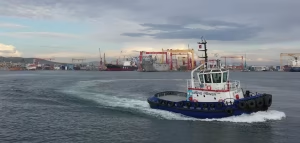
Most of these are in Turkey, with four – Gisaş Power, Gisaş Power II, Gisaş Power III and Gisaş Power IV – all operated by Gisaş/Tuzla Tugboat Services in Tuzla and another four – Botaş Ay, Bayrak, Hilal and Yildiz – allocated to two LNG terminals at Marmara Ereğlisi LNG Terminal and Saros FSRU Terminal.
That leaves just three in the rest of Europe: at the Sound between Denmark and Sweden for the Port of Helsingborg is Svitzer Ingrid; at the Port of Oslo, Buksér og Berging operates BB Electra, built by Sanmar and Europe’s first electric tug; and at Antwerp-Bruges, where Volta 1 was delivered by Damen in November 2024.
There are others under build, and the keels have been laid on four Svitzer TRAnsverse 2600e tugs in India, but it is not known where they will be deployed.
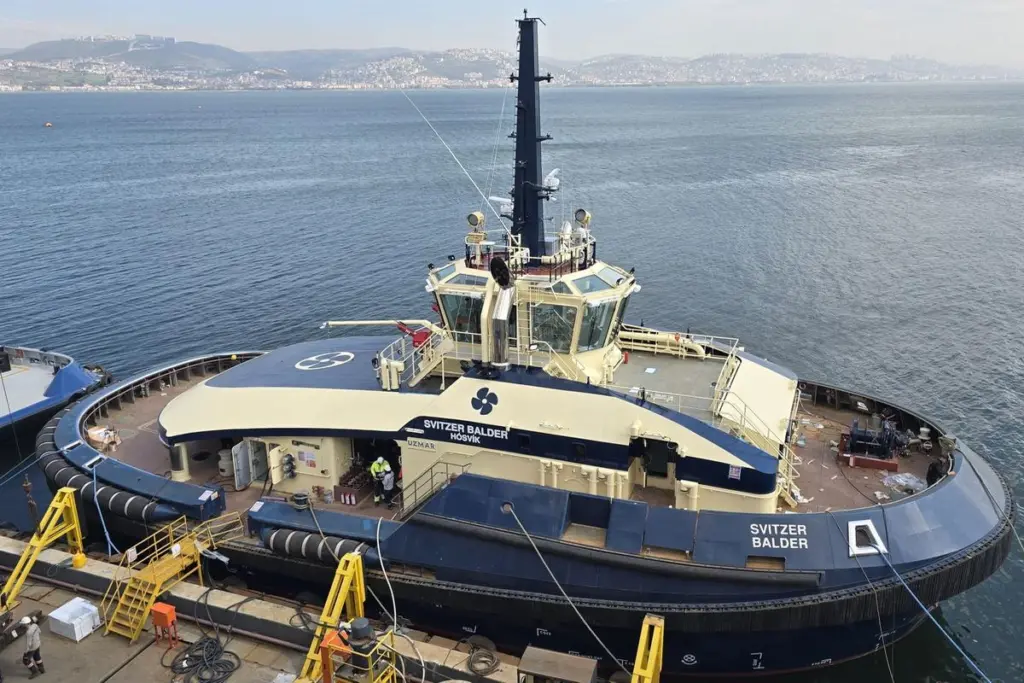
Svitzer Balder
Most surprisingly is the case of Svitzer Balder, an electric-methanol tug that was scheduled to be delivered around now to the Port of Gothenburg and announced in September 2024 in glowing terms.
“Continuing developments in alternative power technologies convinced Svitzer that the combination of battery power and methanol engines can ensure both safe, efficient and reliable operations in a location with the right availability of these two power sources,” said a press release in September 2024 announcing the order of the vessel and placing methanol at the heart of the tug’s green credentials.
“Applications for battery solutions are constantly expanding, and we see it becoming an important power option in the sustainability transition,” said Svitzer CEO Kasper Nilaus, in the same press release. “This battery tug will bring a new dynamic to our operations.”
Not only has Svitzer Balder not yet been deployed – she has also had her methanol engines converted to diesel.
“Svitzer Balder was initially an innovation project aimed at creating a battery-powered TRAnsverse escort tug, equipped with both methanol and diesel range-extender engines,” Thomas Grondorf, head of Communications – Europe, Svitzer told Maritime Journal.
“As expected with innovation, our understanding improved over time. After comprehensive testing and review, we have decided to remove the methanol engines and replace them with additional diesel range-extender engines.
“The methanol gensets had technical difficulties and performance uncertainties. At Svitzer, we need reliable and durable technical solutions to serve our customers. Balder is still methanol-ready, meaning we can reinstall the methanol gensets once the technical solution’s performance is proven.
“Svitzer Balder remains the largest battery-driven escort tug, featuring a 6,000kWh battery, but is now powered by three range-extender diesel engines generating 2,700kWh. We anticipate her departing Turkey in October/November and arriving in Gothenburg some weeks later. That is all we can share at this point.”
Volta 1: Hailed as the future – but where are the others?
When Europe’s first fully battery-electric RSD tug, Volta 1, was officially launched at the Port of Antwerp-Bruges in May 2025, it was accompanied by some fanfare about the future of sustainable harbour towage.
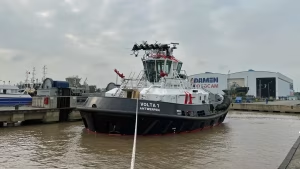
Built by Damen, Volta 1 was described as ‘a ground-breaking addition to our fleet and a beacon for the entire maritime sector’ by then the port COO Rob Smeets, who is now the CEO.
Vincent Maes, Sales manager Benelux at Damen, said the project was ‘a landmark in the adoption of all-electric tugs as mainstream harbour towage solutions’.
Volta 1 has 70 tonnes of bollard pull, can operate for up to 12 hours and be fully recharged in about two hours. With no exhaust emissions during battery-electric operation, she appeared to offer a compelling demonstration of how demanding harbour towage operations could be decarbonised.
But more than a year later, there has been no announcement of an order for a second battery-electric tug by the port. So what has happened to the electric tug revolution?
“We do not currently have a procedure under way to purchase new vessels,” Tom Cuypers, spokesperson for the Port of Antwerp-Bruges, told Maritime Journal. “At the next tender, we will build further on the experience gained and the offers available on the market at that time. This is to make the best choice for the specific operations in Antwerp.”
At the time of the order, announced in October 2023, another five Damen RSD tugs were ordered – all conventionally powered – but Antwerp has also looked at hydrogen propulsion with Hydrotug and methanol with Methatug.
Power bottleneck
Chris Kruger, founder and president of marine battery firm AYK Energy, says battery tugs will be the future, they’re just stalled by the global lack of shore power. When it comes to performance there is no contest, he says.
“One of the first vessels I converted was a hybrid tug in the States,” he says. “The crew would fight to get that tug in the morning because it’s so much more responsive. Electric power is immediate – that responsiveness is unique to electric power, there’s less vibration, and electric motors deliver maximum torque from standstill, making them particularly well suited to vessels that need rapid manoeuvring and pulling power” – benefits that can be transferred to smaller craft as well.
But there are two main problems – the lack of shore power and the upfront costs. Battery tugs are at least a third more upfront, and in countries like the UK it can take a long time to make up the difference because of the cost of electricity needed to charge them.
In China, for instance, where power is cheap and rules are enforced, electric tugs appear to be taking off.
According to the China New Energy and Clean Energy Ship Development Report 2025, compiled by the Ministry of Transport, there were 12 fully electric tugs operating in China by January this year.
That number has now risen by four, with the Haitian Terminal in the Dongdu port area of Xiamen Port welcoming four this year.
In Europe, as well as cost and power limits, skills shortage is another issue.
“Operators face a shortage of licensed mariners, engineers and captains who can handle advanced tug systems,” the Market Reports World report says. “Emission regulations, port specific rules and safety standards differ across regions, which complicates fleet design and compliance planning. Training programs and simulator investment are rising, yet recruitment and retention remain difficult, especially for 24-hour harbour service that demands constant readiness and strong technical skills.”
Until the infrastructure, economics and operational confidence catch up with the technology, battery-powered tugs may be hailed as the future of harbour towage, but that future still looks some way off.
This feature will be published in our Batteries & Electrification Special Report, which comes out next week.