



Semi-submersible platform for new fishing technique
Mussel farming will be carried out within an offshore wind farm, usually a no-go area for any kind of fishing practice.
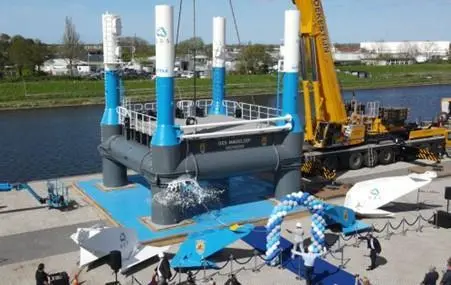
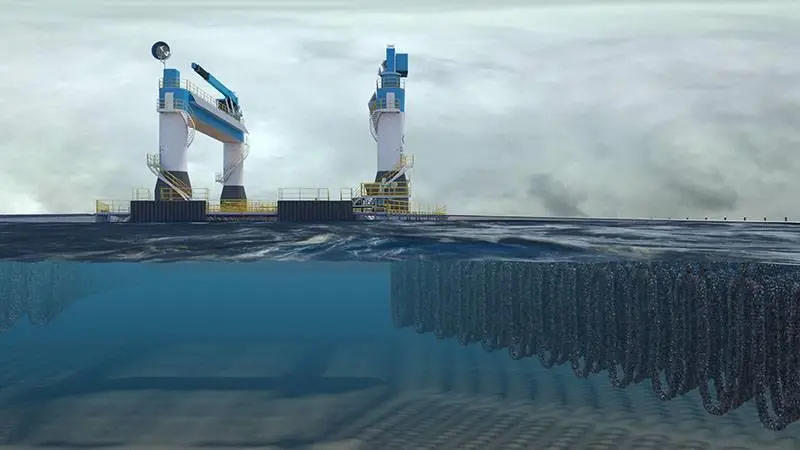
A Dutch company known for its heavy-lift vessels and platform decommissioning expertise is pursuing an innovative, smaller-scale project involving semi-submersible platforms to cultivate and harvest mussels on a large scale – and permission has been given to try it out within the confines of the Borselle wind farm in the Dutch part of the North Sea.
The project involves OOS SMF, part of the OOS Group. Following positive scale model tests under various current, wave and wind conditions at Deltare’s test facility in Delft, the test-SMF (semi-submersible mussel farm) OOS Madelief has been launched in Middelburg to examine aspects of the final SMF.
Five ‘backbones’ with mussel lines will be attached to OOS Madelief, moored within an offshore wind farm to fish for mussels in what is called ‘suspended cultivation’. It will take place over a period of two to 2.5 years, in which Deltare and real-time data collected will contribute to the final SMF design.
Offshore wind farms are generally no-go areas for fishing, but a permit was granted for the test at the Borselle wind farm in the Dutch sector of the North Sea. With mussel farming seen to be good for the sea’s biodiversity, OOS says the SMF will “contribute to the multi-functionality of offshore wind farms”.
By using submersible technology, the breeding and harvesting location is protected against waves and storms, where the best deep-water location can be used for large-scale mussel cultivation.
Partnership
Following news of the launch of OOS Madelief, OOS said it would partner Aquamossel-Triton, based in Yerseke, a village in Zeeland province considered the centre of the oyster and mussel trades.
OOS says mussel production in the Oosterschelde has been decreasing for years, and that its system could halt the decline of the Dutch mussel sector.
“We are curious to see the results this test will bring and gladly support such initiatives,” said David de Koeijer from Aquamossel-Triton. “Together with OOS, we strive to make this test a success.”
Information published by OOS in 2021 on another SMF OOS Cees Leenaars indicates a semi-submersible vessel 72m in length and 36m wide, draught ranging from 2.5m (transit/maintenance) to 11.5m (survival).
Classed by ABS as a Fish Farm Installation Unmanned: Floating Aquaculture Installation Vessel, OOS Cees Leenaars has mussel lines suspended from two groups of 72 lines anchored to the seabed each side of the vessel.
OOS Cees Leenaars gets its energy from main and emergency solar panels, wind turbine generators and tidal turbines beneath the surface.
Battery storage provides at least 18 hours of continuous fire pump operation and other essential services in emergency situations, while in normal times the batteries can be recharged on the attending support vessel that transports mussels back to shore.
Related Articles
 MARINE CONSTRUCTION
 MARINE CONSTRUCTION
 MARINE CONSTRUCTION