![MaritimeJournal[Seawork]](https://www.maritimejournal.com/wp-content/uploads/2026/09/MaritimeJournalSeawork.svg)





Six-yearly lock gate maintenance completed
Three lock gates that have to be overhauled every six years have been dutifully serviced on time at the German port of Cuxhaven.
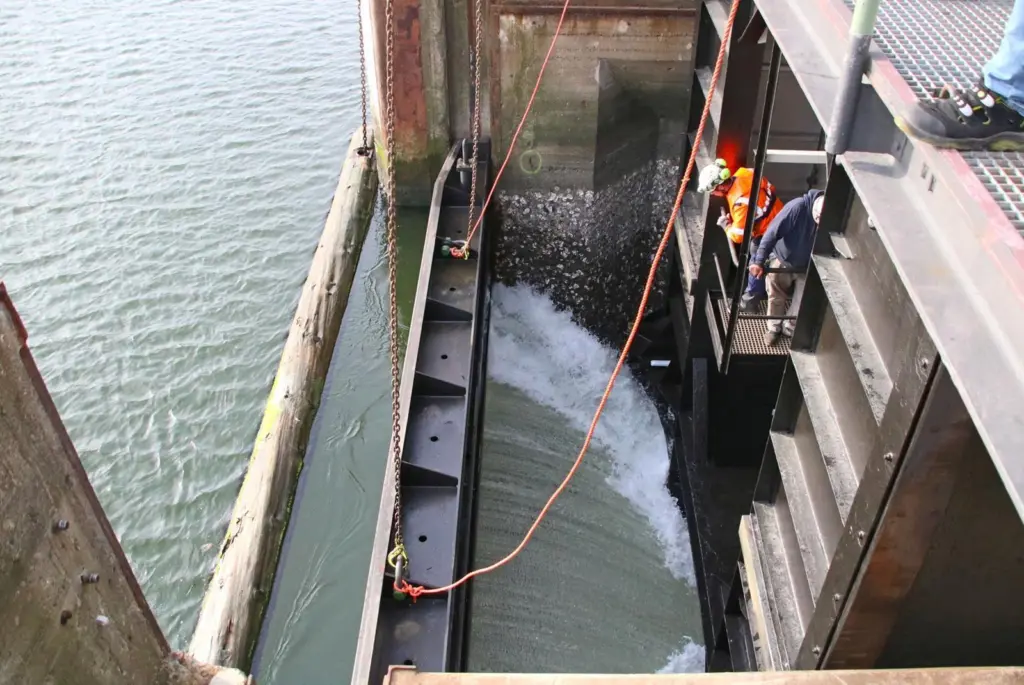
The gates have to be drained and flooded regularly in a complicated procedure that takes five months from start to finish.
Cuxhaven port owner Niedersachsen Ports (NPorts) also operates the ports of Brake, Emden, Stade, Wilhelmshaven and the Island Supply Ports (consisting of the island ports of Norderney, Baltrum, Langeoog, Spiekeroog and Wangerooge).
To carry out the works, seven dam panels stacked on top of each other are pulled out of the central head of the Cuxhaven sea lock, on the northern coast of Germany. The panels weigh up to 8 tonnes each, with the heaviest at the bottom.
About 25 tons of pacific oysters and mussels first have to be removed from the steel of the gates, having fastened themselves on since the last maintenance six years before.
The gates are then docked into a lateral concrete shaft, which is sealed and pumped out.
NPorts then renews the sealing timbers to ensure the gates are water tight, and all hydraulic and mechanical components are checked and replaced if necessary, before the lock is flooded again.
“The flooding of the gate is always an emotional moment and has great significance for everyone involved,” said Knut Kokkelink, head of the NPorts port site in Cuxhaven.
The doors are de-rusted and blasted from both sides and high-pressure cleaned to extend their service life.
Each service costs around €700,000, which makes it one of the most expensive structures in the port of Cuxhaven, NPorts says.
Cuxhaven sea lock was completed in 1965 to separate the outer harbour from the fishing port. It is 182 metres long and 9.7 metres deep, large enough to allow large ships passage.