


New feet for a pioneering vessel
The worlds first dedicated offshore wind turbine installation vessel has been given a set of new feet for its tenth birthday in an operation involving Damens ARNO Dunkerque yard and a UK engineering company.
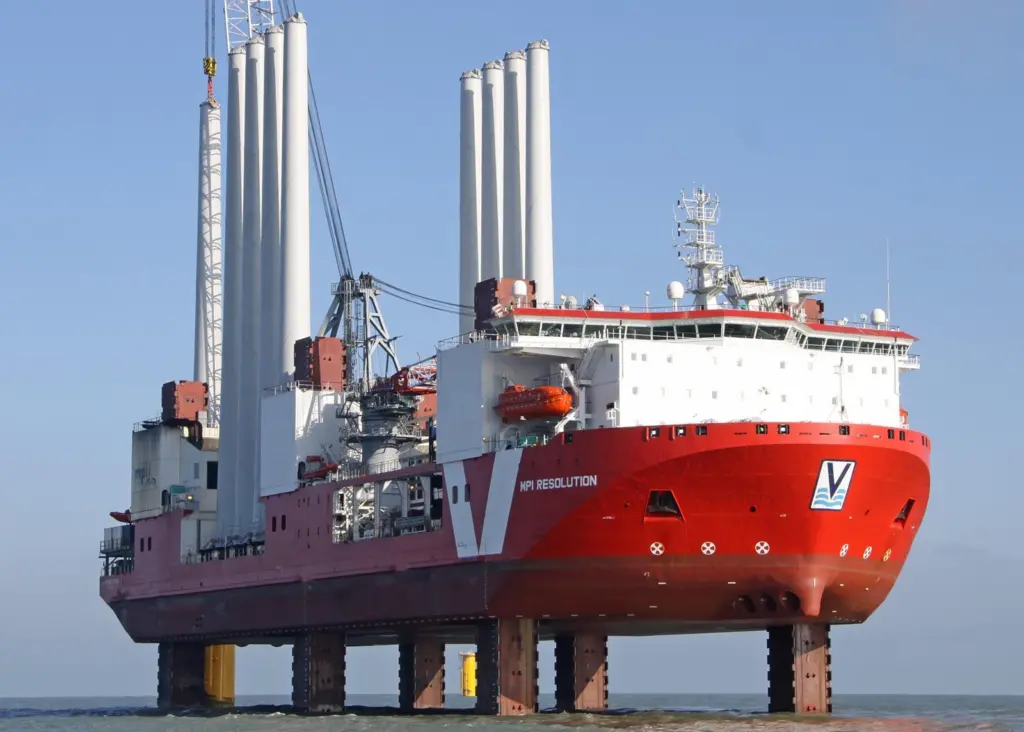
The feet, or spudcans on the bottom of the legs of vessels such as MPI Offshore’s MPI Resolution are subject to substantial loads, particularly when the vessel is being elevated on rocky seabeds. Unlike vessels carrying out jack-up operations in some other sectors, wind turbine installation vessels spend a significant amount of time re-positioning from one turbine location to the next usually close nearby, each involving a separate jacking-up (and down) rotation. In what is thought to be the first operation of its kind, the opportunity was taken during the vessel’s 10 year survey and dry docking to carry out upgrades on all six feet.
The operation involved strengthening the spudcans through use of innovative Sandwich Plate Systems (SPS) technology developed by Intelligent Engineering (UK) Ltd. SPS is a new generation composite building material comprising two metal plates bonded with a polyurethane elastomer core.
The operation was carried out in parallel with scheduled survey work to a tight deadline. ARNO Dunkerque carried out the steel work in conjunction with Intelligent Engineering and was completed within a month, a day ahead of its scheduled delivery date, despite having arrived at Dunkerque two weeks later than expected. Work continued 24 hours a day, seven days a week, the yard’s 165 strong permanent workforce doubled to ensure timely completion. Bob Derks, Damen ARNO Dunkerque managing director said: “The most challenging thing for us was making sure that all the work was carried out in parallel with security, safety and quality assured. The work was carried out from the bottom up right up to the cranes. People were working everywhere.”
Intelligent Engineering explained that use of SPS made the otherwise long and complex operation possible within the vessel’s scheduled drydocking period. This would not have been possible if existing steel plate (40mm) had been replaced by 100mm steel plate which would have involved more time and work. The work involved using 40mm plate and creating a composite sandwich using the polyurethane core. The end result is essentially a new 120mm thick composite plate. The solution allowed MPI Offshore to strengthen the spudcans without exceeding the 25 tonnes per leg additional weight it had set itself for the work.
Strengthening of the spudcans was necessary to allow the vessel to work on the Humber Gateway windfarm currently under construction off the UK east coast, as Dave Galloway, MPI Offshore fleet manager explains: “The Intelligent Engineering upgrade gives a significant increase to the load-bearing capacity of the spudcan without too much increase in weight.”
By Peter Barker
Related Articles
 MARINE RENEWABLES
 OFFSHORE RENEWABLES
 OTHER NEWS