![MaritimeJournal[Seawork]](https://www.maritimejournal.com/wp-content/uploads/2026/09/MaritimeJournalSeawork.svg)


New insights from shallow water container loss research
On the night of January 1st 2019, the large container ship ‘MSC Zoe’ was making its way on the southerly route along the Dutch Wadden Islands during a northwesterly storm.
The storm caused the ship to lose 345 containers, leading to large-scale pollution of the sea and Wadden Islands. The Dutch Safety Board asked the Deltares research institute and the Maritime Research Institute Netherlands, MARIN, to assist in an investigation. The aim: to answer two central questions: what could have caused the loss of containers off the Wadden Islands; and how can we prevent this in the future?
With detailed calculations, Deltares was able to determine the wind, current, water depth and wave conditions at the time of the accident. Arne van der Hout, senior advisor port and waterways at Deltares: ‘The water depth on the route that night was between 21 and 26 metres. There was a northwesterly storm, with winds up to Beaufort 8, almost perpendicular to the route. Large beam waves with a significant height of 6.5 metres were coming towards the ship, resulting in extreme wave heights of up to 11 metres. These conditions occur once or twice every year in this area.’ As a result of the shallow water above the Wadden Islands, the waves are steep with high crests. Regular breaking occurs, resulting in wave crests falling forward at high velocity. These dangerous shallow water waves are well-known to crews sailing regularly in the area.
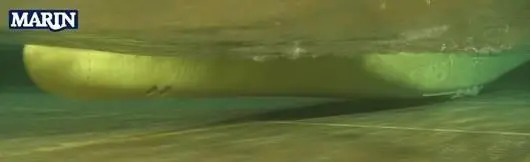
The environmental conditions determined by Deltares were modelled accurately at a scale of 1:63 by MARIN at its unique model testing facilities. MARIN prepared a test model of an Ultra Large Container Ship like the MSC Zoe at this scale. MARIN also performed extensive calculations and simulations and talked to nautical specialists who have sailed containerships in this area.
Based on these investigations MARIN came to the conclusion that the following four phenomena together could have led to the loss of the containers:
1. 60 metre-wide containerships like the MSC Zoe are very stable; When a force is applied to them they want to return to their upright equilibrium position quickly. This results in a short natural period during which the ship starts to roll as it is brought into motion by an external force. For the present generation of ultra large containerships this natural period can be between 15 and 20 seconds, close to the wave periods that occur above the Wadden Islands during northwesterly storms. As a result, roll resonance can occur, causing heeling angles of up to 16 degrees.
2. In these beam waves, the ship does not only roll from side to side, but also heaves up and down many vertical metres. When this happens, shocks and vibrations can occur in the ship, containers and lashings. The lashings can fail as a result.
3. In the very shallow water above the Wadden Islands, breaking waves can hit the side of the ship, resulting in a large upward jet of water reaching the containers, which are 20 to 40 metres above the surface of the sea. This is called ‘green water’, as it is massive sea water, not just white foam in the wind. This massive green water hits the bottom and the side of the containers. These can become damaged as a result, but complete stacks of containers can also be pushed over like dominos.
4. Finally: the hull of the ship was also hit by breaking waves. This can result in vibrations throughout the ship, damaging containers and lashings. To prevent this type of disaster from occurring in the future, it is important to look further to other ship types and sizes that sail this busy area. The same four phenomena will occur for smaller ships, but their sensitivity will be different as will be the limiting weather conditions for safe operations. Bas Buchner, president at MARIN: ‘Based on the annual traffic above the Wadden Islands, MARIN has advised the Ministry of Infrastructure and Water Management to conduct further investigations of three ship types: ultra large containerships with lengths of up to 400 metres, like the MSC Zoe, a shorter and narrower Panamax, nearly 300 metres long, and a smaller container feeder with a length of 160 metres. The importance of testing smaller ships was underscored when the feeder Rauma lost seven containers on February 11th 2020. The goal of the present MARIN investigation is that these ships and their crews and cargos may also sail safely in this Particularly Sensitive Sea Area, as well as the prevention of container loss.
Note: the report of the Dutch Safety Board, the international report and MARIN’s report can be found at https://www.onderzoeksraad.nl/en/page/13223/safe-container-transport-north-of-the-waddenislands.-lessons-learned
By Jake Frith
Related Articles
 ACCESSORIES & EQUIPMENT
 ENVIRONMENT
 MARINE CONSTRUCTION