![MaritimeJournal[Seawork]](https://www.maritimejournal.com/wp-content/uploads/2026/09/MaritimeJournalSeawork.svg)






A bigger, more comfortable reach
Launch and Recovery Systems (LARS) are evolving to meet a changing market.
Whereas a few years ago ROVs might have reached around 2,000m below sea level, the deepest operations are now on the way to doubling this.
Jan Kjærstad of Seaonics, a Norwegian company in the business of handling equipment for the marine and offshore industries, points out that it’s an upward trend. “It’s not only the depth that varies from shallow water to nearly 4,000m, but the size, shape and weight of these loads also varies, from the smaller observation ROVs to the bigger working ROVs with tool attachments.”
All these factors put a greater emphasis on the flexibility of the launch systems, he told MJ. However, he is clear that this flexibility should come from a redesign of the systems themselves rather than an increasing complexity.
“Our slogan is Improving by Simplifying”, he says, and points out that there are a few design ‘wins’ that keep the system as trouble-free as possible. One of them is the reduction of moving parts on the drives for all the lifting gear. Not only has there been a move away from hydraulic to electrical systems, Seonics has pushed this a bit further by the use of permanent magnet motors. “It pretty much gets rid of the gearbox, leaving only one gear step”, he explains. The innovation, although a bit more expensive, has also increased the speed and pull capacity of the winch because the permanent magnet motors can operate on a wider RPM range while maintaining the torque.
But there are other more obvious changes. The company’s latest 22 tonne capacity LARS has room for 4,000m of 39.5mm diameter umbilical and an active heave compensation of 2.4m per second, but its biggest design difference is its 6.7m outreach, between 1m and 2m more than the standard. This longer outreach keeps the ROVs further away from the ship’s side, a big bonus considering the enormous pendulum forces acting on them in very heavy weather.
Mr Kjærstad points out that the design has been paired with a better inward reach of 4.5m and, as a result, the legs of the A-frame are clear of the ROV after retrieval, resulting in an opening of the space on deck. Further, the articulation on the tip of the A-frame has a 180° vertical swivel, adding to its flexibility.
But this is only part of the story, as the new design is both helping to keep the draft out and make the crew happier and safer during ROV deployment.
“Talks with a customer showed that the A-frame can be left out in position while the ROV goes off on duty for weeks at a time, which leaves the crew exposed to some really bad winds and very cold conditions, especially if there’s another hatch or door open”, Mr Kjærstad explains.
So, Seonics has designed a sectioned hangar port. “Although there has been some attempt to shut the upper part of the hangar off before, our design closes both the top and the lower part of the doorway, reducing the opening by 70% or 80% and leaving just the arms of the A-frame and the docking head to stick out.”
The extra reach on the A-frame means the ROV hangar on the latest vessel can be placed several metres higher up than the more usual, very exposed lower deck and still keep operations from falling foul of the increased pendulum effect.
By Stevie Knight
Reaching for the moon – sidebar
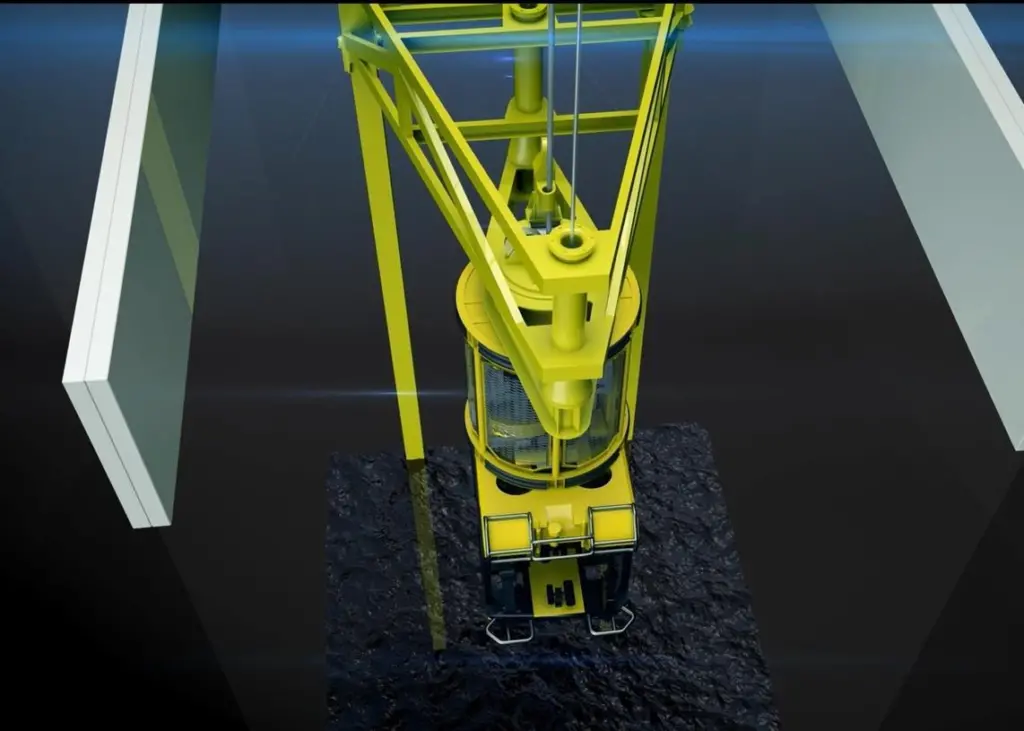
A novel ‘plug and play’ launching tower will help the accurate placing of the rising number of large, costly but comparatively fragile subsea modules.
“So far, cranes have mostly been used for over the side deployment, but we think there will be a need for towers to launch modules through the moonpool,” says Jan Kjærstad.
Developed by Seaonics together with Castor Drilling and ICD, this framework tower stands around 12m high and has a capacity of 90 tonnes at depths of 2,000m.
Although modules will probably be within the standard 6.6m diameter range, the tower will add to the height of the possible load. The top opens to provide benefit from being able to take on a parallel lift with the onboard cranes acting alongside the winches.
“This really helps if you have a module with a difficult centre of gravity, or one that has only a single point of attachment, says Mr Kjærstad, “Along with guidewires, being in the centre of the ship you have more stability, so the placing will be more accurate. There’s also less for the active heave compensation to do so you gain a bigger operational window.”
However, what is quite surprising is that the tower can be lifted on and off the vessel using a harbour’s gantry crane in one operation, explains Mr Kjærstad. So, the tower can be used on several vessels, and not just kept to one dedicated ship or indeed lifted off to free up deck space when not in module handling operation.
Although receiving vessels would have to be strengthened to take the 400 tonne tower, actually deploying it would only take a couple of days. Since all the equipment is mounted in the tower, operators only have to connect up the power supply, so it should be able to be up and running inside two or three days.
Related Articles
 ACCESSORIES & EQUIPMENT
 ACCESSORIES & EQUIPMENT
 ACCESSORIES & EQUIPMENT