![MaritimeJournal[Seawork]](https://www.maritimejournal.com/wp-content/uploads/2026/09/MaritimeJournalSeawork.svg)





A long view for Thames Barrier cranes
Seven new purpose designed cranes for the Thames Barrier are to be built with a reach ‘about the same as four London Buses’ according to Doug Palmer of contract winners Pellegrini UK.
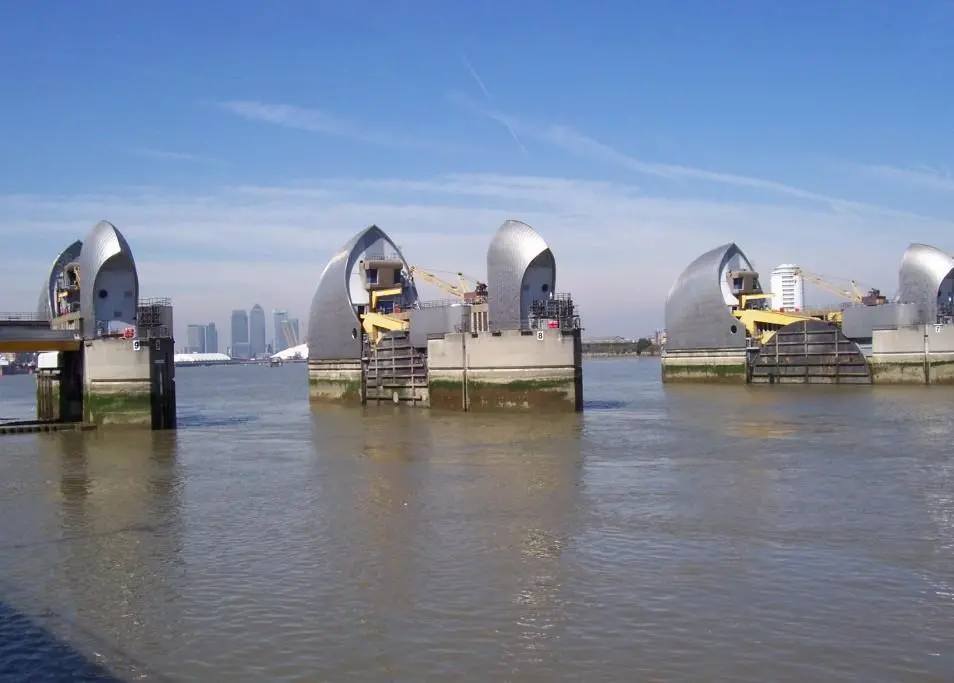
The present cranes on the Thames Barrier are aging and were in line to be replaced, and the UK’s Environment Agency has just awarded the contract. The crane tender specifications have quite a few special features to take into account the structural design of the piers.
Mr Palmer explained that the cranes will have a lifting capacity of around 15 tons at close reach, and 250kg at full extension. ‘Putting this at the end of an 118ft arm needs a sturdy construction whilst still complying with the special light weight turning moment requirement of the piers’, he said. To enable this, the units will have a semi-open construction, with four extensions.
There will also be a man-riding facility to allow close routine inspection and servicing of the Barrier and with remote radio control operation available from the basket. This means that the crane movements need to be slow and buffered against shocks, especially since the crane extension will naturally magnify any recoil. The cranes also have to conform with the latest statutory safety requirements for this man riding facility.
However, alongside this extremely long reach, there is a need to protect the barrier’s superstructure, so the cranes are being designed with a limit to the unit’s operational radius. A number of design characteristics have had to be settled in order to get the most effective combination for the barrier’s projected needs.
Pellegrini says the international competition for the multi-million pound contract was ‘fierce’. Beyond the standard design requirement of any crane, Pellegrini will specially design the interface of these cranes to suit the existing mounting requirements on each specific pier. Pellegrini UK is also contracted to undertake the statutory service requirements and maintenance.
The first crane is programmed for delivery in April 2011, and it is expected that the contract will be completed by April 2012.
Related Articles
 ACCESSORIES & EQUIPMENT
 ACCESSORIES & EQUIPMENT
 ACCESSORIES & EQUIPMENT