![MaritimeJournal[Seawork]](https://www.maritimejournal.com/wp-content/uploads/2026/09/MaritimeJournalSeawork.svg)



A moving story
Preffered Marine Cranes has had an interesting request from one of its customers who wanted both flexibility and speed in order to deploy underwater and offshore equipment across a variety of locations, from a number of different vessels.
Martin Cook of Preffered told
MJ
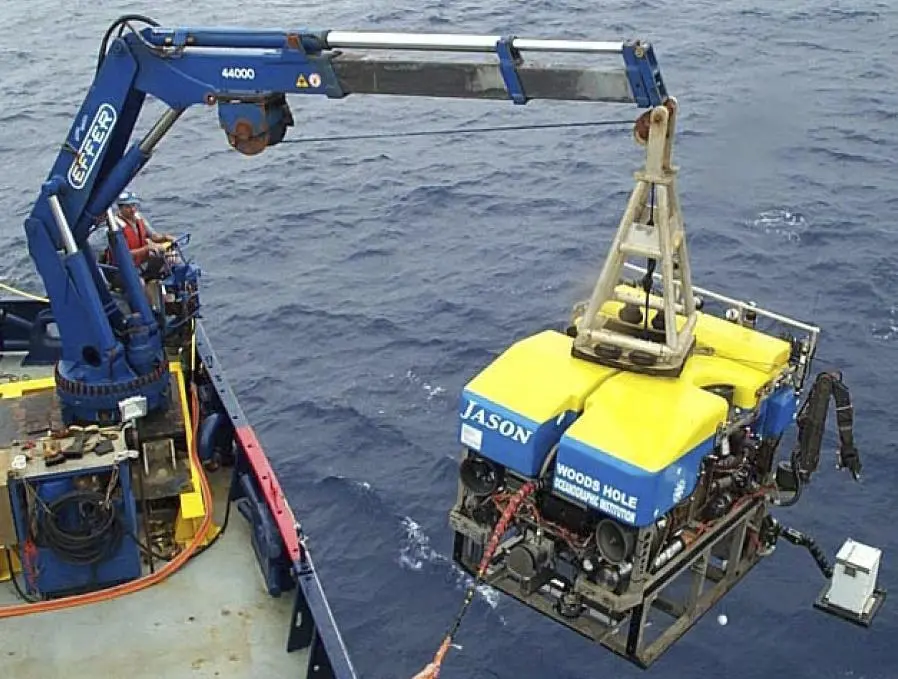
that this involves the supply of two knuckleboom cranes that can be removed or repositioned. They are also able to be transported between Hallin Marine’s vessels by road or barge.
These cranes are to be used by Hallin to deploy three differing sizes of ROV, amongst a variety of other functions. Each crane has two hydraulic extensions, which gives a lift of 8 tons at a reach of 9.2m, and are to be permanently mounted on 2.5 sq/m steel bases that can be attached in any suitable position on the deck.
This set-up gives the load range needed for the ROVs while keeping the weight of the cranes to around 7.3 tons each, (plus approximately another ton for the base plates).
Having such a specific remit has meant a lot of thought, explained Martin Cook. ‘For a start, operational needs mean you want a base as high as possible to give the best position. However, the whole unit has to be put on trucks to go by road, and that means getting under bridges.’ The steel bases themselves have thus undergone a thorough revision before their eventual certification by Lloyds Register. Likewise the whole unit will be certified after testing has been completed.
However, the finesse doesn’t stop here. Hallin needed to run the crane from the vessel’s own hydraulic power units to keep the operation independent, but also wanted to be able to interface with an existing separate winch and spooling mechanism from a supplementary control bank based on the crane itself. This is in order to allow the crane, spool and winch mechanisms to be coordinated and run by one person, keeping the support vessels running efficiently as possible.
The arrangement meant cross linking the respective control banks and hydraulic hoses, so another aspect of the work has been the arrangement of what is a fairly complicated set of interconnections.
Hallin will end up with the flexible solution it wanted, and one that has speed behind it. As Mr Cook explained, ‘In order to get the cranes working you will only have to attach the base onto the deck, connect power to the hydraulic power unit and connect the hoses. It shouldn’t take much time at all.’
Related Articles
 ACCESSORIES & EQUIPMENT
 ACCESSORIES & EQUIPMENT
 ACCESSORIES & EQUIPMENT