![MaritimeJournal[Seawork]](https://www.maritimejournal.com/wp-content/uploads/2026/09/MaritimeJournalSeawork.svg)


Amco Veba gets real about crane stress
Marine cranes have come a long way from their truck-based origins. However, their evolution isn’t always driven by what’s possible, but by what’s pragmatic.
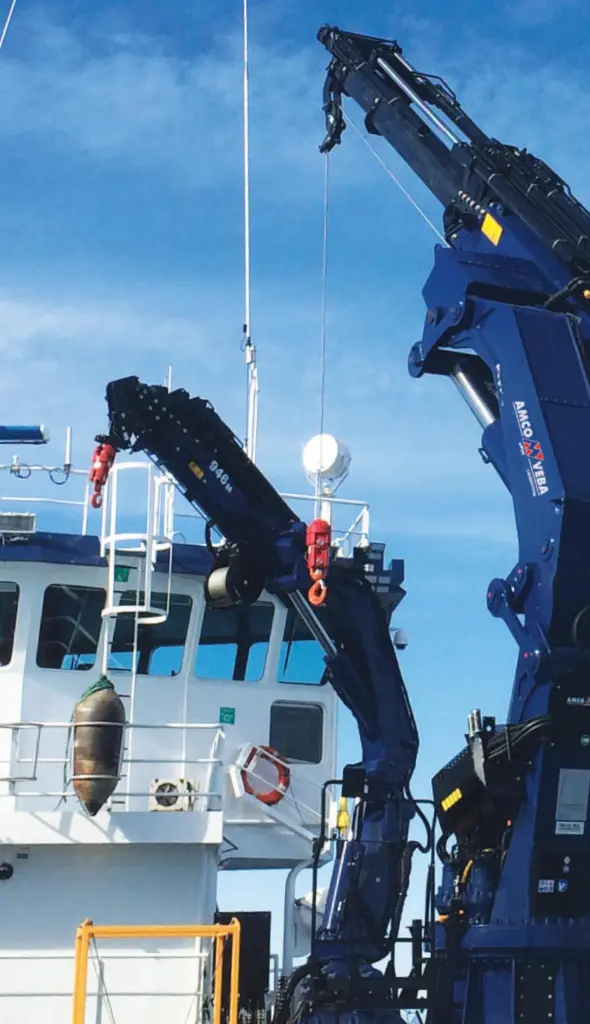
Unlike truck cranes, “small vessels typically experience a lot of movement, so during loading or unloading you can easily see five degrees of heel”,” said Iulian Cojocaru of Amco Veba’s Marine department.
Of course, this means that “while you are operating with the boom extended, you have an inclination that amplifies the forces acting on the crane”, he pointed out, putting significant stress on a typical rack and pinion base. So, the company has been changing its marine range over to a bearing system.
The big difference? Slew bearings allow you install twin or even three planetary motors on larger models, giving more power for turning against the incline; it also minimises play which makes for a more precise lift, he explained.
The latest model to be reworked is Amco Veba’s VR24 marine crane, with a 24t/m moment (giving a working load of 4t at 6m outreach, 2t at 12m). This can come with or without the winch, a useful addition for operations with a potentially long hook travel distance “but if you don’t need it, you can keep it simple without additional valves, tubing… and money”, he added.
Again, the choice of electric or hydraulic power is down to realism: despite the many positive qualities of electronic kit, he says that these haven’t overtaken their hydraulic cousins. Operators “often have just one mechanic to carry out all the maintenance, so give him hydraulic equipment he can maintain easily”, he said: “It’s far harder to find someone to reprogramme the PLC than to find someone to fix a hose.”
Safety has followed suit. Amco Veba has developed a load-limiting device that stops operators endangering the cargo, crane and vessel by pushing the lift outside the safe working load (unfortunately “something that happens all the time”, added Cojocaru). But, while there’s a PLC-based unit, the company has also collaborated with winch specialist TCM on a hydraulic version triggered by accumulated pressure.
For Amco Veba, serving the workboat market means keeping responsive to the different preferences while still “providing a cost-effective product”, said Iulian Cojocaru.
Related Articles
 ACCESSORIES & EQUIPMENT
 OTHER NEWS
 ACCESSORIES & EQUIPMENT