![MaritimeJournal[Seawork]](https://www.maritimejournal.com/wp-content/uploads/2026/09/MaritimeJournalSeawork.svg)


Apache to the rescue of Britannia lift
After a number of challenges and one attempt abandoned due to weight complications, the replica of King George V’s J-Class yacht Britannia was finally lifted out for refurbishment.
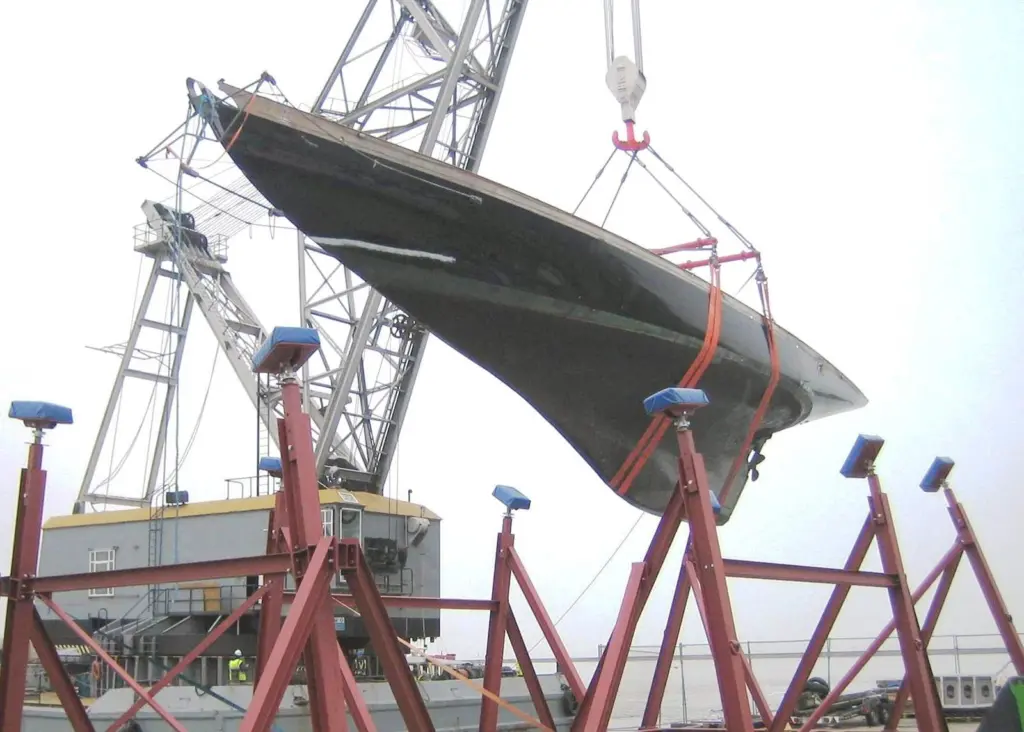
South Boats Service Centre had been approached to enquire whether the vessel could be brought to Venture Quays, East Cowes for the works and they in turn approached Blade Runner Shipping.
It was never going to be easy, Blade Runner Shipping’s CEO Mike Rose told MJ. “There simply aren’t many available floating cranes in the area that can take on Britannia’s 130 tonnes.” In fact, the only one that could do it was the old US military Apache crane stationed at Marchwood, Southampton UK, now owned by Harry Pounds.
Having sourced the crane, Blade Runner had to put together a lifting plan that took into account the need for a high spring tide, because the sizeable hull needed to be brought as close as possible to the land in order to minimise outreach and make the most of the crane’s lifting capacity.
Special lifting strops were manufactured in order to lift the deep draught craft clear and a diving team was on hand to place the strops carefully underneath the hull in order to minimise the risk of slippage.
Despite all this, the first attempt had to be abandoned with the Britannia still in the water. The Apache unit had been certified for a total lifting capacity of 130 tonnes, but with all the equipment in place, the combined weight was now up to 138 tonnes and Mike Rose said he had to prove himself “extremely unpopular” by calling off the process. “However tempting, I just couldn’t let it go ahead, as much for insurance as health and safety reasons”.
With a bit of thought and negotiation, the next steps saw the crane recertified for a 140 tonne over-the-stern lift, possible because the weight distribution was evened out by the different approach, giving the necessary extra margin to play with.
Consequently, the second attempt meant manoeuvring the crane even closer to the water’s edge by a team of three tugs, a difficult act to coordinate in itself.
There were a few tense moments. The operation had to take place in one action, with no turning back if the boat missed engaging properly with the specially built cradle. The nature of the crane’s gearing mechanism meant the whole load had to be lowered completely before it could be rehoisted, not possible if the vessel is over the quay and not the water.
In the event, the lift was successful and South Boats is now working on bringing the Britannia up to scratch for its new role with a charity.
Technical details:
Crane certified for 140 tonnes
Specially manufactured strops
Commissioned cradle
High tide timing
Dive team support
Related Articles
 ACCESSORIES & EQUIPMENT
 ACCESSORIES & EQUIPMENT
 ACCESSORIES & EQUIPMENT