![MaritimeJournal[Seawork]](https://www.maritimejournal.com/wp-content/uploads/2026/09/MaritimeJournalSeawork.svg)





Cradling the new deliveries from Helsinki
The obvious conundrum to moving large Azipod units to waiting shipyards is that although they are designed to be streamlined while in the water, they are anything but elegant and easy to move when out of the water.
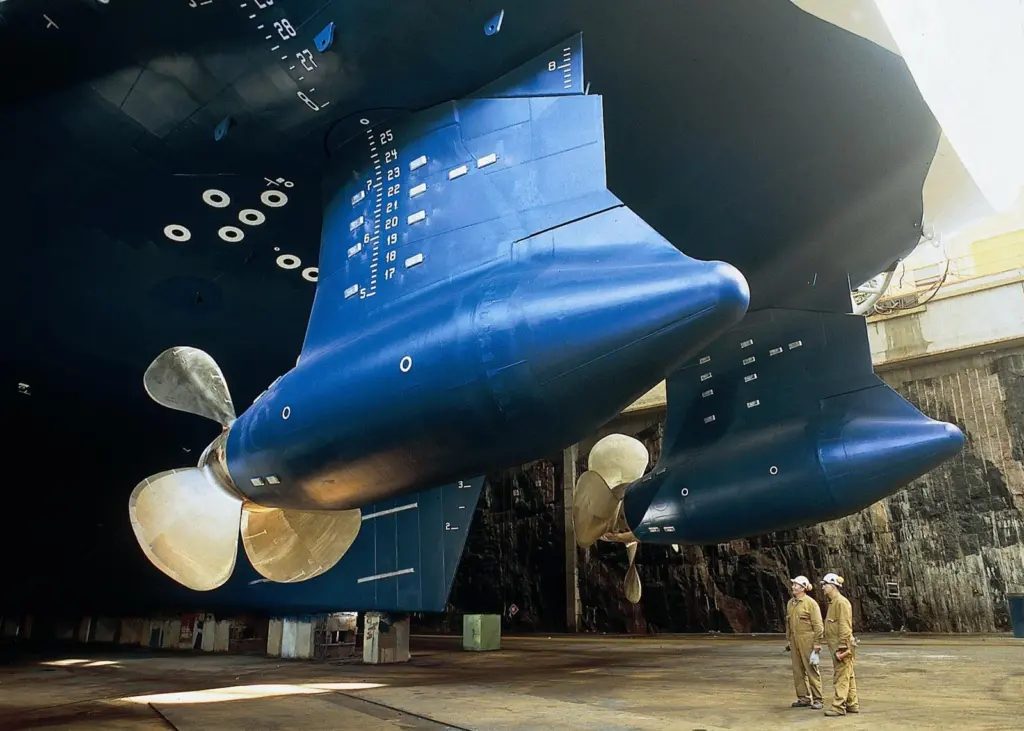
So, while the big Azipod units manufactured in ABB’s Helsinki factory have become one of Finland’s well established exports and are regularly seen leaving the factory via the nearby Vuosaari Harbour, there’s still some devil in the detail to these specialist deliveries.
The units are big, reaching up to 9m high and weighing 200 tonnes each and there is normally a pair of them being moved at a time, although some recent builds are looking at using three units rather than two. Not only are these Azipods heavy and high, says Jani Vestin of Finland based Wasa Logistics, but they also need careful handling.
This in turn throws another element into the mix. Erkki Tirronen of ABB Marine tells MJ : “To prepare for shipping, the Azipod unit is lifted onto a self-standing transportation cradle using the factory’s cranes.” He adds that these cradles, which are made of steel bars with bolt connections, are especially manufactured to cover each size of unit and are absolutely vital to the logistics process.
While the Azipods are designed for the stresses of being incorporated into a large hull, they are not made for standing upright. So, more than just stopping the huge, oddly shaped units from rolling about, “the shape of the cradle is designed to make sure that the Azipod’s weight is evenly distributed and there are no high load points being transmitted through to the Azipod frame” explains Mr Tirronen. The cradle does the necessary work of distributing the propulsion unit’s weight over a wider floor area, reducing load stresses on the transportation vessel.
However, Mr Vestin points out that these cradles add an extra metre or so to the height, and since the longer delivery distances need a ship in which you can stow these units below decks, things can start to get a little tricky.
This is because while the biggest units require around a 10m hold depth, very often you can’t simply use a heavy lift vessel. It’s not only price, contrary to what might be expected quite a few European shipyards suffer from a lack of free water so these roomy holds have to be matched with a limited size and draught. Mr Vestin says he often finds he is looking for transportation craft within a band that runs between 3,000 dwt to 4,000 dwt.
Mr Vestin adds that although many shipyard cranes have no problem with picking up the weight of these Azipods in a straight lift, their outreach can be challenged when faced with getting all the way across to the hold of an incoming vessel. Therefore stowage has to be thought about very carefully, as only the fore of the delivery ship may be able to get close in to be received. “We can’t just put the units down where we like in the ship,” he says.
Despite all this, the regular deliveries have led to a very stable relationship wherein, as Mr Vestin says, it has given all parties the chance to develop a working pattern with a regular crew and engages people. “It gives a sense of ownership, he says, “Everybody pulls together, not something that’s so usual these days.”
By Stevie Knight
Sidebar
Erkki Tirronen of ABB says that it makes sense to deliver to local yards by barge, a useful method to get to places like Arctech’s Helsinki facility.
This yard recently installed two of ABB’s 200 tonne Azipod units on an icebreaking supply vessel. The Azipod unit is lifted onto its own self-standing transportation cradle using the factory’s cranes, and then a low-bed trailer is driven underneath and the whole thing is hitched up by the trailer’s hydraulic system and driven onto the barge.
However, even outside Finland barges come in useful. In one case, Wasa Logistics used a small pontoon barge to take a 19m long, 6m diameter debarking drum from the Port Loksa in Estonia to Grums in Sweden as direct truck transport was out of the question. The barge was carefully sized to fit the tight water channels en route.
Related Articles
 ACCESSORIES & EQUIPMENT
 ACCESSORIES & EQUIPMENT
 ACCESSORIES & EQUIPMENT