![MaritimeJournal[Seawork]](https://www.maritimejournal.com/wp-content/uploads/2026/09/MaritimeJournalSeawork.svg)






Davit safety
Geoscience company CGG has set new standards for workboat safety following the introduction of a system that monitors the loads being lifted by its workboat davits. As we first covered in February’s ‘MJ’ a new weight measurement system was developed in Norway by Henriksen Hooks as a means of solving a safety problem that CGG had decided to address.
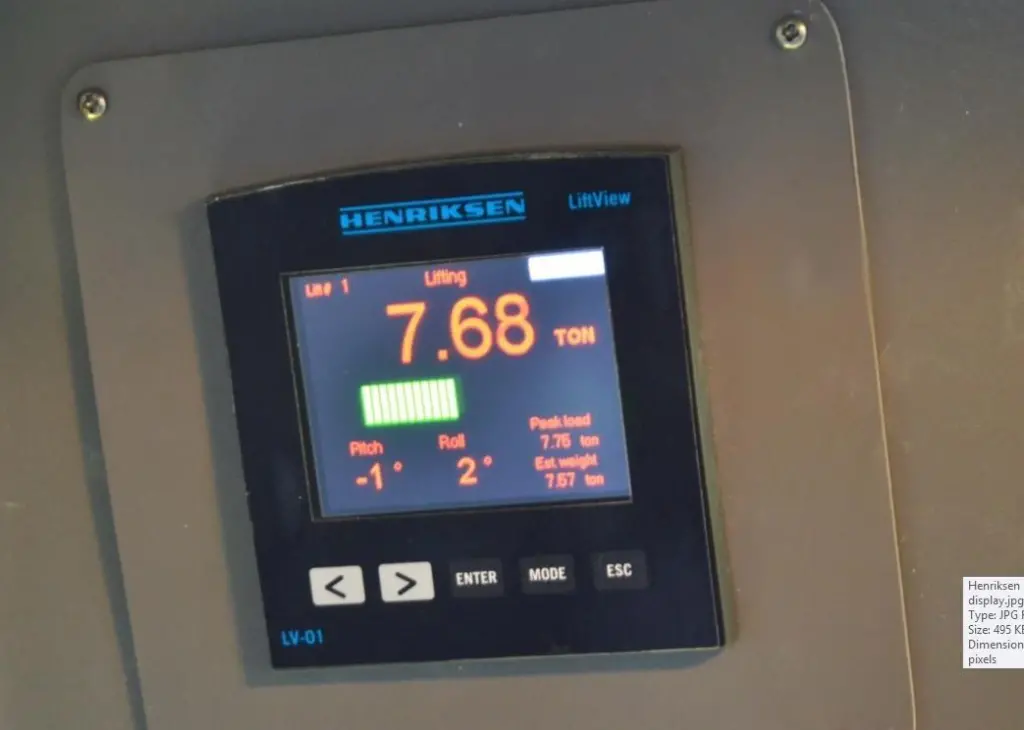
The system, known as LiftView has been introduced to monitor and record the weight of the boats being launched and recovered from the purpose-built seismic survey vessel Geo Celtic. It carries two robust and functional 30 ft Westplas workboats that are each powered by water jets driven by two 280 hp Yamaha engines. CGG is also the first user of the new Awarelight system which was developed at the same time as the Liftview and is being used in conjunction with it to provide clear and unambiguous lifting and release signals between the workboat and the davit winch operator.
“Over the years the marine industry has seen a lot of accidents involving the use of davits and this is something that we had been aware of for some time,” said Hans-Christian Blauenfeldt, field support manager for CGG. “Although we have never experienced an incident, discussions with DNV GL made us realise that we had no record of the dynamic forces to which our single-point lifting hooks were being subjected. We launch our workboats at least three times a day for their crews to undertake maintenance work on the seismic streamers. Each boat weighs 7.3 tonnes and our davits have a lifting capacity of ten tonnes so we need to take care to ensure that our load margin is not exceeded. We wanted to be able to prove that we are operating our davits safely so we asked Henriksen Hooks if they could come up with an answer to the problem.”
Their response was the LiftView system which uses a load cell that can be incorporated into any of the hooks in the Henriksen range. This is linked to a clear wheelhouse display that graphically shows the boat’s coxswain the exact weight that his hook is lifting. Prior to the arrival of LiftView the coxswain needed to make a mathematical calculation of the weight of any additional load items taken on board to ensure that the lifting system stayed within its safety margins. The arrival of LiftView now provides reassurance by showing him whether he is operating within the safety limits while also enabling the data to be stored for record keeping and analysis. This might be to monitor the stresses to which the lifting system has been subjected and also the working practices of the davit operator.
In addition to calculating the direct load on the hook, the system also has the ability to measure the roll of the boat. This is because the dynamic forces created by a rolling motion also need to be monitored to provide an overall picture of the factors working on the hook. Because Henriksen Hooks are also designed to accommodate side forces at angles up to 30 degrees, the ability to understand this will help boat’s crew operate more safely.
The Geo Celtic may be called to work anywhere, from the Barents Sea to the equatorial oceans and during surveys it is likely to be towing several seismic streamers that can be kilometres long at a steady five knots. During daylight hours and in sea swells up to two metres, the four man crews of the ship’s workboats will be engaged in a variety of tasks needed to maintain the streamers’ performance. This might involve replacing damaged sections of streamer or fitting new batteries to the hydrophones that they carry at intervals along them. A 150 metre length of replacement streamer, for example, is known to weigh 450 kg so its presence in the boat can be easily included in the coxswain’s calculations. Replacing one component with another will have no effect upon the initial load calculation but the delivery of new equipment and provisions to the ship must be accounted for carefully. The five knot operating speed also creates another stress factor during lifting operations as it imposes an additional load on the davits and hooks that might be difficult to quantify for weight calculations. This can be further complicated by any unknown volume of water that might have seeped into the boat’s buoyancy chambers and been absorbed by its timber structural elements during the working season.
“After a successful summer’s trial in Arctic waters where we did not find any weak points, the LiftView and Awarelight systems will now be fitted on several of CGG’s workboats,” said Hans-Christian Blauenfeldt.
The Awarelight can be used independently of a LiftView installation if desired as it consists of a bright LED light positioned on the boat’s coach roof from where it is clearly visible to the crane operator, even in bright sunlight, without disturbing the vision of those on board. When the Henriksen hook is closed around the lifting ring and the boat is secure, the coxswain will press the indicator button located beside his helm position. The AwareLight will then show a continuous light, telling the crane operator that the boat is ready for launching and may be lifted off its cradle. As the boat nears the water and the Henriksen hook is activated by a crew member on board and made ready for its automatic off-load release, the light begins to flash slowly. When the boat is on the water and the hook has been opened the flashing becomes rapid. During boat recovery the sequence is reversed.
By Jake Frith
Related Articles
 OTHER NEWS
 ACCESSORIES & EQUIPMENT
 ACCESSORIES & EQUIPMENT