![MaritimeJournal[Seawork]](https://www.maritimejournal.com/wp-content/uploads/2026/09/MaritimeJournalSeawork.svg)



Distress signals need to work in extremes
Two recent incidents have shown the necessity of flares and beacon distress signals which remain reliable even in extreme weather conditions, making the point that we still need ‘old technology’ like pyrotechnics as electronics is not yet the answer to everything.
In the first incident, a fisherman’s life was saved by marine distress signals after an accident which sadly proved fatal for a colleague. The two men were in a small fishing boat which capsized off the East coast of Iceland. Unfortunately, neither had the chance to send a radio distress call.
One of them managed to free a life raft and use fire marine distress signals, parachute rockets and handflares, which were spotted on the coast, allowing him to be rescued a few hours later. The other fisherman sadly did not survive. The death is particularly sad as it is Iceland’s only fatal marine accident in the past two years.
In the second, similar incident, a German fisherman endured temperatures of 3ºC for 15 minutes in the Baltic Sea. His cutter sank after net cases shifted but luckily he located one of two Comet Red Handflares on board and this was spotted by the German maritime search and rescue service.
Keith Bradford of Pains Wessex and Comet says that while it is relatively unusual to be setting off the flares while actually in the sea, the design of these safety items has to take into account the requirement for successful operation ‘even after immersion in water’.
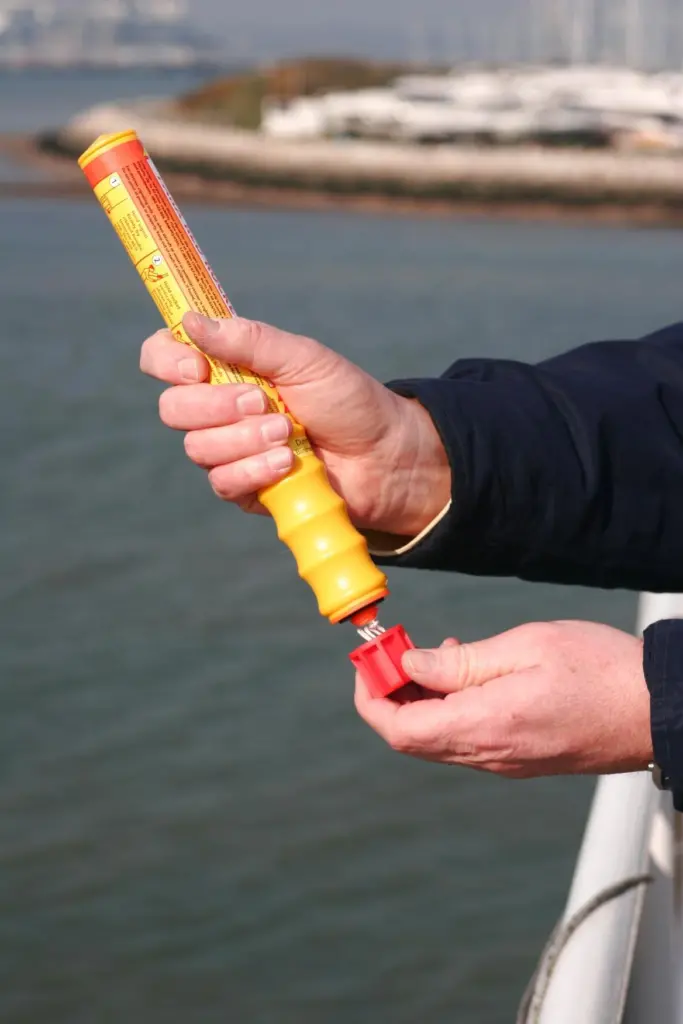
He explained that in order to get SOLAS approval, flares have to work after being submerged for 24 hours under a metre of water. They also have to be able to work even after the seals have been removed and kept under 10cm of water for five minutes.
However, he says there is a balancing act between making the flares easy and too easy to set off, the latter condition making them unsafe to have onboard. The company has settled on a two step process which involves unscrewing the end cap and pulling the string.
‘It is straight forward but every skipper should be showing you how to work the signals and where they are stowed when you get on board a boat, he said. ‘A panic situation is not going to be conducive to reading instructions, even if they are simple’.
He added that pyrotechnics will be with us for some time. ‘By the time you set off an EPIRB signal and it gets relayed, you may well have been picked up by someone closer if they can see a flare.’
The back up of an instant pyrotechnic is often required to pinpoint your final position even after an EPIRB call. ‘So far there’s nothing that does the job of a flare’, concluded Mr Bradford.
Related Articles
 ACCESSORIES & EQUIPMENT
 ACCESSORIES & EQUIPMENT
 ACCESSORIES & EQUIPMENT